




A rail track is banked for speed v by making the outer rail h higher than the inner rail. The distance between the rails is d. The radius of curvature of the track is r, then
A. $\dfrac{h}{d} = \dfrac{{{v^2}}}{{rg}}$
B. $\tan \left( {{{\sin }^{ - 1}}\dfrac{h}{d}} \right) = \dfrac{{{v^2}}}{{rg}}$
C. ${\tan ^{ - 1}}\dfrac{h}{d} = \dfrac{{{v^2}}}{{rg}}$
D. $\dfrac{h}{d} = \dfrac{{{v^2}}}{{dg}}$
Answer
 Verified
652.2k+ views
Hint: Draw a free body diagram for the scenario and calculate the net forces in order to balance the centrifugal force we should prevent toppling.
Complete step by step answer:
When vehicles traveling with some speed take a turn, then while taking the turn it experiences centrifugal force in the opposite direction of the turn. If the speed of the vehicle is very high, then the centrifugal force will also be high and can topple the vehicle leading to an accident. Therefore, to prevent these accidents banking of tracks is done at the turns.
Banking of the terms are done by increasing the height of that side of the track which is opposite to the turn. Due to this, the net contact force of the vehicle with the ground increases which causes an increasing frictional force with the ground, and thus preventing the vehicle from toppling.
The height of the banks depend on the radius of curvature of the track, the velocity of the vehicle, the width of the vehicle (distance between the wheels for a car are the distance between the rails for a train). To find the relation between them we must look at their force body diagrams calculating the net force to prevent toppling.
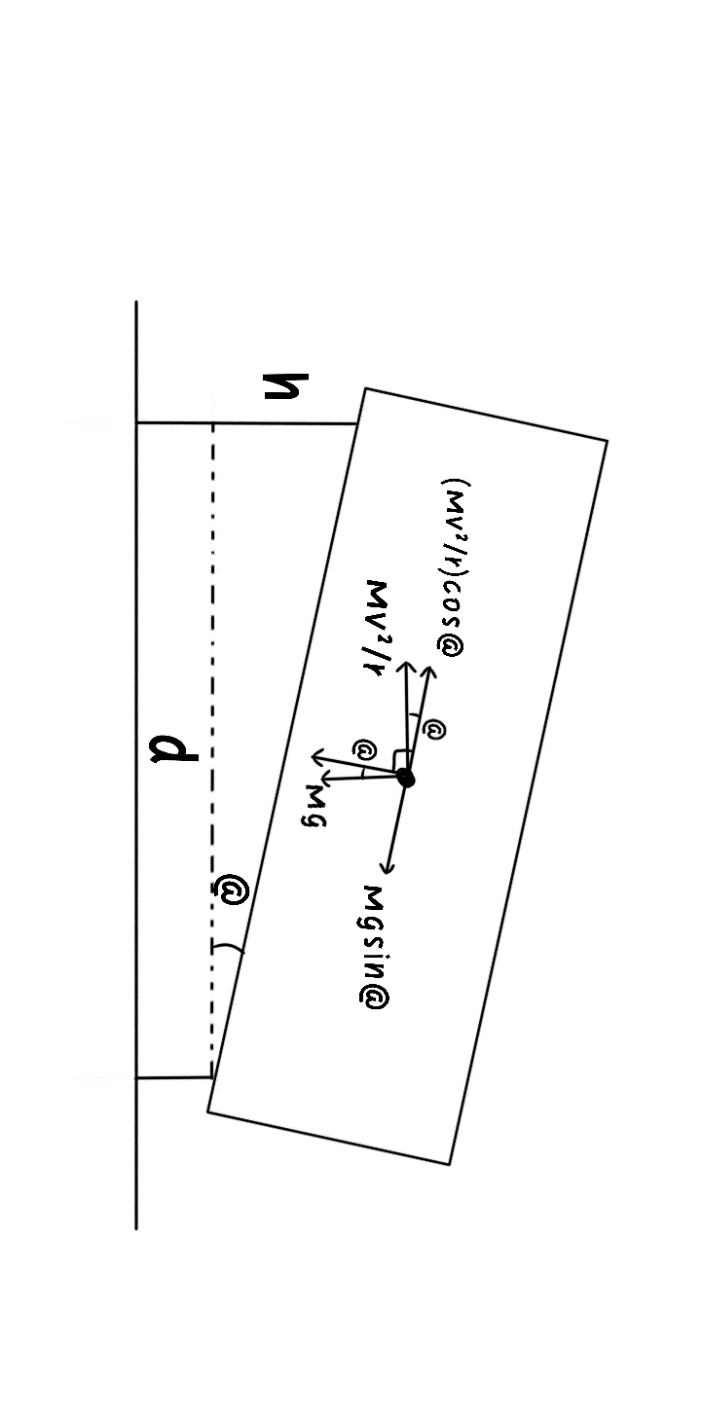 $\tan \theta = \dfrac{h}{d}$
$ mg\sin \theta = \dfrac{{m{v^2}}}{r}\cos \theta \\
g\sin \theta = \dfrac{{{v^2}}}{r}\cos \theta \\
\tan \theta = \dfrac{{{v^2}}}{{rg}} \\ $
$\therefore \dfrac{h}{d} = \dfrac{{{v^2}}}{{rg}}$
So, the correct answer is “Option A”.
Note:
The banking is made only once and cannot be altered every time. Therefore, the maximum speed limit that a vehicle should have to prevent toppling is fixed and cannot be altered, and therefore to prevent any accident the maximum speed limit should be always followed.
Complete step by step answer:
When vehicles traveling with some speed take a turn, then while taking the turn it experiences centrifugal force in the opposite direction of the turn. If the speed of the vehicle is very high, then the centrifugal force will also be high and can topple the vehicle leading to an accident. Therefore, to prevent these accidents banking of tracks is done at the turns.
Banking of the terms are done by increasing the height of that side of the track which is opposite to the turn. Due to this, the net contact force of the vehicle with the ground increases which causes an increasing frictional force with the ground, and thus preventing the vehicle from toppling.
The height of the banks depend on the radius of curvature of the track, the velocity of the vehicle, the width of the vehicle (distance between the wheels for a car are the distance between the rails for a train). To find the relation between them we must look at their force body diagrams calculating the net force to prevent toppling.
$ mg\sin \theta = \dfrac{{m{v^2}}}{r}\cos \theta \\
g\sin \theta = \dfrac{{{v^2}}}{r}\cos \theta \\
\tan \theta = \dfrac{{{v^2}}}{{rg}} \\ $
$\therefore \dfrac{h}{d} = \dfrac{{{v^2}}}{{rg}}$
So, the correct answer is “Option A”.
Note:
The banking is made only once and cannot be altered every time. Therefore, the maximum speed limit that a vehicle should have to prevent toppling is fixed and cannot be altered, and therefore to prevent any accident the maximum speed limit should be always followed.
Recently Updated Pages
If x a + bt + ct2 where x is in meters and t is in class 11 physics CBSE

A car covers the first half distance between two places class 11 physics CBSE
The resultant of two vectors overrightarrow P and overrightarrow class 11 physics CBSE
Find the value of cos 135 class 11 maths CBSE
A mass M is held in place by an applied force F and class 11 physics CBSE
A solution of glucose in water is labelled as 10 dfracwv class 11 chemistry CBSE
Trending doubts
One Metric ton is equal to kg A 10000 B 1000 C 100 class 11 physics CBSE
Find the value of the expression given below sin 30circ class 11 maths CBSE
What do you mean by retardation What is its SI uni class 11 physics CBSE
Draw a diagram of nephron and explain its structur class 11 biology CBSE
10 examples of friction in our daily life
Difference between physical and chemical change class 11 chemistry CBSE