




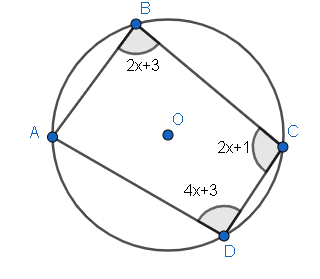
A quadrilateral ABCD is inscribed in a circle O. What is the measure of $\angle C$ ?
Answer
 Verified
560.7k+ views
Hint: To find the value of $\angle C$ , we have to find the value of x. We have to apply the property that the sum of opposite angles in a cyclic quadrilateral is equal to $180{}^\circ $ . Hence, the sum of $\angle B$ and $\angle D$ is $180{}^\circ $ . We have to substitute the values of these angles from the figure and solve for x. Then, we have to substitute the value of x in the $\angle C$ from the figure.
Complete step by step solution:
We have to find the value of $\angle C$ . We know that in a cyclic quadrilateral, the sum of opposite angles is equal to $180{}^\circ $ .
$\Rightarrow \angle B+\angle D=180{}^\circ $
From the figure, we can see that $\angle B=2x+3\text{ and }\angle D=4x+3$ .Let us substitute these values in the above equation.
$\Rightarrow 2x+3+4x+3=180{}^\circ $
We have to find the value of x. Let us combine the like terms on the LHS.
$\Rightarrow 2x+4x+3+3=180{}^\circ $
Let us add the like terms on the LHS.
$\Rightarrow 6x+6=180{}^\circ $
Let us collect the constant on the RHS.
$\begin{align}
& \Rightarrow 6x=180{}^\circ -6 \\
& \Rightarrow 6x=174{}^\circ \\
\end{align}$
We have to take the coefficient of x to the RHS.
$\Rightarrow x=\dfrac{174{}^\circ }{6}=29{}^\circ $
Now, we are given that $\angle C=2x+1$ . Let us substitute the value of x in this angle.
$\angle C=\left( 2\times 29{}^\circ \right)+1=58{}^\circ +1=59{}^\circ $
Therefore, the measure of $\angle C$ is $59{}^\circ $
Note: Students must know what a cyclic quadrilateral is and their properties. A cyclic quadrilateral is a quadrilateral which has all its four vertices lying on a circle. It is also sometimes called inscribed quadrilateral. They may misunderstand that the opposite angles of a cyclic quadrilateral are equal.
Complete step by step solution:
We have to find the value of $\angle C$ . We know that in a cyclic quadrilateral, the sum of opposite angles is equal to $180{}^\circ $ .
$\Rightarrow \angle B+\angle D=180{}^\circ $
From the figure, we can see that $\angle B=2x+3\text{ and }\angle D=4x+3$ .Let us substitute these values in the above equation.
$\Rightarrow 2x+3+4x+3=180{}^\circ $
We have to find the value of x. Let us combine the like terms on the LHS.
$\Rightarrow 2x+4x+3+3=180{}^\circ $
Let us add the like terms on the LHS.
$\Rightarrow 6x+6=180{}^\circ $
Let us collect the constant on the RHS.
$\begin{align}
& \Rightarrow 6x=180{}^\circ -6 \\
& \Rightarrow 6x=174{}^\circ \\
\end{align}$
We have to take the coefficient of x to the RHS.
$\Rightarrow x=\dfrac{174{}^\circ }{6}=29{}^\circ $
Now, we are given that $\angle C=2x+1$ . Let us substitute the value of x in this angle.
$\angle C=\left( 2\times 29{}^\circ \right)+1=58{}^\circ +1=59{}^\circ $
Therefore, the measure of $\angle C$ is $59{}^\circ $
Note: Students must know what a cyclic quadrilateral is and their properties. A cyclic quadrilateral is a quadrilateral which has all its four vertices lying on a circle. It is also sometimes called inscribed quadrilateral. They may misunderstand that the opposite angles of a cyclic quadrilateral are equal.
Recently Updated Pages
Master Class 12 Economics: Engaging Questions & Answers for Success

Master Class 12 English: Engaging Questions & Answers for Success
Master Class 12 Social Science: Engaging Questions & Answers for Success
Master Class 12 Maths: Engaging Questions & Answers for Success
Master Class 12 Physics: Engaging Questions & Answers for Success
Master Class 9 General Knowledge: Engaging Questions & Answers for Success
Trending doubts
Explain the Treaty of Vienna of 1815 class 10 social science CBSE
Why is it 530 pm in india when it is 1200 afternoon class 10 social science CBSE
What is the full form of POSCO class 10 social science CBSE
Define Potential, Developed, Stock and Reserved resources
The speaker of the Lok Sabha is elected by the APresident class 10 social science CBSE
Complete the sentence with the most appropriate word class 10 english CBSE