




A pyramid with trapezium base with sides AB = 9cm, BC = 12cm, CD = 15cm and DA = 18cm. The volume of the pyramid $=1458c{{m}^{3}}$. Find the height H, in cm?
Answer
 Verified
596.7k+ views
Hint: The volume of the pyramid is given by the formula $=\dfrac{1}{3}\times area\ of\ trapezium\times height$.
Area of trapezium can be found by dividing it into two sides such that each forms a triangle. Then we can check if it is a right angled triangle using the Pythagoras theorem. Now, once verified, we will use the area of the triangle as $\dfrac{1}{2}\times base\times height$. The other triangle would be a scalene triangle which would require the Heron's formula to find area, root of \[s\left( s-a \right)\left( s-b \right)\left( s-c \right)\], where \[s=\dfrac{a+b+c}{2}\]. Now, we can substitute everything in the volume of the pyramid and find the height.
Complete step-by-step answer:
The figure is shown below,
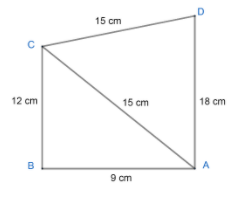
We have joined AC to divide the trapezium into two triangles CBA, CDA. From diagram we can see that triangle CBA is right angled at B. Therefore, using Pythagoras Theorem
$\Rightarrow {{12}^{2}}+{{9}^{2}}={{15}^{2}}$
So, the length of AC is 15cm and $\Delta ABC$ is right - angle triangle.
So, the area of trapezium ABCD = area of $\Delta ABC$ + area of $\Delta ACD$………..(1)
The area of triangle ABC as it is right angle triangle, so the formula is,
$\begin{align}
& =\dfrac{1}{2}\times base\times height \\
& =\dfrac{1}{2}\times AB\times BC \\
& =\dfrac{1}{2}\times 9\times 12 \\
& =\dfrac{108}{2}=54c{{m}^{2}}...........\left( 2 \right) \\
\end{align}$
The area of $\Delta ACD$ will be find using Heron’s formula,
The Heron’s formula states that,
$Area=\sqrt{s\left( s-a \right)\left( s-b \right)\left( s-c \right)}$
Where a, b and c are sides of triangle and s is semi – perimeter which is,
\[s=\dfrac{a+b+c}{2}\]
Applying Heron’s formula to find the area of $\Delta ACD$.
The sides are,
$\begin{align}
& a=15cm \\
& b=15cm \\
& c=18cm \\
& s=\dfrac{15+15+18}{2} \\
& s=\dfrac{48}{2} \\
& s=24cm \\
& \Rightarrow Area\ of\ \Delta ACD=\sqrt{24\left( 24-15 \right)\left( 24-15 \right)\left( 24-18 \right)} \\
& =\sqrt{24\times 9\times 9\times 6} \\
& =\sqrt{144\times 81} \\
& =\sqrt{{{12}^{2}}\times {{9}^{2}}} \\
& =12\times 9 \\
& =108c{{m}^{2}}.............\left( 3 \right) \\
\end{align}$
Using the equation (1), (2) and (3)
The area of trapezium \[=54+108\]
\[=162c{{m}^{2}}\]
Now, to find the height of the pyramid we will use the formula of volume of the pyramid.
The volume of pyramid is given by,
$=\dfrac{1}{3}\times area\ of\ trapezium\times height$
The volume of the pyramid is given $=1458c{{m}^{3}}$.
Applying formula,
$\begin{align}
& =\dfrac{1}{3}\times 162\times H=1458 \\
& \Rightarrow H=\dfrac{1458\times 3}{162} \\
& \Rightarrow H=27cm \\
\end{align}$
So, the height of the pyramid = 27cm.
Note: Students can make mistakes such as they may not think of a triangle ABC is right angle triangle. As two sides of trapezium are parallel to each other. So, students can make the mistake that they might take any two sides parallel to each other but it is not given in the question so we cannot do that.
Area of trapezium can be found by dividing it into two sides such that each forms a triangle. Then we can check if it is a right angled triangle using the Pythagoras theorem. Now, once verified, we will use the area of the triangle as $\dfrac{1}{2}\times base\times height$. The other triangle would be a scalene triangle which would require the Heron's formula to find area, root of \[s\left( s-a \right)\left( s-b \right)\left( s-c \right)\], where \[s=\dfrac{a+b+c}{2}\]. Now, we can substitute everything in the volume of the pyramid and find the height.
Complete step-by-step answer:
The figure is shown below,
We have joined AC to divide the trapezium into two triangles CBA, CDA. From diagram we can see that triangle CBA is right angled at B. Therefore, using Pythagoras Theorem
$\Rightarrow {{12}^{2}}+{{9}^{2}}={{15}^{2}}$
So, the length of AC is 15cm and $\Delta ABC$ is right - angle triangle.
So, the area of trapezium ABCD = area of $\Delta ABC$ + area of $\Delta ACD$………..(1)
The area of triangle ABC as it is right angle triangle, so the formula is,
$\begin{align}
& =\dfrac{1}{2}\times base\times height \\
& =\dfrac{1}{2}\times AB\times BC \\
& =\dfrac{1}{2}\times 9\times 12 \\
& =\dfrac{108}{2}=54c{{m}^{2}}...........\left( 2 \right) \\
\end{align}$
The area of $\Delta ACD$ will be find using Heron’s formula,
The Heron’s formula states that,
$Area=\sqrt{s\left( s-a \right)\left( s-b \right)\left( s-c \right)}$
Where a, b and c are sides of triangle and s is semi – perimeter which is,
\[s=\dfrac{a+b+c}{2}\]
Applying Heron’s formula to find the area of $\Delta ACD$.
The sides are,
$\begin{align}
& a=15cm \\
& b=15cm \\
& c=18cm \\
& s=\dfrac{15+15+18}{2} \\
& s=\dfrac{48}{2} \\
& s=24cm \\
& \Rightarrow Area\ of\ \Delta ACD=\sqrt{24\left( 24-15 \right)\left( 24-15 \right)\left( 24-18 \right)} \\
& =\sqrt{24\times 9\times 9\times 6} \\
& =\sqrt{144\times 81} \\
& =\sqrt{{{12}^{2}}\times {{9}^{2}}} \\
& =12\times 9 \\
& =108c{{m}^{2}}.............\left( 3 \right) \\
\end{align}$
Using the equation (1), (2) and (3)
The area of trapezium \[=54+108\]
\[=162c{{m}^{2}}\]
Now, to find the height of the pyramid we will use the formula of volume of the pyramid.
The volume of pyramid is given by,
$=\dfrac{1}{3}\times area\ of\ trapezium\times height$
The volume of the pyramid is given $=1458c{{m}^{3}}$.
Applying formula,
$\begin{align}
& =\dfrac{1}{3}\times 162\times H=1458 \\
& \Rightarrow H=\dfrac{1458\times 3}{162} \\
& \Rightarrow H=27cm \\
\end{align}$
So, the height of the pyramid = 27cm.
Note: Students can make mistakes such as they may not think of a triangle ABC is right angle triangle. As two sides of trapezium are parallel to each other. So, students can make the mistake that they might take any two sides parallel to each other but it is not given in the question so we cannot do that.
Recently Updated Pages
Master Class 10 Computer Science: Engaging Questions & Answers for Success

Master Class 10 General Knowledge: Engaging Questions & Answers for Success
Master Class 10 English: Engaging Questions & Answers for Success
Master Class 10 Social Science: Engaging Questions & Answers for Success
Master Class 10 Maths: Engaging Questions & Answers for Success
Master Class 10 Science: Engaging Questions & Answers for Success
Trending doubts
What is the median of the first 10 natural numbers class 10 maths CBSE
Which women's tennis player has 24 Grand Slam singles titles?
Who is the Brand Ambassador of Incredible India?
Why is there a time difference of about 5 hours between class 10 social science CBSE
Write a letter to the principal requesting him to grant class 10 english CBSE
A moving boat is observed from the top of a 150 m high class 10 maths CBSE