




A pulse of a wave train travels along a stretched string and reaches the fixed end of the string. It will be reflected back with:
A. a phase change of ${180^ \circ }$ with velocity reversed
B. the same phase as the incident pulse with no reversal of velocity
C. a phase change of ${180^ \circ }$ with no reversal of velocity
D. the same phase as the incident pulse but with velocity reversed
Answer
 Verified
619.5k+ views
Hint: When the pulse travels in a direction with velocity v and gets travelled back then there will be a phase difference of ${180^ \circ }$ and the direction of the velocity will be changed, -v, as the reflected pulse travels in an opposite direction.
Complete step by step answer:
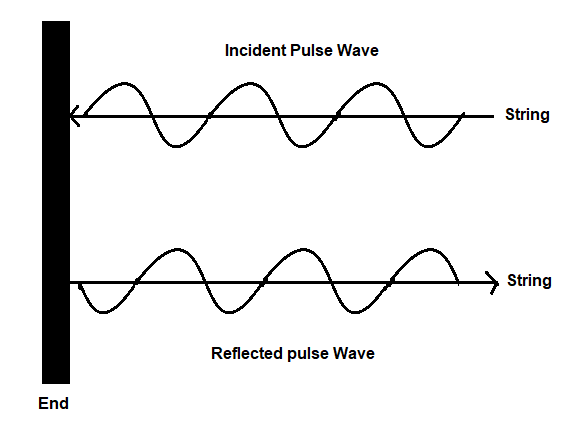
We are given that a pulse of a wave train travels along a stretched string and reaches the fixed end of the string.
We have to find the phase difference and the direction of the velocity when the pulse of the wave train is reflected back.
When the pulse of the wave is reflected back, the crusts of the incident wave are corresponded with the troughs of the reflected wave, and the troughs of the incident wave are corresponded with the crusts of the reflected wave.
There will be a phase change of $\pi \left( {{{180}^ \circ }} \right)$
The value of $\pi $ in degrees is 180.
Let us say the incident pulse of a wave train travels with velocity V, then the reflected pulse will travel with the same magnitude of incident velocity but the direction of the reflected velocity will be changed. Therefore the velocity will be reversed.
So when the pulse of the wave train along the string is reflected back, then there will be a phase change of ${180^ \circ }$ with the reversal of velocity.
So, the correct answer is “Option A”.
Note:
Phase describes the location of a point within a wave cycle of a repeating waveform whereas phase difference is If two or more waveforms have same frequency, same wavelength and same cycle but not overlapped then they are said to be in phase. Phase difference is used to describe the difference in degrees of two waves with same frequency, difference in phase angle. Phase is different from phase difference.
Complete step by step answer:
We are given that a pulse of a wave train travels along a stretched string and reaches the fixed end of the string.
We have to find the phase difference and the direction of the velocity when the pulse of the wave train is reflected back.
When the pulse of the wave is reflected back, the crusts of the incident wave are corresponded with the troughs of the reflected wave, and the troughs of the incident wave are corresponded with the crusts of the reflected wave.
There will be a phase change of $\pi \left( {{{180}^ \circ }} \right)$
The value of $\pi $ in degrees is 180.
Let us say the incident pulse of a wave train travels with velocity V, then the reflected pulse will travel with the same magnitude of incident velocity but the direction of the reflected velocity will be changed. Therefore the velocity will be reversed.
So when the pulse of the wave train along the string is reflected back, then there will be a phase change of ${180^ \circ }$ with the reversal of velocity.
So, the correct answer is “Option A”.
Note:
Phase describes the location of a point within a wave cycle of a repeating waveform whereas phase difference is If two or more waveforms have same frequency, same wavelength and same cycle but not overlapped then they are said to be in phase. Phase difference is used to describe the difference in degrees of two waves with same frequency, difference in phase angle. Phase is different from phase difference.
Recently Updated Pages
Master Class 11 English: Engaging Questions & Answers for Success

Master Class 11 Social Science: Engaging Questions & Answers for Success
Master Class 11 Maths: Engaging Questions & Answers for Success
Master Class 11 Biology: Engaging Questions & Answers for Success
Master Class 11 Physics: Engaging Questions & Answers for Success
Master Class 11 Chemistry: Engaging Questions & Answers for Success
Trending doubts
One Metric ton is equal to kg A 10000 B 1000 C 100 class 11 physics CBSE
Difference Between Prokaryotic Cells and Eukaryotic Cells
Two of the body parts which do not appear in MRI are class 11 biology CBSE
Find the value of the expression given below sin 30circ class 11 maths CBSE
Draw a diagram of a plant cell and label at least eight class 11 biology CBSE
10 examples of friction in our daily life