




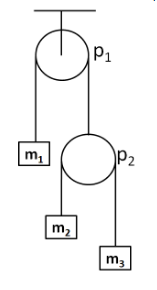
A pulley-rope-mass arrangement is shown in figure. Find the acceleration of block $ {m_1} $ when the masses are set free to move. Assume that the pulleys and the ropes are ideal.
Answer
 Verified
563.1k+ views
Hint: To solve this question, we need to apply the Newton’s second law of motion to each of the three blocks after considering their free body diagrams. On solving the equations formed, we can get the required acceleration of $ {m_1} $ .
Complete Answer:
Let the tension in the string connecting the blocks of masses $ {m_2} $ and $ {m_3} $ be $ T $ . Also, the tension in the string connecting the block of mass $ {m_1} $ with the pulley $ {P_2} $ be $ {T_1} $ . So the free body diagram of the pulley $ {P_2} $ is as shown in the below diagram.

Since the pulley is massless, so from the Newton’s second law of motion, the net force on the pulley $ {P_2} $ must be equal to zero. So we have
$ {T_1} - T - T = 0 $
$ \Rightarrow {T_1} = 2T $ ..............................(1)
Let the acceleration of the block of masses $ {m_1} $ , $ {m_2} $ and $ {m_3} $ be $ {a_1} $ , $ {a_2} $ and $ {a_3} $ respectively.
Since the pulley $ {P_2} $ is connected with the block of mass $ {m_1} $ , so its acceleration is also equal to $ {a_1} $ .
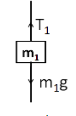
Now, considering the free body diagram of the block of mass $ {m_1} $ , we have the following figure
From the Newton’s second law of motion, we can write
$ {T_1} - {m_1}g = {m_1}{a_1} $
From (1) we can write
$ 2T - {m_1}g = {m_1}{a_1} $ ..............................(2)
Now, the masses $ {m_2} $ and $ {m_3} $ are connected to the pulley $ {P_2} $ which is itself accelerating with acceleration $ {a_1} $ , so we consider their motion with respect to the pulley to get the equation
$ {a_2} - {a_1} = - \left( {{a_3} - {a_1}} \right) $
$ \Rightarrow 2{a_1} = {a_2} + {a_3} $ ..............................(3)
So considering the free body diagrams of $ {m_2} $ and $ {m_3} $ , we can write the following equations
$ {m_2}g - T = {m_2}{a_2} $ ..............................(4)
$ T - {m_3}g = {m_3}{a_3} $ ..............................(5)
Multiplying both sides of (4) by $ {m_3} $ we get
$ {m_2}{m_3}g - {m_3}T = {m_2}{m_3}{a_2} $ ..............................(6)
Multiplying both sides of (5) by $ {m_2} $ we get
$ {m_2}T - {m_2}{m_3}g = {m_2}{m_3}{a_3} $ ..............................(7)
Adding (6) and (7) we have
$ \left( {{m_2} - {m_3}} \right)T = {m_2}{m_3}\left( {{a_2} + {a_3}} \right) $
Putting (3) in the above equation, we get
$ \left( {{m_2} - {m_3}} \right)T = 2{m_2}{m_3}{a_1} $
$ \Rightarrow T = \dfrac{{2{m_2}{m_3}}}{{\left( {{m_2} - {m_3}} \right)}}{a_1} $
Putting this in (2) we have
$ \dfrac{{4{m_2}{m_3}}}{{\left( {{m_2} - {m_3}} \right)}}{a_1} - {m_1}g = {m_1}{a_1} $
$ \Rightarrow \left( {\dfrac{{4{m_2}{m_3}}}{{\left( {{m_2} - {m_3}} \right)}} - {m_1}} \right){a_1} = {m_1}g $
On simplifying we get
$ \left( {\dfrac{{4{m_2}{m_3} - {m_1}\left( {{m_2} - {m_3}} \right)}}{{\left( {{m_2} - {m_3}} \right)}}} \right){a_1} = {m_1}g $
$ \Rightarrow {a_1} = \dfrac{{{m_1}\left( {{m_2} - {m_3}} \right)g}}{{4{m_2}{m_3} - {m_1}\left( {{m_2} - {m_3}} \right)}} $
Hence, this is the required acceleration of the block of mass $ {m_1} $ .
Note:
Do not combine the blocks $ {m_2} $ and $ {m_3} $ as a single block to write the acceleration of the block $ {m_1} $ . This is because the motion of these blocks will affect the acceleration of $ {m_1} $ .
Complete Answer:
Let the tension in the string connecting the blocks of masses $ {m_2} $ and $ {m_3} $ be $ T $ . Also, the tension in the string connecting the block of mass $ {m_1} $ with the pulley $ {P_2} $ be $ {T_1} $ . So the free body diagram of the pulley $ {P_2} $ is as shown in the below diagram.
Since the pulley is massless, so from the Newton’s second law of motion, the net force on the pulley $ {P_2} $ must be equal to zero. So we have
$ {T_1} - T - T = 0 $
$ \Rightarrow {T_1} = 2T $ ..............................(1)
Let the acceleration of the block of masses $ {m_1} $ , $ {m_2} $ and $ {m_3} $ be $ {a_1} $ , $ {a_2} $ and $ {a_3} $ respectively.
Since the pulley $ {P_2} $ is connected with the block of mass $ {m_1} $ , so its acceleration is also equal to $ {a_1} $ .
Now, considering the free body diagram of the block of mass $ {m_1} $ , we have the following figure
From the Newton’s second law of motion, we can write
$ {T_1} - {m_1}g = {m_1}{a_1} $
From (1) we can write
$ 2T - {m_1}g = {m_1}{a_1} $ ..............................(2)
Now, the masses $ {m_2} $ and $ {m_3} $ are connected to the pulley $ {P_2} $ which is itself accelerating with acceleration $ {a_1} $ , so we consider their motion with respect to the pulley to get the equation
$ {a_2} - {a_1} = - \left( {{a_3} - {a_1}} \right) $
$ \Rightarrow 2{a_1} = {a_2} + {a_3} $ ..............................(3)
So considering the free body diagrams of $ {m_2} $ and $ {m_3} $ , we can write the following equations
$ {m_2}g - T = {m_2}{a_2} $ ..............................(4)
$ T - {m_3}g = {m_3}{a_3} $ ..............................(5)
Multiplying both sides of (4) by $ {m_3} $ we get
$ {m_2}{m_3}g - {m_3}T = {m_2}{m_3}{a_2} $ ..............................(6)
Multiplying both sides of (5) by $ {m_2} $ we get
$ {m_2}T - {m_2}{m_3}g = {m_2}{m_3}{a_3} $ ..............................(7)
Adding (6) and (7) we have
$ \left( {{m_2} - {m_3}} \right)T = {m_2}{m_3}\left( {{a_2} + {a_3}} \right) $
Putting (3) in the above equation, we get
$ \left( {{m_2} - {m_3}} \right)T = 2{m_2}{m_3}{a_1} $
$ \Rightarrow T = \dfrac{{2{m_2}{m_3}}}{{\left( {{m_2} - {m_3}} \right)}}{a_1} $
Putting this in (2) we have
$ \dfrac{{4{m_2}{m_3}}}{{\left( {{m_2} - {m_3}} \right)}}{a_1} - {m_1}g = {m_1}{a_1} $
$ \Rightarrow \left( {\dfrac{{4{m_2}{m_3}}}{{\left( {{m_2} - {m_3}} \right)}} - {m_1}} \right){a_1} = {m_1}g $
On simplifying we get
$ \left( {\dfrac{{4{m_2}{m_3} - {m_1}\left( {{m_2} - {m_3}} \right)}}{{\left( {{m_2} - {m_3}} \right)}}} \right){a_1} = {m_1}g $
$ \Rightarrow {a_1} = \dfrac{{{m_1}\left( {{m_2} - {m_3}} \right)g}}{{4{m_2}{m_3} - {m_1}\left( {{m_2} - {m_3}} \right)}} $
Hence, this is the required acceleration of the block of mass $ {m_1} $ .
Note:
Do not combine the blocks $ {m_2} $ and $ {m_3} $ as a single block to write the acceleration of the block $ {m_1} $ . This is because the motion of these blocks will affect the acceleration of $ {m_1} $ .
Recently Updated Pages
Master Class 11 Computer Science: Engaging Questions & Answers for Success

Master Class 11 Business Studies: Engaging Questions & Answers for Success
Master Class 11 Economics: Engaging Questions & Answers for Success
Master Class 11 English: Engaging Questions & Answers for Success
Master Class 11 Maths: Engaging Questions & Answers for Success
Master Class 11 Biology: Engaging Questions & Answers for Success
Trending doubts
One Metric ton is equal to kg A 10000 B 1000 C 100 class 11 physics CBSE
There are 720 permutations of the digits 1 2 3 4 5 class 11 maths CBSE
Discuss the various forms of bacteria class 11 biology CBSE
Draw a diagram of a plant cell and label at least eight class 11 biology CBSE
State the laws of reflection of light
Explain zero factorial class 11 maths CBSE