




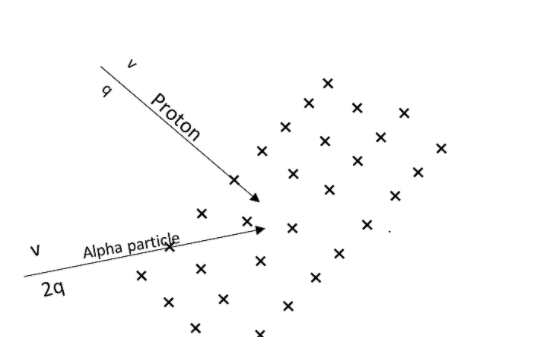
A proton and a $\alpha \text{ particle}$ moving with the same speed enter a uniform magnetic field. The proton enters perpendicular to the field. The magnetic force $F$ on the particles will be equivalent when the direction of motion of a particle is given as,
A. Parallel to the field
B. Perpendicular to the field
C. At $30{}^\circ $to the field
D. At $60{}^\circ $to the field
Answer
 Verified
597.9k+ views
Hint: The power radiated by the black body is found by taking the product of the area of the black body, Stefan’s constant and the fourth power of temperature. The area is given as the area of a sphere as the black body is given as a spherical one. Now the conditions of halving the radius and making the temperature doubled, should be applied in the same equation and compare it with the previous condition. These all will help you to solve this question.
Complete step by step answer:
As we all know, the magnetic force acting due to the charged particle moving across a uniform magnetic field is given as,
$F=qvB\sin \theta $
As the angle between the field and velocity vector of a proton is given as,
$\theta =90{}^\circ $
Substituting this in the equation will give,
${{F}_{1}}=qvB$
Now let us calculate the magnetic force due to a $\alpha \text{ particle}$. As the charge of an $\alpha \text{ particle}$is given as the twice of the charge of a proton, we can write that,
$q=2q$
Substituting this in the equation will give,
${{F}_{2}}=2qvB\sin \theta $
As it is mentioned in the question that the magnetic force are equal, we can compare both the equations,
$qvB=2qvB\sin \theta $
Cancelling the common terms in the equation,
$\sin \theta =\dfrac{1}{2}$
From this we can calculate the angle of the direction of motion is,
$\theta =30{}^\circ $
Therefore the correct answer is option C.
Note:
Magnetic force is defined as the force of repulsion or attraction between the electrically charged particles due to the motion. It is the fundamental force which causes the action of electric motors and the magnetic attraction for iron. This is a vector quantity as well.
Complete step by step answer:
As we all know, the magnetic force acting due to the charged particle moving across a uniform magnetic field is given as,
$F=qvB\sin \theta $
As the angle between the field and velocity vector of a proton is given as,
$\theta =90{}^\circ $
Substituting this in the equation will give,
${{F}_{1}}=qvB$
Now let us calculate the magnetic force due to a $\alpha \text{ particle}$. As the charge of an $\alpha \text{ particle}$is given as the twice of the charge of a proton, we can write that,
$q=2q$
Substituting this in the equation will give,
${{F}_{2}}=2qvB\sin \theta $
As it is mentioned in the question that the magnetic force are equal, we can compare both the equations,
$qvB=2qvB\sin \theta $
Cancelling the common terms in the equation,
$\sin \theta =\dfrac{1}{2}$
From this we can calculate the angle of the direction of motion is,
$\theta =30{}^\circ $
Therefore the correct answer is option C.
Note:
Magnetic force is defined as the force of repulsion or attraction between the electrically charged particles due to the motion. It is the fundamental force which causes the action of electric motors and the magnetic attraction for iron. This is a vector quantity as well.
Recently Updated Pages
Master Class 12 Social Science: Engaging Questions & Answers for Success

Master Class 12 Physics: Engaging Questions & Answers for Success
Master Class 12 Maths: Engaging Questions & Answers for Success
Master Class 12 Economics: Engaging Questions & Answers for Success
Master Class 12 Chemistry: Engaging Questions & Answers for Success
Master Class 12 Business Studies: Engaging Questions & Answers for Success
Trending doubts
Which are the Top 10 Largest Countries of the World?
Draw a labelled sketch of the human eye class 12 physics CBSE
Explain the structure of megasporangium class 12 biology CBSE
What are the major means of transport Explain each class 12 social science CBSE
How many chromosomes are found in human ovum a 46 b class 12 biology CBSE
The diagram of the section of a maize grain is given class 12 biology CBSE