




A projectile is given an initial velocity of $\hat i + 2\hat j$. Find the cartesian equation of its path. Take $g = 10{\text{m}}{{\text{s}}^{ - 2}}$.
A) $y = x - 5{x^2}$
B) $y = 2x - 5{x^2}$
C) $y = 2x - 15{x^2}$
D) $y = 2x - 25{x^2}$
Answer
 Verified
620.4k+ views
Hint: The given initial velocity of the projectile has an x component and a y component. So the displacement of the projectile must have a horizontal component and a vertical component. The trajectory of the projectile can then be considered to be parabolic in nature. Newton’s first equation of motion for the displacement in the y-direction will give the equation of the trajectory of the projectile.
Formula used:
Newton’s first equation of motion is given by, $s = ut + \dfrac{1}{2}a{t^2}$ where $s$ is the displacement of the body, $u$ is its initial velocity, $t$ is the time taken and $a$ is its acceleration.
The equation of the trajectory of a projectile is given by, $y = x\tan \theta - \dfrac{1}{2}g\left( {\dfrac{{{x^2}}}{{{u_x}^2}}} \right)$ where $y$ is its vertical displacement, $x$ is its horizontal displacement, $\theta $ is the angle made by the projectile as it is thrown, $g$ is the acceleration due to gravity and ${u_x}$ is the x-component of its initial velocity.
Complete step by step answer:
Step 1: List the x-component and y-component of the given initial velocity.
The initial velocity of the projectile is given to be $\vec u = \hat i + 2\hat j$.
Then the x-component of the initial velocity will be ${u_x} = 1$ and its y-component is ${u_y} = 2$ .
Let $x$ be the displacement of the projectile along the x-direction.
Let $y$ be the displacement of the projectile along the y-direction.
Step 2: Using Newton’s first equation of motion to express the displacement of the projectile in the x-direction and the y-direction.
Newton’s first equation of motion gives the horizontal displacement of the projectile as $x = {u_x}t + \dfrac{1}{2}{a_x}{t^2}$
where $t$ is the time taken and ${a_x}$ is its acceleration in the x-direction.
For a projectile, the velocity in the x-direction remains constant.
$ \Rightarrow {a_x} = 0$
Thus we have $x = {u_x}t$ and on substituting for ${u_x} = 1$ we get, $x = 1 \times t = t$.
So the displacement along the horizontal direction is $x = t$
Similarly, the displacement of the projectile in the y-direction will be $y = {u_y}t + \dfrac{1}{2}{a_y}{t^2}$ where $t$ is the time taken and ${a_y}$ is its acceleration in the y-direction.
For a projectile, the acceleration in the y-direction is given by the acceleration due to gravity.
$ \Rightarrow {a_y} = - g$
Thus we have $y = {u_y}t - \dfrac{1}{2}g{t^2}$ ----------- (1)
Substituting for $t = x$, ${u_y} = 2$ and $g = 10{\text{m}}{{\text{s}}^{ - 2}}$ in equation (1) we get,
$\Rightarrow y = 2x - \dfrac{1}{2}10{x^2}$.
Simplifying we get,
$\Rightarrow y = 2x - 5{x^2}$ .
Thus the equation of the trajectory of the projectile is $y = 2x - 5{x^2}$. So the correct option is B.
Note:
Alternate method
The projectile can be considered to make an angle $\theta $ with the x-axis as it moves with the initial velocity $\vec u = \hat i + 2\hat j$. We have ${u_x} = 1$ and ${u_y} = 2$ as the x-component and y-component of the initial velocity. The projection of the projectile is shown in the figure below.
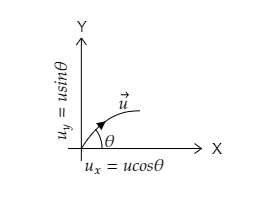
From the figure, the x-component and y-component of the initial velocity are given by. ${u_x} = u\cos \theta = 1$ and ${u_y} = u\sin \theta = 2$ respectively.
Let $x$ and $y$ be the displacements of the projectile along the x-direction and y-direction respectively.
Then the equation of the trajectory of the projectile is generally expressed as
$y = x\tan \theta - \dfrac{1}{2}g\left( {\dfrac{{{x^2}}}{{{u_x}^2}}} \right)$ --------- (A)
We have $\tan \theta = \dfrac{{u\cos \theta }}{{u\sin \theta }} = \dfrac{2}{1} = 2$.
Then substituting for $\tan \theta = 2$, ${u_x} = 1$ and $g = 10{\text{m}}{{\text{s}}^{ - 2}}$ in equation (A) we get,$y = 2x - \dfrac{1}{2}10\left( {\dfrac{{{x^2}}}{{{1^2}}}} \right)$
$ \Rightarrow y = 2x - 5{x^2}$ .
Thus the equation of the trajectory is $y = 2x - 5{x^2}$.
Formula used:
Newton’s first equation of motion is given by, $s = ut + \dfrac{1}{2}a{t^2}$ where $s$ is the displacement of the body, $u$ is its initial velocity, $t$ is the time taken and $a$ is its acceleration.
The equation of the trajectory of a projectile is given by, $y = x\tan \theta - \dfrac{1}{2}g\left( {\dfrac{{{x^2}}}{{{u_x}^2}}} \right)$ where $y$ is its vertical displacement, $x$ is its horizontal displacement, $\theta $ is the angle made by the projectile as it is thrown, $g$ is the acceleration due to gravity and ${u_x}$ is the x-component of its initial velocity.
Complete step by step answer:
Step 1: List the x-component and y-component of the given initial velocity.
The initial velocity of the projectile is given to be $\vec u = \hat i + 2\hat j$.
Then the x-component of the initial velocity will be ${u_x} = 1$ and its y-component is ${u_y} = 2$ .
Let $x$ be the displacement of the projectile along the x-direction.
Let $y$ be the displacement of the projectile along the y-direction.
Step 2: Using Newton’s first equation of motion to express the displacement of the projectile in the x-direction and the y-direction.
Newton’s first equation of motion gives the horizontal displacement of the projectile as $x = {u_x}t + \dfrac{1}{2}{a_x}{t^2}$
where $t$ is the time taken and ${a_x}$ is its acceleration in the x-direction.
For a projectile, the velocity in the x-direction remains constant.
$ \Rightarrow {a_x} = 0$
Thus we have $x = {u_x}t$ and on substituting for ${u_x} = 1$ we get, $x = 1 \times t = t$.
So the displacement along the horizontal direction is $x = t$
Similarly, the displacement of the projectile in the y-direction will be $y = {u_y}t + \dfrac{1}{2}{a_y}{t^2}$ where $t$ is the time taken and ${a_y}$ is its acceleration in the y-direction.
For a projectile, the acceleration in the y-direction is given by the acceleration due to gravity.
$ \Rightarrow {a_y} = - g$
Thus we have $y = {u_y}t - \dfrac{1}{2}g{t^2}$ ----------- (1)
Substituting for $t = x$, ${u_y} = 2$ and $g = 10{\text{m}}{{\text{s}}^{ - 2}}$ in equation (1) we get,
$\Rightarrow y = 2x - \dfrac{1}{2}10{x^2}$.
Simplifying we get,
$\Rightarrow y = 2x - 5{x^2}$ .
Thus the equation of the trajectory of the projectile is $y = 2x - 5{x^2}$. So the correct option is B.
Note:
Alternate method
The projectile can be considered to make an angle $\theta $ with the x-axis as it moves with the initial velocity $\vec u = \hat i + 2\hat j$. We have ${u_x} = 1$ and ${u_y} = 2$ as the x-component and y-component of the initial velocity. The projection of the projectile is shown in the figure below.
From the figure, the x-component and y-component of the initial velocity are given by. ${u_x} = u\cos \theta = 1$ and ${u_y} = u\sin \theta = 2$ respectively.
Let $x$ and $y$ be the displacements of the projectile along the x-direction and y-direction respectively.
Then the equation of the trajectory of the projectile is generally expressed as
$y = x\tan \theta - \dfrac{1}{2}g\left( {\dfrac{{{x^2}}}{{{u_x}^2}}} \right)$ --------- (A)
We have $\tan \theta = \dfrac{{u\cos \theta }}{{u\sin \theta }} = \dfrac{2}{1} = 2$.
Then substituting for $\tan \theta = 2$, ${u_x} = 1$ and $g = 10{\text{m}}{{\text{s}}^{ - 2}}$ in equation (A) we get,$y = 2x - \dfrac{1}{2}10\left( {\dfrac{{{x^2}}}{{{1^2}}}} \right)$
$ \Rightarrow y = 2x - 5{x^2}$ .
Thus the equation of the trajectory is $y = 2x - 5{x^2}$.
Recently Updated Pages
Master Class 11 English: Engaging Questions & Answers for Success

Master Class 11 Social Science: Engaging Questions & Answers for Success
Master Class 11 Maths: Engaging Questions & Answers for Success
Master Class 11 Biology: Engaging Questions & Answers for Success
Master Class 11 Physics: Engaging Questions & Answers for Success
Master Class 11 Chemistry: Engaging Questions & Answers for Success
Trending doubts
One Metric ton is equal to kg A 10000 B 1000 C 100 class 11 physics CBSE
Difference Between Prokaryotic Cells and Eukaryotic Cells
Find the value of the expression given below sin 30circ class 11 maths CBSE
Difference between physical and chemical change class 11 chemistry CBSE
Two of the body parts which do not appear in MRI are class 11 biology CBSE
Draw a diagram of a plant cell and label at least eight class 11 biology CBSE