




A projectile is fired at a speed of \[100m/s\]at an angle of \[{{37}^{0}}\]above horizontal. At the highest point, the projectile breaks into two parts of mass ratio\[1:3\]the smaller coming to rest, then the distance between launching point and the point where the heavier piece lands:
A.\[480m\]
B.\[960m\]
C.\[1120m\]
D.\[640m\]
Answer
 Verified
606.6k+ views
Hint: When projectile reaches the highest point this means its vertical component of velocity becomes zero and its horizontal component of velocity is common through the motion. When a projectile breaks at the highest point the heavy particle follows a new parabolic path because its velocity changes following conservation of momentum because no external forces are acting at the highest point.
Complete answer:
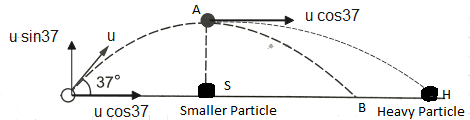
Let us assume the velocity with which projectile is fired as\[u=100m/s\]
According to question, at highest point \[A\]projectile breaks into two parts of mass ratio\[1:3\]and the smaller particle comes at rest so it must fall immediately from highest point A and reach at point S under gravity while heavier particle reaches to point H on new projectile path because its velocity get changed.
Let us assume Mass of heavier part is \[3x\]
Mass of lighter part is \[x\]
Since at point A all external forces are zero so momentum is conserved.
Let us assume the velocity of heavier particles at point A will be \[{{v}_{h}}\]and that of lighter particles is \[{{v}_{l}}\] .
According to conservation of momentum,
\[(4x)(100cos{{37}^{0}})=(3x)({{v}_{h}})+(x)({{v}_{l}})\]
\[(4x)(76.5)=(3x)({{v}_{h}})+(x)(0)\]
\[{{v}_{h}}=102m{{s}^{-1}}\]----Equation (1)
So the velocity of the heavy particle at the highest point will become\[102m{{s}^{-1}}\]and it will follow a new projectile path and reach at point H.
If projectile does not break at point A then it will reach the ground at point B following the initial projectile path.
So Range of initial projectile path when whole particle is present is calculated as –
\[R=\dfrac{2{{u}^{2}}Sin\theta Cos\theta }{g}\]
\[R=\dfrac{2{{(100)}^{2}}Sin{{37}^{0}}Cos{{37}^{0}}}{9.8}\]
\[R=980.87m\]
Distance of \[OB=980.87m\]
since S is the midpoint of OB. So we can write \[OS=SB=490.44m\]--- Equation (2)
Maximum height of Projectile is calculated as –
\[H=\dfrac{{{u}^{2}}Si{{n}^{2}}\theta }{2g}\]
\[H=\dfrac{{{(100Sin37)}^{2}}}{2\times 9.8}\]
\[H=184.77m\]
Now consider only the heavier particle it is performing half projectile motion from the highest point with new velocity\[102m{{s}^{-1}}\]. (From equation 1)
So time taken by that heavy particle to reach point H from highest point A is calculated as,
\[t=\sqrt{\dfrac{2H}{g}}=\sqrt{\dfrac{2\times 184.77}{9.8}}=6.14s\]
Horizontal distance SH covered by this heavy particle will be calculated as,
\[Dis\tan ce=Speed\times time\]
\[SH=102\times 6.14=626.28m\]----- Equation (3)
We have to calculate the distance between launching point and point where the heavier particle lands.
Let us assume that distance to OH.
\[OH=OS+SH\]
Put the values of OS and SH from Equation 2 and Equation 3 respectively.
\[OH=490.44+626.28\]
\[OH=1116.72m\]\[\approx 1120m\].
So,option C is the correct answer.
Note:
When no external force acts on the system then momentum of the system remains conserved, which signifies that initial momentum is equal to final momentum. Whenever projectile motion particles break and velocity of particles gets changed then that particles will always follow a new parabolic path and their velocity can be calculated by using the Law of conservation of momentum because no external force acts on the system.
Complete answer:
Let us assume the velocity with which projectile is fired as\[u=100m/s\]
According to question, at highest point \[A\]projectile breaks into two parts of mass ratio\[1:3\]and the smaller particle comes at rest so it must fall immediately from highest point A and reach at point S under gravity while heavier particle reaches to point H on new projectile path because its velocity get changed.
Let us assume Mass of heavier part is \[3x\]
Mass of lighter part is \[x\]
Since at point A all external forces are zero so momentum is conserved.
Let us assume the velocity of heavier particles at point A will be \[{{v}_{h}}\]and that of lighter particles is \[{{v}_{l}}\] .
According to conservation of momentum,
\[(4x)(100cos{{37}^{0}})=(3x)({{v}_{h}})+(x)({{v}_{l}})\]
\[(4x)(76.5)=(3x)({{v}_{h}})+(x)(0)\]
\[{{v}_{h}}=102m{{s}^{-1}}\]----Equation (1)
So the velocity of the heavy particle at the highest point will become\[102m{{s}^{-1}}\]and it will follow a new projectile path and reach at point H.
If projectile does not break at point A then it will reach the ground at point B following the initial projectile path.
So Range of initial projectile path when whole particle is present is calculated as –
\[R=\dfrac{2{{u}^{2}}Sin\theta Cos\theta }{g}\]
\[R=\dfrac{2{{(100)}^{2}}Sin{{37}^{0}}Cos{{37}^{0}}}{9.8}\]
\[R=980.87m\]
Distance of \[OB=980.87m\]
since S is the midpoint of OB. So we can write \[OS=SB=490.44m\]--- Equation (2)
Maximum height of Projectile is calculated as –
\[H=\dfrac{{{u}^{2}}Si{{n}^{2}}\theta }{2g}\]
\[H=\dfrac{{{(100Sin37)}^{2}}}{2\times 9.8}\]
\[H=184.77m\]
Now consider only the heavier particle it is performing half projectile motion from the highest point with new velocity\[102m{{s}^{-1}}\]. (From equation 1)
So time taken by that heavy particle to reach point H from highest point A is calculated as,
\[t=\sqrt{\dfrac{2H}{g}}=\sqrt{\dfrac{2\times 184.77}{9.8}}=6.14s\]
Horizontal distance SH covered by this heavy particle will be calculated as,
\[Dis\tan ce=Speed\times time\]
\[SH=102\times 6.14=626.28m\]----- Equation (3)
We have to calculate the distance between launching point and point where the heavier particle lands.
Let us assume that distance to OH.
\[OH=OS+SH\]
Put the values of OS and SH from Equation 2 and Equation 3 respectively.
\[OH=490.44+626.28\]
\[OH=1116.72m\]\[\approx 1120m\].
So,option C is the correct answer.
Note:
When no external force acts on the system then momentum of the system remains conserved, which signifies that initial momentum is equal to final momentum. Whenever projectile motion particles break and velocity of particles gets changed then that particles will always follow a new parabolic path and their velocity can be calculated by using the Law of conservation of momentum because no external force acts on the system.
Recently Updated Pages
If x a + bt + ct2 where x is in meters and t is in class 11 physics CBSE

A car covers the first half distance between two places class 11 physics CBSE
The resultant of two vectors overrightarrow P and overrightarrow class 11 physics CBSE
Find the value of cos 135 class 11 maths CBSE
A mass M is held in place by an applied force F and class 11 physics CBSE
A solution of glucose in water is labelled as 10 dfracwv class 11 chemistry CBSE
Trending doubts
One Metric ton is equal to kg A 10000 B 1000 C 100 class 11 physics CBSE
Find the value of the expression given below sin 30circ class 11 maths CBSE
What do you mean by retardation What is its SI uni class 11 physics CBSE
Draw a diagram of nephron and explain its structur class 11 biology CBSE
10 examples of friction in our daily life
Difference between physical and chemical change class 11 chemistry CBSE