




A projectile fired at an angle of ${{45}^{0}}$with the horizontal. Elevation angle of the projectile at its highest point as seen from the point of projection is?
$A.\quad {{60}^{0}}$
$B.\quad {{\tan }^{-1}}\dfrac{1}{2}$
$C.\quad {{\tan }^{-1}}(\dfrac{\sqrt{3}}{2})$
$D.\quad {{45}^{0}}$
Answer
 Verified
665.1k+ views
Hint: Projectile motion of a body initially fired at an angle of $\theta ={{45}^{0}}$with the horizontal is fired. We will then find the maximum height of the projectile: ${{h}_{\max }}=\dfrac{{{u}^{2}}{{\sin }^{2}}\theta }{2g}$. The range (R) of the projectile motion is, $R=\dfrac{{{u}^{2}}\sin 2\theta }{g}$. The value of angle of elevation at the highest point, from the point of projection can be found by $\tan \phi $ for the right angled triangle OAB.
Step by step solution:
Let’s start by making a detailed diagram of projectile motion given in the problem.
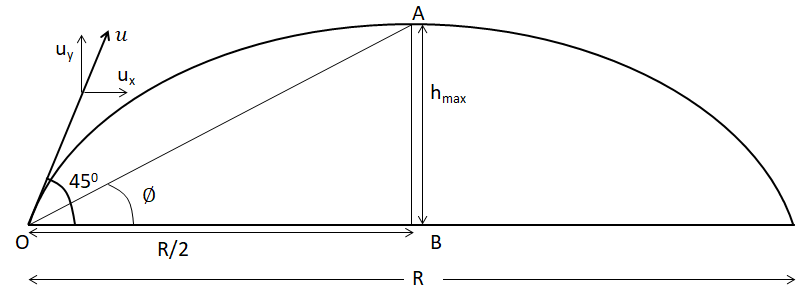
The initial velocity of the projectile is (u) making an angle of $\theta ={{45}^{0}}$with the horizontal. We will break the initial velocity (u) into the horizontal component given by: ${{u}_{x}}=u\sin \theta =u\sin {{45}^{0}}=\dfrac{u}{\sqrt{2}}$. Similarly, the vertical component of the initial velocity (u) is given by: ${{u}_{y}}=u\cos \theta =u\cos {{45}^{0}}=\dfrac{u}{\sqrt{2}}$.
To find the maximum height of the projectile, we will consider the newton’s laws of motion in two dimension: ${{h}_{\max }}=\dfrac{v_{y}^{2}-u_{y}^{2}}{2g}$. At the maximum height of the projectile motion, the final velocity of the body along the vertical will be zero and the acceleration due to gravity will be (-g), since it is against the direction of the motion. Therefore: ${{h}_{\max }}=\dfrac{v_{y}^{2}-u_{y}^{2}}{2g}\Rightarrow {{h}_{\max }}=\dfrac{(0)_{{}}^{2}-(\dfrac{u}{\sqrt{2}})_{{}}^{2}}{2(-g)}\Rightarrow {{h}_{\max }}=\dfrac{{{u}^{2}}}{4g}$.
Similarly, we will find the time of flight of the projectile motion. To find the time (T=2t), we will use the formula: ${{v}_{y}}={{u}_{y}}+(-g)t$. Putting in the initial and final values of the vertical velocity we find: ${{v}_{y}}={{u}_{y}}+(-g)t\Rightarrow 0=\dfrac{u}{\sqrt{2}}-gt\Rightarrow t=\dfrac{u}{g\sqrt{2}}$. Hence, $T=2t=\dfrac{u\sqrt{2}}{g}$
Using this value of the time of flight (t), we will find the horizontal range (R) of the projectile motion, which is the horizontal distance travelled by the projectile.
$\therefore R={{u}_{x}}t+\dfrac{1}{2}a{{T}^{2}}$. However, since no horizontal acceleration acts on the projectile, hence a=0.
Therefore the value of R becomes, $R={{u}_{x}}t+\dfrac{1}{2}a{{T}^{2}}\Rightarrow R=\dfrac{u}{\sqrt{2}}(\dfrac{\sqrt{2}u}{g})+\dfrac{1}{2}(0){{t}^{2}}\Rightarrow R=\dfrac{{{u}^{2}}}{g}$.
The base of the right angled triangle OAB is $\dfrac{R}{2}$, which is: $\dfrac{R}{2}=\dfrac{{{u}^{2}}}{2g}$.
Hence, to find the angle of elevation at the highest point, from the point of projection, we will find$\tan \phi $. That is, $\tan \phi =\dfrac{{{h}_{\max }}}{\dfrac{R}{2}}\Rightarrow \tan \phi =\dfrac{\dfrac{{{u}^{2}}}{4g}}{\dfrac{{{u}^{2}}}{2g}}\Rightarrow \tan \phi =\dfrac{{{u}^{2}}}{4g}\times \dfrac{2g}{{{u}^{2}}}\Rightarrow \tan \phi =\dfrac{1}{2}\Rightarrow \phi ={{\tan }^{-1}}(\dfrac{1}{2})$.
Hence, Option B is the solution.
Note: The value of the total time of flight is given by (T). This value is equal to 2t, because (t) is the amount of time taken by the projectile to reach the maximum height, hence that is half the total time of flight. Upon reaching the highest point, it takes an equal amount of time (t) to reach the ground. Hence, the total time of flight is (T).
Step by step solution:
Let’s start by making a detailed diagram of projectile motion given in the problem.
The initial velocity of the projectile is (u) making an angle of $\theta ={{45}^{0}}$with the horizontal. We will break the initial velocity (u) into the horizontal component given by: ${{u}_{x}}=u\sin \theta =u\sin {{45}^{0}}=\dfrac{u}{\sqrt{2}}$. Similarly, the vertical component of the initial velocity (u) is given by: ${{u}_{y}}=u\cos \theta =u\cos {{45}^{0}}=\dfrac{u}{\sqrt{2}}$.
To find the maximum height of the projectile, we will consider the newton’s laws of motion in two dimension: ${{h}_{\max }}=\dfrac{v_{y}^{2}-u_{y}^{2}}{2g}$. At the maximum height of the projectile motion, the final velocity of the body along the vertical will be zero and the acceleration due to gravity will be (-g), since it is against the direction of the motion. Therefore: ${{h}_{\max }}=\dfrac{v_{y}^{2}-u_{y}^{2}}{2g}\Rightarrow {{h}_{\max }}=\dfrac{(0)_{{}}^{2}-(\dfrac{u}{\sqrt{2}})_{{}}^{2}}{2(-g)}\Rightarrow {{h}_{\max }}=\dfrac{{{u}^{2}}}{4g}$.
Similarly, we will find the time of flight of the projectile motion. To find the time (T=2t), we will use the formula: ${{v}_{y}}={{u}_{y}}+(-g)t$. Putting in the initial and final values of the vertical velocity we find: ${{v}_{y}}={{u}_{y}}+(-g)t\Rightarrow 0=\dfrac{u}{\sqrt{2}}-gt\Rightarrow t=\dfrac{u}{g\sqrt{2}}$. Hence, $T=2t=\dfrac{u\sqrt{2}}{g}$
Using this value of the time of flight (t), we will find the horizontal range (R) of the projectile motion, which is the horizontal distance travelled by the projectile.
$\therefore R={{u}_{x}}t+\dfrac{1}{2}a{{T}^{2}}$. However, since no horizontal acceleration acts on the projectile, hence a=0.
Therefore the value of R becomes, $R={{u}_{x}}t+\dfrac{1}{2}a{{T}^{2}}\Rightarrow R=\dfrac{u}{\sqrt{2}}(\dfrac{\sqrt{2}u}{g})+\dfrac{1}{2}(0){{t}^{2}}\Rightarrow R=\dfrac{{{u}^{2}}}{g}$.
The base of the right angled triangle OAB is $\dfrac{R}{2}$, which is: $\dfrac{R}{2}=\dfrac{{{u}^{2}}}{2g}$.
Hence, to find the angle of elevation at the highest point, from the point of projection, we will find$\tan \phi $. That is, $\tan \phi =\dfrac{{{h}_{\max }}}{\dfrac{R}{2}}\Rightarrow \tan \phi =\dfrac{\dfrac{{{u}^{2}}}{4g}}{\dfrac{{{u}^{2}}}{2g}}\Rightarrow \tan \phi =\dfrac{{{u}^{2}}}{4g}\times \dfrac{2g}{{{u}^{2}}}\Rightarrow \tan \phi =\dfrac{1}{2}\Rightarrow \phi ={{\tan }^{-1}}(\dfrac{1}{2})$.
Hence, Option B is the solution.
Note: The value of the total time of flight is given by (T). This value is equal to 2t, because (t) is the amount of time taken by the projectile to reach the maximum height, hence that is half the total time of flight. Upon reaching the highest point, it takes an equal amount of time (t) to reach the ground. Hence, the total time of flight is (T).
Recently Updated Pages
If x a + bt + ct2 where x is in meters and t is in class 11 physics CBSE

A car covers the first half distance between two places class 11 physics CBSE
The resultant of two vectors overrightarrow P and overrightarrow class 11 physics CBSE
Find the value of cos 135 class 11 maths CBSE
A mass M is held in place by an applied force F and class 11 physics CBSE
A solution of glucose in water is labelled as 10 dfracwv class 11 chemistry CBSE
Trending doubts
Find the value of the expression given below sin 30circ class 11 maths CBSE
What is the maximum height of a projectile class 11 physics CBSE
Derive an expression for maximum height and range of class 11 physics CBSE
Describe various types of epithelial tissues with the class 11 biology CBSE
Lysosomes are known as suicidal bags of cell why class 11 biology CBSE
State and derive law of conservation of momentum class 11 physics CBSE