




A potential barrier of 0.5 V exists across a p-n junction (i) If the depletion region is $5\times {{10}^{-7}}$ m wide. What is the average intensity of the electric field in the region? (ii) An electron with speed $5\times {{10}^{5}}m/s$ approaches the p-n junction from the n-side with what speed will it enter the p-side?
Answer
 Verified
642k+ views
Hint: speed of electron will decrease because when electron enters the p – side from n – side, it crosses a barrier and so its speed decreases. To calculate the final velocity of an electron in the p- side, just apply kinetic energy balance or do conservation of energy.
Complete step by step answer:
Average intensity of the electric field
given data,
d = $5\times {{10}^{-7}}$m
$\begin{align}
& \overrightarrow{E}=\dfrac{v}{d} \\
& \overrightarrow{E}=\dfrac{0.5V}{5\times {{10}^{-7}}} \\
& \overrightarrow{E}={{10}^{6}}v/m \\
\end{align}$
Here, $\overrightarrow{E}$= average intensity of the electric field
V = potential
d = depletion width
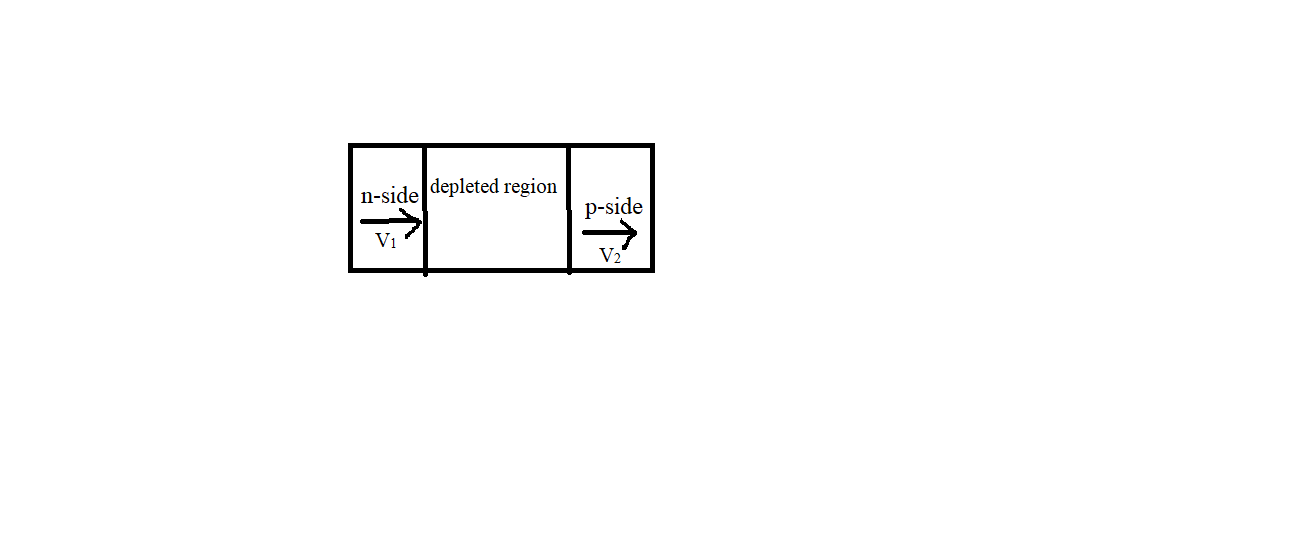
Given data
Speed of electron $5\times {{10}^{5}}m/s$ in n-side
Mass of electron =\[9.1\times {{10}^{-31}}\] kg
Applying conservation of energy
Kinetic energy before entering = ev + Kinetic energy after reaching p-side
\[\begin{align}
& \dfrac{1}{2}mv_{1}^{2}=ev+\dfrac{1}{2}mv_{2}^{2} \\
& \dfrac{1}{2}(9.1\times {{10}^{-31}}){{(5\times {{10}^{5}})}^{2}}=(1.5\times {{10}^{-19}})0.5+\dfrac{1}{2}(9.1\times {{10}^{-31}})v_{2}^{2} \\
& \dfrac{1}{2}(9.1\times {{10}^{-31}})v_{2}^{2}=\dfrac{1}{2}(9.1\times {{10}^{-31}}){{(5\times {{10}^{5}})}^{2}}-(1.5\times {{10}^{-19}})0.5 \\
& v_{2}^{2}=7.2\times {{10}^{10}} \\
& {{v}_{2}}=\sqrt{7.2\times {{10}^{10}}} \\
& {{v}_{2}}=2.68\times {{10}^{5}}m/s \\
\end{align}\]
Note: Conservation of energy, conservation of momentum and conservation of mass are very important laws in physics. Always apply this whenever required. Conservation of mass is called continuity equation and conservation of energy is known as Bernoulli’s principle.
Complete step by step answer:
Average intensity of the electric field
given data,
d = $5\times {{10}^{-7}}$m
$\begin{align}
& \overrightarrow{E}=\dfrac{v}{d} \\
& \overrightarrow{E}=\dfrac{0.5V}{5\times {{10}^{-7}}} \\
& \overrightarrow{E}={{10}^{6}}v/m \\
\end{align}$
Here, $\overrightarrow{E}$= average intensity of the electric field
V = potential
d = depletion width
Given data
Speed of electron $5\times {{10}^{5}}m/s$ in n-side
Mass of electron =\[9.1\times {{10}^{-31}}\] kg
Applying conservation of energy
Kinetic energy before entering = ev + Kinetic energy after reaching p-side
\[\begin{align}
& \dfrac{1}{2}mv_{1}^{2}=ev+\dfrac{1}{2}mv_{2}^{2} \\
& \dfrac{1}{2}(9.1\times {{10}^{-31}}){{(5\times {{10}^{5}})}^{2}}=(1.5\times {{10}^{-19}})0.5+\dfrac{1}{2}(9.1\times {{10}^{-31}})v_{2}^{2} \\
& \dfrac{1}{2}(9.1\times {{10}^{-31}})v_{2}^{2}=\dfrac{1}{2}(9.1\times {{10}^{-31}}){{(5\times {{10}^{5}})}^{2}}-(1.5\times {{10}^{-19}})0.5 \\
& v_{2}^{2}=7.2\times {{10}^{10}} \\
& {{v}_{2}}=\sqrt{7.2\times {{10}^{10}}} \\
& {{v}_{2}}=2.68\times {{10}^{5}}m/s \\
\end{align}\]
Note: Conservation of energy, conservation of momentum and conservation of mass are very important laws in physics. Always apply this whenever required. Conservation of mass is called continuity equation and conservation of energy is known as Bernoulli’s principle.
Recently Updated Pages
Master Class 12 Economics: Engaging Questions & Answers for Success

Master Class 12 English: Engaging Questions & Answers for Success
Master Class 12 Social Science: Engaging Questions & Answers for Success
Master Class 12 Maths: Engaging Questions & Answers for Success
Master Class 12 Physics: Engaging Questions & Answers for Success
Master Class 9 General Knowledge: Engaging Questions & Answers for Success
Trending doubts
Which are the Top 10 Largest Countries of the World?
Draw a labelled sketch of the human eye class 12 physics CBSE
Differentiate between homogeneous and heterogeneous class 12 chemistry CBSE
Why is the cell called the structural and functional class 12 biology CBSE
Draw ray diagrams each showing i myopic eye and ii class 12 physics CBSE
Which is the correct genotypic ratio of mendel dihybrid class 12 biology CBSE