




A pole is slightly inclined towards the east. At two points due west of it at distances $a\,\,and\,\,b$, the angle of elevation of the top of the pole are \[\alpha \,\,and\,\,\beta \] respectively. The inclination of the pole to the horizon is:
A. ${\tan ^{ - 1}}\left[ {\dfrac{{a + b}}{{b\cot \alpha - \cot \beta }}} \right]$
B. ${\tan ^{ - 1}}\left[ {\dfrac{{b - a}}{{b\cot \alpha - acot\beta }}} \right]$
C. ${\cos ^{ - 1}}\left[ {\dfrac{{a - b}}{{b\cos \alpha - \cos \beta }}} \right]$
D. ${\sin ^{ - 1}}\left[ {\dfrac{{a - b}}{{b\cot \alpha - a\cot \beta }}} \right]$
Answer
 Verified
637.8k+ views
Hint: Firstly, we will make a diagram according to the information in the question. Thereafter, we will solve and find the value of $c$and $h$, then find the inclined angle to get the answer.
Complete step-by-step answer:
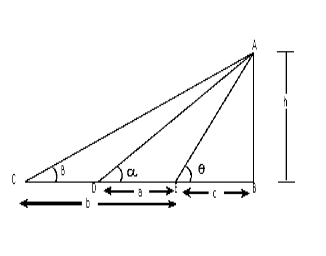
Let $AB$ be a pole $C\,\,and\,\,D$ are the points from where it is observed.
Let $AB = h,\,\,BE = c$
Here, $ED = a\,\,and\,\,EC = b$
Now, in$\Delta ABD,\,\,at\,\,\angle B = {90^o}$, by using trigonometric ratio, we have
$
tan\alpha = \dfrac{{AB}}{{BD}} \\
\tan \alpha = \dfrac{{AB}}{{BE + ED}} \\
$
We will substitute the value of $AB = h,\,\,BE = c$and $ED = a\,$,we have
$\tan \alpha = \dfrac{h}{{a + c}}$
\[(a + C)\tan \alpha = h\] …..(i)
Similarly, in $\Delta ABC,\,\,at\,\,\angle \beta = {90^{}}O$, so by using trigonometric ratio we have
$
tan\beta = \dfrac{{AB}}{{BC}} \\
\tan \beta = \dfrac{{AB}}{{BE + EC}} \\
$
We will substitute the value of $AB = h,\,\,BE = c$and $EC = b$,we have
$\tan \beta = \dfrac{h}{{c + b}}$
\[(b + c)\tan \beta = h\] ……(ii)
Now, from equation (i) and (ii), we have
$(a + c)\tan \alpha = (b + c)\tan \beta $
$a\tan \alpha + c\tan \alpha = b\tan \beta + c\tan \beta $
$a\tan \alpha - b\tan \beta = c\tan \beta - c\tan \alpha $
$a\tan \alpha - b\tan \beta = c(\tan \beta - \tan \alpha )$
$ \Rightarrow c = \dfrac{{a\tan \alpha - b\tan \beta }}{{\tan \beta - \tan \alpha }}$ …….(iii)
Now, we will substitute the value of $c$in equation (i), we have
$h = a\tan \alpha + c\tan \alpha $
\[h = \dfrac{{a\tan \alpha }}{1} + \tan \alpha \left( {\dfrac{{a\tan \alpha - b\tan \beta }}{{\tan \beta - \tan \alpha }}} \right)\]
Now, we will take LCM $\tan \beta - \tan \alpha ,$we have
$h = \dfrac{{a\tan \alpha (\tan \beta - \tan \alpha ) + \tan \alpha (a\tan \alpha - b\tan \beta )}}{{\tan \beta - \tan \alpha }}$
$h = \dfrac{{a\tan \alpha \tan \beta - a{{\tan }^2}\alpha + a{{\tan }^2}\alpha - b\tan \alpha \tan \beta }}{{\tan \beta - \tan \alpha }}$
$h = \dfrac{{a\tan \alpha \tan \beta - b\tan \alpha \tan \beta }}{{\tan \beta - \tan \alpha }}$
$h = \dfrac{{a\tan \alpha \tan \beta - b\tan \alpha \tan \beta }}{{\tan \beta - \tan \alpha }}$
Take $\tan \alpha \tan \beta $ common in the numerator, we have
$h = \dfrac{{\tan \alpha \tan \beta (a - b)}}{{\tan \beta - \tan \alpha }}$
Now, in $\Delta ABE$
$\tan \theta = \dfrac{{AB}}{{BE}}$
$\tan \theta = \dfrac{h}{c}$ …..(iv)
Now, we will substitute ion value of $h$ and $c$ in equation (iv) , we have
$\tan \theta = \dfrac{{\dfrac{{(a - b)\tan \alpha \tan \beta )}}{{\tan \beta - \tan \alpha }}}}{{\dfrac{{a\tan \alpha - b\tan \beta }}{{\tan \beta - \tan \alpha }}}}$
$\tan \theta = \dfrac{{(a - b)\tan \alpha \tan \beta }}{{\tan \beta - \tan \alpha }} \times \dfrac{{tan\beta - \tan \alpha }}{{a\tan \alpha - b\tan \beta }}$
$\tan \theta = \dfrac{{(a - b)\tan \alpha \tan \beta }}{{(a\tan \alpha - btain\beta )}}$
\[\tan \theta = \dfrac{{ - (b - a)\tan \alpha \tan \beta }}{{ - (b\tan \beta - a\tan \alpha )}}\]
$\tan \theta = \dfrac{{(b - a)\tan \alpha \tan \beta }}{{b\tan \beta - a\tan \alpha }}$
Now, as we know that $\tan \theta = \dfrac{1}{{\cot \theta }}$
$\tan \theta = \dfrac{{(b - a)\dfrac{1}{{\cot \alpha }} \times \dfrac{1}{{\cot \beta }}}}{{\left( {\dfrac{b}{{\cot \beta }} - \dfrac{a}{{\cot \alpha }}} \right)}}$
$ \Rightarrow \tan \theta = \dfrac{{(b - a)\dfrac{1}{{\cot \alpha }} \times \dfrac{1}{{\cot \beta }}}}{{\left( {\dfrac{{b\cot \alpha - a\cot \beta }}{{\cot \beta \times \cot \alpha }}} \right)}}$
$ \Rightarrow \tan \theta = \dfrac{{(b - a)\dfrac{1}{{\cot \alpha }} \times \dfrac{1}{{\cot \beta }} \times \cot \beta \times \cot \alpha }}{{b\cot \alpha - a\cot \beta )}}$
$ \Rightarrow \tan \theta = \dfrac{{(b - a)}}{{b\cot \alpha - a\cot \beta }}$
$ \Rightarrow \theta = {\tan ^{ - 1}}\dfrac{{(b - a)}}{{b\cot \alpha - a\cot \beta }}$
So, the correct answer is “Option B”.
Note: Students remember that when you make an angle of elevation then follow this instruction it will help you. When you see an object above you, there is an angle of elevation between the horizontal and your line of sight to the object.
Complete step-by-step answer:
Let $AB$ be a pole $C\,\,and\,\,D$ are the points from where it is observed.
Let $AB = h,\,\,BE = c$
Here, $ED = a\,\,and\,\,EC = b$
Now, in$\Delta ABD,\,\,at\,\,\angle B = {90^o}$, by using trigonometric ratio, we have
$
tan\alpha = \dfrac{{AB}}{{BD}} \\
\tan \alpha = \dfrac{{AB}}{{BE + ED}} \\
$
We will substitute the value of $AB = h,\,\,BE = c$and $ED = a\,$,we have
$\tan \alpha = \dfrac{h}{{a + c}}$
\[(a + C)\tan \alpha = h\] …..(i)
Similarly, in $\Delta ABC,\,\,at\,\,\angle \beta = {90^{}}O$, so by using trigonometric ratio we have
$
tan\beta = \dfrac{{AB}}{{BC}} \\
\tan \beta = \dfrac{{AB}}{{BE + EC}} \\
$
We will substitute the value of $AB = h,\,\,BE = c$and $EC = b$,we have
$\tan \beta = \dfrac{h}{{c + b}}$
\[(b + c)\tan \beta = h\] ……(ii)
Now, from equation (i) and (ii), we have
$(a + c)\tan \alpha = (b + c)\tan \beta $
$a\tan \alpha + c\tan \alpha = b\tan \beta + c\tan \beta $
$a\tan \alpha - b\tan \beta = c\tan \beta - c\tan \alpha $
$a\tan \alpha - b\tan \beta = c(\tan \beta - \tan \alpha )$
$ \Rightarrow c = \dfrac{{a\tan \alpha - b\tan \beta }}{{\tan \beta - \tan \alpha }}$ …….(iii)
Now, we will substitute the value of $c$in equation (i), we have
$h = a\tan \alpha + c\tan \alpha $
\[h = \dfrac{{a\tan \alpha }}{1} + \tan \alpha \left( {\dfrac{{a\tan \alpha - b\tan \beta }}{{\tan \beta - \tan \alpha }}} \right)\]
Now, we will take LCM $\tan \beta - \tan \alpha ,$we have
$h = \dfrac{{a\tan \alpha (\tan \beta - \tan \alpha ) + \tan \alpha (a\tan \alpha - b\tan \beta )}}{{\tan \beta - \tan \alpha }}$
$h = \dfrac{{a\tan \alpha \tan \beta - a{{\tan }^2}\alpha + a{{\tan }^2}\alpha - b\tan \alpha \tan \beta }}{{\tan \beta - \tan \alpha }}$
$h = \dfrac{{a\tan \alpha \tan \beta - b\tan \alpha \tan \beta }}{{\tan \beta - \tan \alpha }}$
$h = \dfrac{{a\tan \alpha \tan \beta - b\tan \alpha \tan \beta }}{{\tan \beta - \tan \alpha }}$
Take $\tan \alpha \tan \beta $ common in the numerator, we have
$h = \dfrac{{\tan \alpha \tan \beta (a - b)}}{{\tan \beta - \tan \alpha }}$
Now, in $\Delta ABE$
$\tan \theta = \dfrac{{AB}}{{BE}}$
$\tan \theta = \dfrac{h}{c}$ …..(iv)
Now, we will substitute ion value of $h$ and $c$ in equation (iv) , we have
$\tan \theta = \dfrac{{\dfrac{{(a - b)\tan \alpha \tan \beta )}}{{\tan \beta - \tan \alpha }}}}{{\dfrac{{a\tan \alpha - b\tan \beta }}{{\tan \beta - \tan \alpha }}}}$
$\tan \theta = \dfrac{{(a - b)\tan \alpha \tan \beta }}{{\tan \beta - \tan \alpha }} \times \dfrac{{tan\beta - \tan \alpha }}{{a\tan \alpha - b\tan \beta }}$
$\tan \theta = \dfrac{{(a - b)\tan \alpha \tan \beta }}{{(a\tan \alpha - btain\beta )}}$
\[\tan \theta = \dfrac{{ - (b - a)\tan \alpha \tan \beta }}{{ - (b\tan \beta - a\tan \alpha )}}\]
$\tan \theta = \dfrac{{(b - a)\tan \alpha \tan \beta }}{{b\tan \beta - a\tan \alpha }}$
Now, as we know that $\tan \theta = \dfrac{1}{{\cot \theta }}$
$\tan \theta = \dfrac{{(b - a)\dfrac{1}{{\cot \alpha }} \times \dfrac{1}{{\cot \beta }}}}{{\left( {\dfrac{b}{{\cot \beta }} - \dfrac{a}{{\cot \alpha }}} \right)}}$
$ \Rightarrow \tan \theta = \dfrac{{(b - a)\dfrac{1}{{\cot \alpha }} \times \dfrac{1}{{\cot \beta }}}}{{\left( {\dfrac{{b\cot \alpha - a\cot \beta }}{{\cot \beta \times \cot \alpha }}} \right)}}$
$ \Rightarrow \tan \theta = \dfrac{{(b - a)\dfrac{1}{{\cot \alpha }} \times \dfrac{1}{{\cot \beta }} \times \cot \beta \times \cot \alpha }}{{b\cot \alpha - a\cot \beta )}}$
$ \Rightarrow \tan \theta = \dfrac{{(b - a)}}{{b\cot \alpha - a\cot \beta }}$
$ \Rightarrow \theta = {\tan ^{ - 1}}\dfrac{{(b - a)}}{{b\cot \alpha - a\cot \beta }}$
So, the correct answer is “Option B”.
Note: Students remember that when you make an angle of elevation then follow this instruction it will help you. When you see an object above you, there is an angle of elevation between the horizontal and your line of sight to the object.
Recently Updated Pages
Basicity of sulphurous acid and sulphuric acid are

Master Class 11 English: Engaging Questions & Answers for Success
Master Class 11 Physics: Engaging Questions & Answers for Success
Master Class 11 Computer Science: Engaging Questions & Answers for Success
Master Class 11 Chemistry: Engaging Questions & Answers for Success
Master Class 11 Social Science: Engaging Questions & Answers for Success
Trending doubts
Difference Between Prokaryotic Cells and Eukaryotic Cells
Two of the body parts which do not appear in MRI are class 11 biology CBSE
One Metric ton is equal to kg A 10000 B 1000 C 100 class 11 physics CBSE
10 examples of friction in our daily life
Draw a diagram of nephron and explain its structur class 11 biology CBSE
What will happen if the mucus is not secreted by the class 11 biology CBSE