




A pole 6m high casts a shadow of $2\sqrt 3 m$ long on the ground, then the sun’s elevation is?
Answer
 Verified
644.1k+ views
Hint: Draw the diagram according to the description given. Know where exactly is the elevation of the sun. apply $\tan \theta = \dfrac{{{\text{Opposite}}}}{{Adjacent}}$ and find the value of $\theta $ required. Where $\theta $ is the elevation of the sun.
Complete step by step solution:
So we have the height of the pole given as $6m$ high. And the length of the shadow will be as $2\sqrt 3 m$ .
So for solving it we will first draw the figure, in this figure the side $AB$ will be the height and the $BC$ will be the path difference between it.
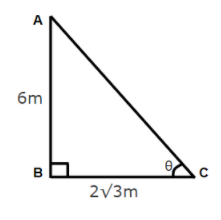
Let us assume that the $\theta $ be the elevation of the sun, so from this by using the formula of it, we get
$ \Rightarrow \tan \theta = \dfrac{{AB}}{{BC}}$
Now on substituting the values, we get
$ \Rightarrow \tan \theta = \dfrac{6}{{2\sqrt 3 }}$
Now on solving the above equation, we get
$ \Rightarrow \tan \theta = \sqrt 3 $
As we know the value of the $\theta $ when it is $\sqrt 3 $ , so we get
$ \Rightarrow \tan \theta = \tan \left( {\dfrac{\pi }{3}} \right)$
On equating this, we get
$ \Rightarrow \theta = \dfrac{\pi }{3}$
And it can also be written in degrees from as ${60^ \circ }$ .
So the ${60^ \circ }$ will be the angle of elevation of sun.
Note:
when asked about the angle of elevation of the sun, the angle is opposite to the vertical heights and when asked about the angle of depression of the sun, the angle is opposite to the distance of the path. So by using this we can solve these types of questions.
Complete step by step solution:
So we have the height of the pole given as $6m$ high. And the length of the shadow will be as $2\sqrt 3 m$ .
So for solving it we will first draw the figure, in this figure the side $AB$ will be the height and the $BC$ will be the path difference between it.
Let us assume that the $\theta $ be the elevation of the sun, so from this by using the formula of it, we get
$ \Rightarrow \tan \theta = \dfrac{{AB}}{{BC}}$
Now on substituting the values, we get
$ \Rightarrow \tan \theta = \dfrac{6}{{2\sqrt 3 }}$
Now on solving the above equation, we get
$ \Rightarrow \tan \theta = \sqrt 3 $
As we know the value of the $\theta $ when it is $\sqrt 3 $ , so we get
$ \Rightarrow \tan \theta = \tan \left( {\dfrac{\pi }{3}} \right)$
On equating this, we get
$ \Rightarrow \theta = \dfrac{\pi }{3}$
And it can also be written in degrees from as ${60^ \circ }$ .
So the ${60^ \circ }$ will be the angle of elevation of sun.
Note:
when asked about the angle of elevation of the sun, the angle is opposite to the vertical heights and when asked about the angle of depression of the sun, the angle is opposite to the distance of the path. So by using this we can solve these types of questions.
Recently Updated Pages
Master Class 10 Computer Science: Engaging Questions & Answers for Success

Differentiate between voluntary action and reflex class 10 biology CBSE
The uses of bleaching powder are A It is used bleaching class 10 chemistry CBSE
Fill in the blanks with abstract nouns of the words class 10 english CBSE
How many threedigit numbers are there class 10 maths CBSE
What is a reflex arc class 10 biology CBSE
Trending doubts
Explain the Treaty of Vienna of 1815 class 10 social science CBSE
10 examples of evaporation in daily life with explanations
Which country is known as "The land of Fire and Ice"?
What is the full form of POSCO class 10 social science CBSE
Make a sketch of the human nerve cell What function class 10 biology CBSE
In which year voting age was reduced from 21 to 18?