




A point on the line x+y = 4, which is at a unit distance from the line 4x+3y = 10 is
[a] (-4,-7)
[b] (-7,11)
[c] (1,-2)
[d] (-1,2)
[e] (4,-7)
Answer
 Verified
619.2k+ views
Hint: Let the point on the line x+y = 4 be P (x,4-x) such that it is at a distance of 1 from 4x+3y = 10. Take any two points on the line 4x+3y=10 say A and B and find the area of the triangle PAB using coordinate geometry. Also, the area of triangle PAB is $\dfrac{1}{2}\times 1\times AB$ since the height of the triangle PAB is 1, and the base is AB. Using distance formulas find the length of AB and hence compare the areas found using two methods. This will give an equation in x. Solve for x to find the coordinates of the point which is at a unit distance from the line.
Complete step-by-step answer:
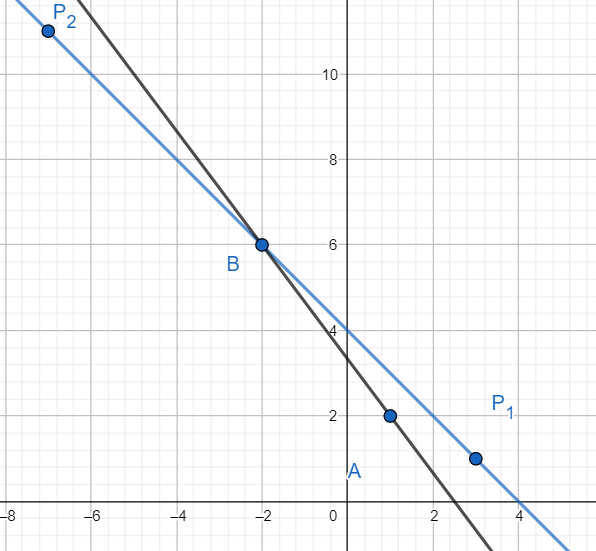
Let P(x,4-x) be at a unit distance of 4x+3y = 10.
Finding two points A and B on 4x+3y = 10:
When x =1, we have
4(1) + 3y = 10
Subtracting 4 on both sides, we get
3y = 6
Dividing both sides by 3, we get
y = 2.
Hence one point is A (1,2)
When x = -2, we have
4(-2) + 3y = 10
Adding 8 on both sides, we get
3y = 18
Dividing both sides by 3, we get
y = 6.
Hence another point is B (-2,6).
Now we know that area of triangle ABC with $A\equiv \left( {{x}_{1}},{{y}_{1}} \right),B\equiv \left( {{x}_{2}},{{y}_{2}} \right)$ and $C\equiv \left( {{x}_{3}},{{y}_{3}} \right)$ is given by
$\dfrac{1}{2}\left| \begin{matrix}
{{x}_{2}}-{{x}_{1}} & {{y}_{2}}-{{y}_{1}} \\
{{x}_{3}}-{{x}_{1}} & {{y}_{3}}-{{y}_{1}} \\
\end{matrix} \right|$
In triangle PAB, we have
${{x}_{1}}=1,{{x}_{2}}=-2,{{x}_{3}}=x,{{y}_{1}}=2,{{y}_{2}}=6$ and ${{y}_{3}}=4-x$
Hence the area of triangle PAB is
\[\begin{align}
& \dfrac{1}{2}\left| \begin{matrix}
-2-1 & 6-2 \\
x-1 & 4-x-2 \\
\end{matrix} \right|=\dfrac{1}{2}\left| \begin{matrix}
-3 & 4 \\
x-1 & 2-x \\
\end{matrix} \right| \\
& =\dfrac{1}{2}\left| -3\left( 2-x \right)-4\left( x-1 \right) \right| \\
& =\dfrac{1}{2}\left| -6+3x-4x+4 \right| \\
& =\dfrac{1}{2}\left| -2-x \right|=\dfrac{\left| x+2 \right|}{2} \\
\end{align}\]
Also by distance formula, AB $=\sqrt{{{\left( -2-1 \right)}^{2}}+{{\left( 6-2 \right)}^{2}}}=\sqrt{9+16}=5$
Now the area of triangle PAB $=\dfrac{1}{2}\times 1\times AB=\dfrac{AB}{2}=\dfrac{5}{2}$
Hence we have
$\begin{align}
& \dfrac{\left| 2+x \right|}{2}=\dfrac{5}{2} \\
& \Rightarrow \left| x+2 \right|=5 \\
\end{align}$
We know that if $\left| x \right|=a,a>0$ then $x=\pm a$
Hence we have
$\begin{align}
& x+2=\pm 5 \\
& \Rightarrow x=3,-7 \\
\end{align}$
When x = 3, we have
$P\equiv \left( 3,4-3 \right)=\left( 3,1 \right)$
When x = -7, we have
$P\equiv \left( -7,4-\left( -7 \right) \right)=\left( -7,11 \right)$
Hence the points on the line x+y = 4 which are at a distance of 1 unit from it are (3,1) and (-7,11).
Hence option [b] is correct.
Note: Alternative solution:
We know that the distance of the point $P\left( {{x}_{1}},{{y}_{1}} \right)$ from the line with equation ax+by+c = 0 is given by
$\dfrac{\left| a{{x}_{1}}+b{{y}_{1}}+c \right|}{\sqrt{{{a}^{2}}+{{b}^{2}}}}$
Hence the distance of P(x,4-x) from 4x+3y-10 = 0 is given by
$\dfrac{\left| 4\left( x \right)+3\left( 4-x \right)-10 \right|}{\sqrt{{{4}^{2}}+{{3}^{2}}}}=\dfrac{\left| x+2 \right|}{5}$
Also, the distance of the point P from the line 4x+3y – 10 = 0 is 1. Hence we have
\[\dfrac{\left| x+2 \right|}{5}=1\Rightarrow \left| x+2 \right|=5\], which is the same equation as obtained above and hence, solving the equation will again give the same answer, (3,1) and (-7,11).
Complete step-by-step answer:
Let P(x,4-x) be at a unit distance of 4x+3y = 10.
Finding two points A and B on 4x+3y = 10:
When x =1, we have
4(1) + 3y = 10
Subtracting 4 on both sides, we get
3y = 6
Dividing both sides by 3, we get
y = 2.
Hence one point is A (1,2)
When x = -2, we have
4(-2) + 3y = 10
Adding 8 on both sides, we get
3y = 18
Dividing both sides by 3, we get
y = 6.
Hence another point is B (-2,6).
Now we know that area of triangle ABC with $A\equiv \left( {{x}_{1}},{{y}_{1}} \right),B\equiv \left( {{x}_{2}},{{y}_{2}} \right)$ and $C\equiv \left( {{x}_{3}},{{y}_{3}} \right)$ is given by
$\dfrac{1}{2}\left| \begin{matrix}
{{x}_{2}}-{{x}_{1}} & {{y}_{2}}-{{y}_{1}} \\
{{x}_{3}}-{{x}_{1}} & {{y}_{3}}-{{y}_{1}} \\
\end{matrix} \right|$
In triangle PAB, we have
${{x}_{1}}=1,{{x}_{2}}=-2,{{x}_{3}}=x,{{y}_{1}}=2,{{y}_{2}}=6$ and ${{y}_{3}}=4-x$
Hence the area of triangle PAB is
\[\begin{align}
& \dfrac{1}{2}\left| \begin{matrix}
-2-1 & 6-2 \\
x-1 & 4-x-2 \\
\end{matrix} \right|=\dfrac{1}{2}\left| \begin{matrix}
-3 & 4 \\
x-1 & 2-x \\
\end{matrix} \right| \\
& =\dfrac{1}{2}\left| -3\left( 2-x \right)-4\left( x-1 \right) \right| \\
& =\dfrac{1}{2}\left| -6+3x-4x+4 \right| \\
& =\dfrac{1}{2}\left| -2-x \right|=\dfrac{\left| x+2 \right|}{2} \\
\end{align}\]
Also by distance formula, AB $=\sqrt{{{\left( -2-1 \right)}^{2}}+{{\left( 6-2 \right)}^{2}}}=\sqrt{9+16}=5$
Now the area of triangle PAB $=\dfrac{1}{2}\times 1\times AB=\dfrac{AB}{2}=\dfrac{5}{2}$
Hence we have
$\begin{align}
& \dfrac{\left| 2+x \right|}{2}=\dfrac{5}{2} \\
& \Rightarrow \left| x+2 \right|=5 \\
\end{align}$
We know that if $\left| x \right|=a,a>0$ then $x=\pm a$
Hence we have
$\begin{align}
& x+2=\pm 5 \\
& \Rightarrow x=3,-7 \\
\end{align}$
When x = 3, we have
$P\equiv \left( 3,4-3 \right)=\left( 3,1 \right)$
When x = -7, we have
$P\equiv \left( -7,4-\left( -7 \right) \right)=\left( -7,11 \right)$
Hence the points on the line x+y = 4 which are at a distance of 1 unit from it are (3,1) and (-7,11).
Hence option [b] is correct.
Note: Alternative solution:
We know that the distance of the point $P\left( {{x}_{1}},{{y}_{1}} \right)$ from the line with equation ax+by+c = 0 is given by
$\dfrac{\left| a{{x}_{1}}+b{{y}_{1}}+c \right|}{\sqrt{{{a}^{2}}+{{b}^{2}}}}$
Hence the distance of P(x,4-x) from 4x+3y-10 = 0 is given by
$\dfrac{\left| 4\left( x \right)+3\left( 4-x \right)-10 \right|}{\sqrt{{{4}^{2}}+{{3}^{2}}}}=\dfrac{\left| x+2 \right|}{5}$
Also, the distance of the point P from the line 4x+3y – 10 = 0 is 1. Hence we have
\[\dfrac{\left| x+2 \right|}{5}=1\Rightarrow \left| x+2 \right|=5\], which is the same equation as obtained above and hence, solving the equation will again give the same answer, (3,1) and (-7,11).
Recently Updated Pages
Basicity of sulphurous acid and sulphuric acid are

Master Class 11 Business Studies: Engaging Questions & Answers for Success
Master Class 11 Computer Science: Engaging Questions & Answers for Success
Master Class 11 Economics: Engaging Questions & Answers for Success
Master Class 11 Social Science: Engaging Questions & Answers for Success
Master Class 11 English: Engaging Questions & Answers for Success
Trending doubts
The largest wind power cluster is located in the state class 11 social science CBSE
Explain zero factorial class 11 maths CBSE
Which among the following are examples of coming together class 11 social science CBSE
Draw a diagram of a plant cell and label at least eight class 11 biology CBSE
A body is said to be in dynamic equilibrium if A When class 11 physics CBSE
List of Hottest and Coldest Planets in the Solar System