




A point object O is placed on the principal axis of a convex lens of focal length f= 20cm at a distance of 40cm to the left of it. The diameter of the lens is 10cm. An eye is placed 60cm to the right of the lens and a distance h below the principal axis. The maximum value of h to see the image is
A. Zero
B. 2.5cm
C. 5cm
D. 10cm
Answer
 Verified
637.5k+ views
Hint: This type of optics questions always utilize the lens formula. Here we can calculate image distance using this formula. Then simple mathematical symmetry of triangles aids us in calculating the value of h.
Formula Used: Lens Formula:
$$\dfrac{1}{f}=\dfrac{1}{v}-\dfrac{1}{u}$$
Where f is the focal length of lens, v is the distance of image from lens and u is the distance of object from lens.
Complete Step-by-Step solution:
While solving optics questions like this, lens formulas always come handy. We have the following values given to us.
f=20cm
u=-40cm
Solving for v using lens formula, we get
$
\dfrac{1}{{20}} = \dfrac{1}{v} - \dfrac{1}{{( - 40)}} \\
\Rightarrow \dfrac{1}{{20}} = \dfrac{1}{v} + \dfrac{1}{{40}} \\
\Rightarrow \dfrac{1}{v} = \dfrac{1}{{20}} - \dfrac{1}{{40}} \\
\Rightarrow \dfrac{1}{v} = \dfrac{{2 - 1}}{{40}} \\
\Rightarrow \dfrac{1}{v} = \dfrac{1}{{40}} \\
\Rightarrow v = 40cm \\
$
This means that the image is formed at the center of curvature. Therefore, we can draw the ray diagram as follows.
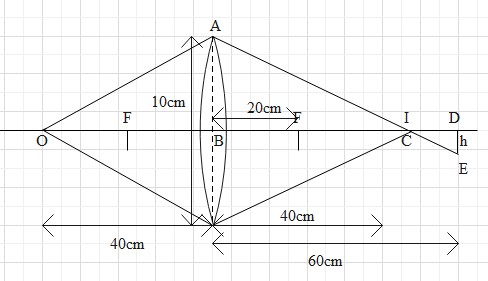
Now in the figure, $\Delta$CED and $\Delta$CAB are symmetric. So we have
$ \dfrac{{AB}}{{DE}} = \dfrac{{BC}}{{DC}} \\
\Rightarrow \dfrac{5}{h} = \dfrac{{40}}{{20}} \\
\Rightarrow \dfrac{5}{h} = 2 \\
\Rightarrow h = \dfrac{5}{2} \\
\Rightarrow h = 2.5cm \\ $
This is the required answer. Hence, the correct option is option B.
Additional Information:
We can also calculate the magnification of an object using the following formula.
$$M = \dfrac{{{h_i}}}{{{h_o}}} = - \dfrac{v}{u}$$
where $h_i$ is the height of the image and $h_o$ is the height of the object.
Note: The student must take care of the convention followed for the signs of various distances. Take care of the negative sign for u and positive sign for v. All distances to the left of the lens are taken as negative whereas all the distances to the right of the lens are taken as positive.
Formula Used: Lens Formula:
$$\dfrac{1}{f}=\dfrac{1}{v}-\dfrac{1}{u}$$
Where f is the focal length of lens, v is the distance of image from lens and u is the distance of object from lens.
Complete Step-by-Step solution:
While solving optics questions like this, lens formulas always come handy. We have the following values given to us.
f=20cm
u=-40cm
Solving for v using lens formula, we get
$
\dfrac{1}{{20}} = \dfrac{1}{v} - \dfrac{1}{{( - 40)}} \\
\Rightarrow \dfrac{1}{{20}} = \dfrac{1}{v} + \dfrac{1}{{40}} \\
\Rightarrow \dfrac{1}{v} = \dfrac{1}{{20}} - \dfrac{1}{{40}} \\
\Rightarrow \dfrac{1}{v} = \dfrac{{2 - 1}}{{40}} \\
\Rightarrow \dfrac{1}{v} = \dfrac{1}{{40}} \\
\Rightarrow v = 40cm \\
$
This means that the image is formed at the center of curvature. Therefore, we can draw the ray diagram as follows.
Now in the figure, $\Delta$CED and $\Delta$CAB are symmetric. So we have
$ \dfrac{{AB}}{{DE}} = \dfrac{{BC}}{{DC}} \\
\Rightarrow \dfrac{5}{h} = \dfrac{{40}}{{20}} \\
\Rightarrow \dfrac{5}{h} = 2 \\
\Rightarrow h = \dfrac{5}{2} \\
\Rightarrow h = 2.5cm \\ $
This is the required answer. Hence, the correct option is option B.
Additional Information:
We can also calculate the magnification of an object using the following formula.
$$M = \dfrac{{{h_i}}}{{{h_o}}} = - \dfrac{v}{u}$$
where $h_i$ is the height of the image and $h_o$ is the height of the object.
Note: The student must take care of the convention followed for the signs of various distances. Take care of the negative sign for u and positive sign for v. All distances to the left of the lens are taken as negative whereas all the distances to the right of the lens are taken as positive.
Recently Updated Pages
Master Class 12 Economics: Engaging Questions & Answers for Success

Master Class 12 English: Engaging Questions & Answers for Success
Master Class 12 Social Science: Engaging Questions & Answers for Success
Master Class 12 Maths: Engaging Questions & Answers for Success
Master Class 12 Physics: Engaging Questions & Answers for Success
Master Class 9 General Knowledge: Engaging Questions & Answers for Success
Trending doubts
The speaker of the Lok Sabha is elected by the APresident class 10 social science CBSE
Complete the sentence with the most appropriate word class 10 english CBSE
a Draw a labelled diagram of a sectional view of the class 10 biology CBSE
What were the majoritarian measures taken in Sri Lanka class 10 social science CBSE
Fill the blanks with proper collective nouns 1 A of class 10 english CBSE
Identify the feminine form of the noun Bachelor a Bachelorette class 10 english CBSE