




A plant with unifoliate leaves is
(a) Balanites
(b) Citrus
(c) Aegle
(d) Paris
Answer
 Verified
624.6k+ views
Hint: Unifoliate refers to plants that have one leaf-like structure present on the tip of the leaf stalk. This leaf-like structure is not actually a leaf but instead a leaflet. This is because the leaflet does not have an axillary bud which a true leaf always does.
Complete Step by Step Answer:
Leaves are of two types i.e. simple and compound on the basis of whether the incision of the leaf touches the midrib. In the compound leaf, the incision touches the midrib and converts the leaf into many tiny leaflets. This compound leaf is of two types which are pinnately and palmately compound leaf. In palmately compound leaf, all the leaflets are attached at a common point which is the tip of the petiole.
Now palmately compound leaf is of many types based on the number of leaflets attached to the petiole.
- If 1 leaflet attached - Unifoliate - Citrus
- If 2 leaflets attached - Bifoliate - Balanites
- If 3 leaflets attached - Trifoliate - Aegle
- If 4 leaflets attached - Quadrifoliate - Paris
- If 5 or more leaflets attached - Multifoliate - Bombax
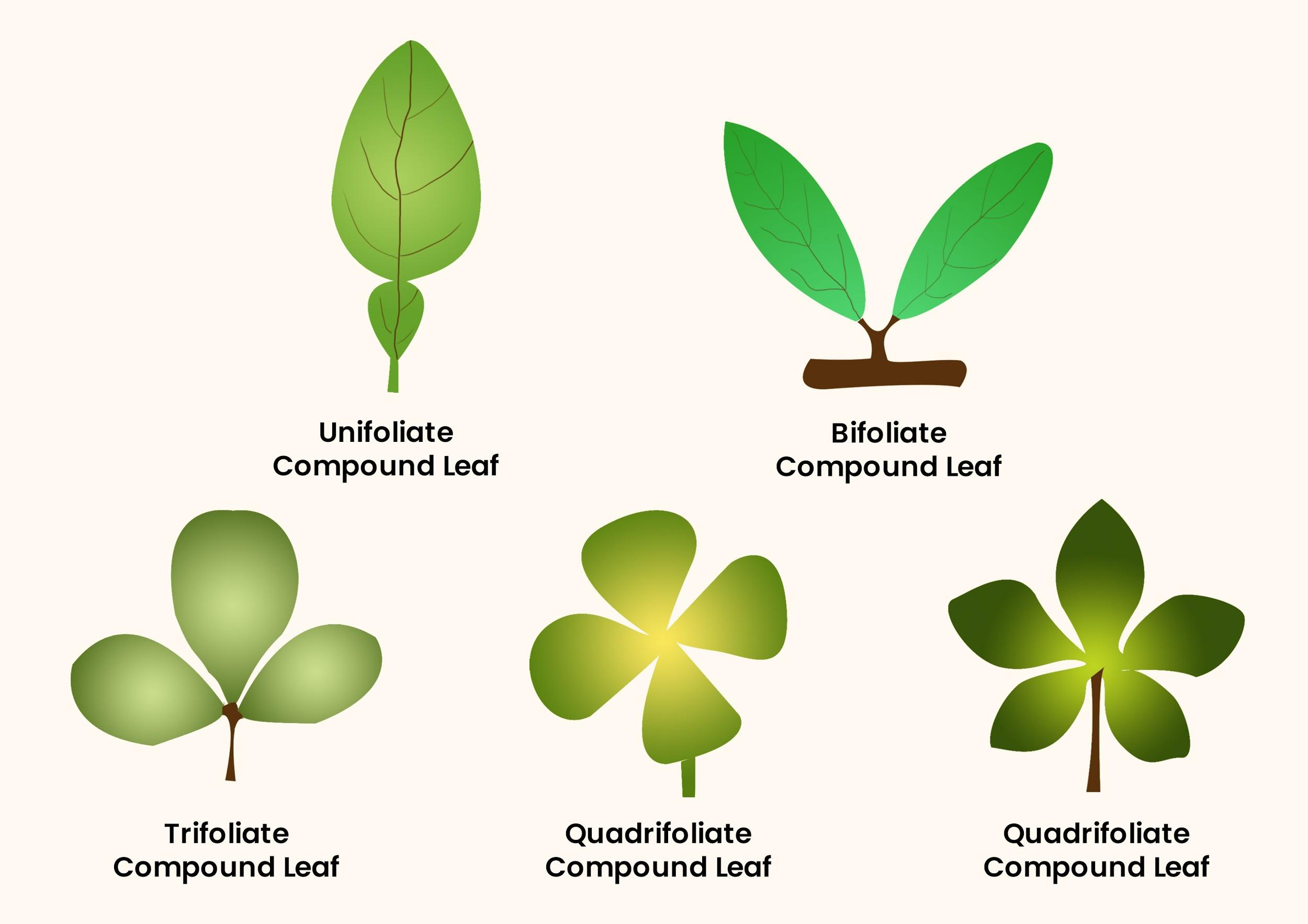
So, the correct option is ‘Citrus’.
Note:
- In a pinnately compound leaf, the leaflets are attached to the midrib which is known as the rachis. Eg: Neem.
- A simple leaf is a leaf that does not have any incisions and even if it does, the incision does not reach the midrib.
- An axillary bud is a bud that grows in between the axil of the leaf and stem and has the potential to become a new flower or a branch.
Complete Step by Step Answer:
Leaves are of two types i.e. simple and compound on the basis of whether the incision of the leaf touches the midrib. In the compound leaf, the incision touches the midrib and converts the leaf into many tiny leaflets. This compound leaf is of two types which are pinnately and palmately compound leaf. In palmately compound leaf, all the leaflets are attached at a common point which is the tip of the petiole.
Now palmately compound leaf is of many types based on the number of leaflets attached to the petiole.
- If 1 leaflet attached - Unifoliate - Citrus
- If 2 leaflets attached - Bifoliate - Balanites
- If 3 leaflets attached - Trifoliate - Aegle
- If 4 leaflets attached - Quadrifoliate - Paris
- If 5 or more leaflets attached - Multifoliate - Bombax
So, the correct option is ‘Citrus’.
Note:
- In a pinnately compound leaf, the leaflets are attached to the midrib which is known as the rachis. Eg: Neem.
- A simple leaf is a leaf that does not have any incisions and even if it does, the incision does not reach the midrib.
- An axillary bud is a bud that grows in between the axil of the leaf and stem and has the potential to become a new flower or a branch.
Recently Updated Pages
The given figure shows two endocrine glands marked class 11 biology NEET_UG

Match columnI with columnII and select the correct class 11 biology NEET
Match column I with column II and select the correct class 11 biology NEET_UG
Which floral family has left 9 right + 1 arrangement class 11 biology NEET_UG
Which is not a variety of sheep A Lohi B Beetal C Nellore class 11 biology NEET_UG
Match column I with column II and select the correct class 11 biology NEET_UG
Trending doubts
One Metric ton is equal to kg A 10000 B 1000 C 100 class 11 physics CBSE
Draw a diagram of a plant cell and label at least eight class 11 biology CBSE
Difference Between Prokaryotic Cells and Eukaryotic Cells
Draw a well labelled diagram of reflex arc and explain class 11 biology CBSE
Two of the body parts which do not appear in MRI are class 11 biology CBSE
1 ton equals to A 100 kg B 1000 kg C 10 kg D 10000 class 11 physics CBSE