




A plano-convex lens, when silvered on the plane side, behaves like a concave mirror of focal length 60cm. However, when silver on the convex side, it behaves like a concave mirror of focal length 20cm. Then, the refractive index of the lens is:
A. 3.0
B. 1.5
C. 1.0
D. 2.0
Answer
 Verified
575.3k+ views
Hint: We can consider the plano-convex lens with plane-side mirrored to act like two lenses. Use the formula for two consecutive lenses to find the effective focal length of the convex part. Then find the Radius of curvature using the second condition. Finally, use the focal length formula of the plano-convex lens to find the final result.
Formula Used:
The effective focal length of a plano-convex or plano-concave or similar mirrors is given by,
$\dfrac{1}{F}=\dfrac{2}{f}+\dfrac{1}{{{f}_{m}}}$.....................(1)
$f$ is the focal length of the first surface
${{f}_{m}}$ is the focal length of the mirrored surface
$F$ is the overall focal length
Focal length formula of the plano-convex lens is given by,
$\dfrac{1}{f}=(\mu -1)\dfrac{1}{R}$....................(2)
Where,
$\mu $ is the refractive index of the lens
$R$ is the Radius of curvature of the curved surface
Complete step-by-step answer:
First, let us look at the first configuration.
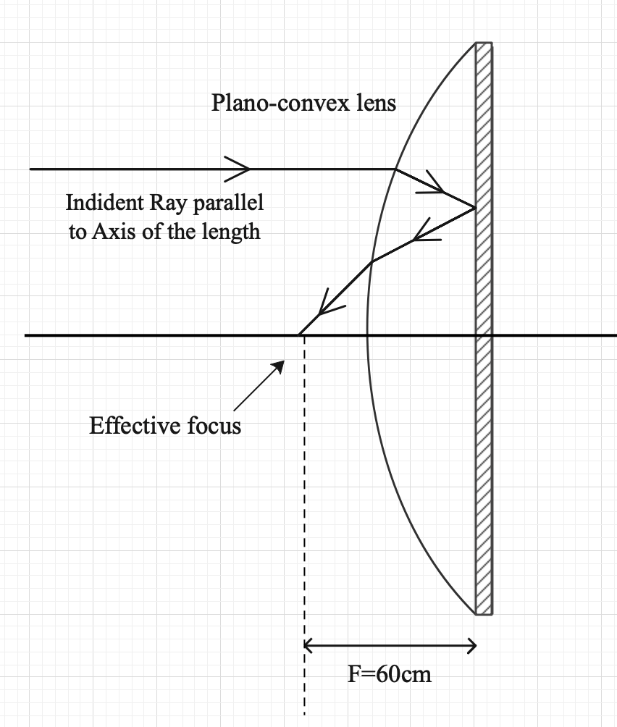
From equation (1) we can write that,
$\dfrac{1}{F}=\dfrac{2}{f}+\dfrac{1}{{{f}_{m}}}$
Given that,
$F=60$
${{f}_{m}}=\infty $ (because the plane surface is mirrored)
So, we write,
$\dfrac{1}{60}=\dfrac{2}{f}+\dfrac{1}{\infty }$
$\Rightarrow f=120$
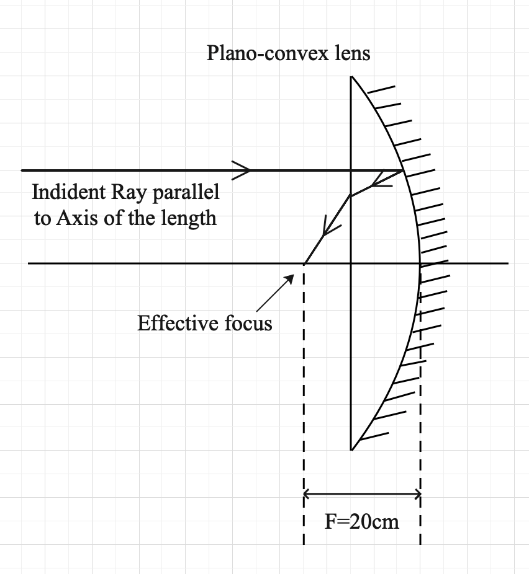
Now, for the second case,
$f=120$
Here, the convex side is mirrored, so
${{f}_{m}}=\dfrac{R}{2}$
And the overall system works like a concave mirror of focal length 20 cm.
Hence,$F=20$
So, we can write,
$\dfrac{1}{20}=\dfrac{2}{120}+\dfrac{2}{R}$
$\Rightarrow \dfrac{2}{R}=\dfrac{1}{20}-\dfrac{1}{60}$
$\Rightarrow R=60$
Hence, R =60cm
So, we can use equation (2) to find the refractive index of the lens. We can write,
$\dfrac{1}{f}=(\mu -1)\times \dfrac{1}{R}$
$\Rightarrow \dfrac{1}{120}=(\mu -1)\times \dfrac{1}{60}$
$\Rightarrow \dfrac{1}{2}=(\mu -1)$
$\Rightarrow \mu =1.5$
Hence, refractive index of the lens =1.5
So, the correct answer is - (B)
Note:
These equations should be memorized for accurate and fast solutions. However, you can follow the ray to find the image due to each refraction and reflection to find the focal length. However, that process is tough and time-consuming.
Formula Used:
The effective focal length of a plano-convex or plano-concave or similar mirrors is given by,
$\dfrac{1}{F}=\dfrac{2}{f}+\dfrac{1}{{{f}_{m}}}$.....................(1)
$f$ is the focal length of the first surface
${{f}_{m}}$ is the focal length of the mirrored surface
$F$ is the overall focal length
Focal length formula of the plano-convex lens is given by,
$\dfrac{1}{f}=(\mu -1)\dfrac{1}{R}$....................(2)
Where,
$\mu $ is the refractive index of the lens
$R$ is the Radius of curvature of the curved surface
Complete step-by-step answer:
First, let us look at the first configuration.
From equation (1) we can write that,
$\dfrac{1}{F}=\dfrac{2}{f}+\dfrac{1}{{{f}_{m}}}$
Given that,
$F=60$
${{f}_{m}}=\infty $ (because the plane surface is mirrored)
So, we write,
$\dfrac{1}{60}=\dfrac{2}{f}+\dfrac{1}{\infty }$
$\Rightarrow f=120$
Now, for the second case,
$f=120$
Here, the convex side is mirrored, so
${{f}_{m}}=\dfrac{R}{2}$
And the overall system works like a concave mirror of focal length 20 cm.
Hence,$F=20$
So, we can write,
$\dfrac{1}{20}=\dfrac{2}{120}+\dfrac{2}{R}$
$\Rightarrow \dfrac{2}{R}=\dfrac{1}{20}-\dfrac{1}{60}$
$\Rightarrow R=60$
Hence, R =60cm
So, we can use equation (2) to find the refractive index of the lens. We can write,
$\dfrac{1}{f}=(\mu -1)\times \dfrac{1}{R}$
$\Rightarrow \dfrac{1}{120}=(\mu -1)\times \dfrac{1}{60}$
$\Rightarrow \dfrac{1}{2}=(\mu -1)$
$\Rightarrow \mu =1.5$
Hence, refractive index of the lens =1.5
So, the correct answer is - (B)
Note:
These equations should be memorized for accurate and fast solutions. However, you can follow the ray to find the image due to each refraction and reflection to find the focal length. However, that process is tough and time-consuming.
Recently Updated Pages
Basicity of sulphurous acid and sulphuric acid are

Master Class 12 Economics: Engaging Questions & Answers for Success
Master Class 12 Biology: Engaging Questions & Answers for Success
Master Class 11 English: Engaging Questions & Answers for Success
Master Class 11 Physics: Engaging Questions & Answers for Success
Master Class 11 Computer Science: Engaging Questions & Answers for Success
Trending doubts
Draw a labelled sketch of the human eye class 12 physics CBSE
The chemical formula of tear gas is A CO Cl 2 B C 10 class 12 chemistry CBSE
Draw ray diagrams each showing i myopic eye and ii class 12 physics CBSE
Which are the Top 10 Largest Countries of the World?
Differentiate between homogeneous and heterogeneous class 12 chemistry CBSE
Which is the correct genotypic ratio of mendel dihybrid class 12 biology CBSE