




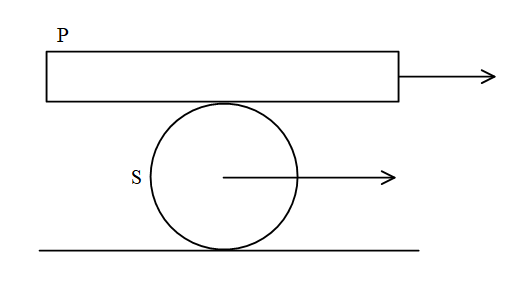
A plank P is placed on a solid cylinder S, which rolls on a horizontal surface. The two are of equal mass. There is no slipping at any surface in contact. The ratio of the kinetic energy of P to the kinetic energy of S is
A) $1:1$
B) $2:1$
C) $8:3$
D) $11:8$
Answer
 Verified
600.6k+ views
Hint: The point of contact of the plank and the solid cylinder has a velocity equal to the product of angular velocity and the distance from the center. There is no relative motion between the cylinder and the ground.
Complete step by step answer:
As it is given that the mass of the cylinder and mass of the plank is equal. The velocity of the plank is given by,
$ \Rightarrow {v_p} = {v_s} + \omega \cdot R$………eq. (1)
As at the point of contact of the cylinder and the plank there is no relative motion therefore,
$ \Rightarrow {v_s} - \omega \cdot R = 0$
\[ \Rightarrow {v_s} = \omega \cdot R\]………eq.(2)
Replace the value of \[\omega \cdot R\] is from the equation (2) into the equation (1).
$ \Rightarrow {v_p} = {v_s} + \omega \cdot R$
$ \Rightarrow {v_p} = {v_s} + {v_s}$
$ \Rightarrow {v_p} = 2{v_s}$
Now let us calculate the kinetic energy of the plank and the solid cylinder respectively.
The kinetic energy of plank is given by,
$ \Rightarrow K.E = \dfrac{1}{2} \cdot {m_p} \cdot {v^2}_p$
$ \Rightarrow K.E = \dfrac{1}{2} \cdot m \cdot {v^2}_p$
As ${v_p} = 2{v_s}$
Therefore,
$ \Rightarrow K.E = \dfrac{1}{2} \cdot m \cdot {\left( {2{v_s}} \right)^2}$
$ \Rightarrow K.E = 4 \cdot \dfrac{1}{2} \cdot m \cdot {v^2}_s$
$ \Rightarrow K.E = 2 \cdot m \cdot {v^2}_s$………eq. (3)
And the kinetic energy of the solid is given by,
$ \Rightarrow K.E = \dfrac{1}{2} \cdot {m_s} \cdot {v^2}_s + \dfrac{1}{2}I{\omega ^2}$
$ \Rightarrow K.E = \dfrac{1}{2} \cdot {m_s} \cdot {v^2}_s + \dfrac{1}{2}I{\omega ^2}$
The moment of inertia is equal to $I = \dfrac{{m{R^2}}}{2}$ let us replace the value of the moment of inertia in the above relation to find the kinetic energy of plank P.
$ \Rightarrow K.E = \dfrac{1}{2} \cdot {m_s} \cdot {v^2}_s + \dfrac{1}{2}I{\omega ^2}$
\[ \Rightarrow K.E = \dfrac{1}{2} \cdot m \cdot {v^2}_s + \dfrac{1}{2} \cdot \left( {\dfrac{{m{R^2}}}{2}} \right){\omega ^2}\]
On simplification,
\[ \Rightarrow K.E = \dfrac{1}{2} \cdot m \cdot {v^2}_s + \dfrac{m}{2} \cdot \left( {\dfrac{{{\omega ^2}{R^2}}}{2}} \right)\]
\[ \Rightarrow K.E = \dfrac{1}{2} \cdot m \cdot {v^2}_s + \dfrac{m}{2} \cdot \left( {\dfrac{{{v^2}_s}}{2}} \right)\]
On further calculations,
\[ \Rightarrow K.E = \dfrac{{m \cdot {v^2}_s}}{2} + \dfrac{{m \cdot {v^2}_s}}{4}\]
\[ \Rightarrow K.E = \dfrac{{2m \cdot {v^2}_s + m \cdot {v^2}_s}}{4}\]
\[ \Rightarrow K.E = \dfrac{{3m \cdot {v^2}_s}}{4}\]………eq. (4)
The ratio of the kinetic energy of the plank to the kinetic energy of the solid cylinder (from equation (3) and (4) )is equal to,
$ \Rightarrow \dfrac{{{{\left( {K.E} \right)}_P}}}{{{{\left( {K.E} \right)}_S}}} = \dfrac{{2m{v_s}^2}}{{\left( {\dfrac{3}{4}} \right) \cdot m{v_s}^2}}$
$ \Rightarrow \dfrac{{{{\left( {K.E} \right)}_P}}}{{{{\left( {K.E} \right)}_S}}} = \dfrac{{2m{v_s}^2}}{{\left( {\dfrac{3}{4}} \right) \cdot m{v_s}^2}}$
On cancelling the common terms,
$ \Rightarrow \dfrac{{{{\left( {K.E} \right)}_P}}}{{{{\left( {K.E} \right)}_S}}} = \dfrac{8}{3}$
Therefore, the ratio of the kinetic energy of the plank and the kinetic energy of the solid cylinder is equal to $\dfrac{{{{\left( {K.E} \right)}_P}}}{{{{\left( {K.E} \right)}_S}}} = \dfrac{8}{3}$. The correct answer for this problem is option C.
Note:
The kinetic energy of a rotation body includes the moment of inertia of the rotating body. So students are advised to remember the moment of inertia of all the standard solids. There is no relative motion between the cylinder and the ground.
Complete step by step answer:
As it is given that the mass of the cylinder and mass of the plank is equal. The velocity of the plank is given by,
$ \Rightarrow {v_p} = {v_s} + \omega \cdot R$………eq. (1)
As at the point of contact of the cylinder and the plank there is no relative motion therefore,
$ \Rightarrow {v_s} - \omega \cdot R = 0$
\[ \Rightarrow {v_s} = \omega \cdot R\]………eq.(2)
Replace the value of \[\omega \cdot R\] is from the equation (2) into the equation (1).
$ \Rightarrow {v_p} = {v_s} + \omega \cdot R$
$ \Rightarrow {v_p} = {v_s} + {v_s}$
$ \Rightarrow {v_p} = 2{v_s}$
Now let us calculate the kinetic energy of the plank and the solid cylinder respectively.
The kinetic energy of plank is given by,
$ \Rightarrow K.E = \dfrac{1}{2} \cdot {m_p} \cdot {v^2}_p$
$ \Rightarrow K.E = \dfrac{1}{2} \cdot m \cdot {v^2}_p$
As ${v_p} = 2{v_s}$
Therefore,
$ \Rightarrow K.E = \dfrac{1}{2} \cdot m \cdot {\left( {2{v_s}} \right)^2}$
$ \Rightarrow K.E = 4 \cdot \dfrac{1}{2} \cdot m \cdot {v^2}_s$
$ \Rightarrow K.E = 2 \cdot m \cdot {v^2}_s$………eq. (3)
And the kinetic energy of the solid is given by,
$ \Rightarrow K.E = \dfrac{1}{2} \cdot {m_s} \cdot {v^2}_s + \dfrac{1}{2}I{\omega ^2}$
$ \Rightarrow K.E = \dfrac{1}{2} \cdot {m_s} \cdot {v^2}_s + \dfrac{1}{2}I{\omega ^2}$
The moment of inertia is equal to $I = \dfrac{{m{R^2}}}{2}$ let us replace the value of the moment of inertia in the above relation to find the kinetic energy of plank P.
$ \Rightarrow K.E = \dfrac{1}{2} \cdot {m_s} \cdot {v^2}_s + \dfrac{1}{2}I{\omega ^2}$
\[ \Rightarrow K.E = \dfrac{1}{2} \cdot m \cdot {v^2}_s + \dfrac{1}{2} \cdot \left( {\dfrac{{m{R^2}}}{2}} \right){\omega ^2}\]
On simplification,
\[ \Rightarrow K.E = \dfrac{1}{2} \cdot m \cdot {v^2}_s + \dfrac{m}{2} \cdot \left( {\dfrac{{{\omega ^2}{R^2}}}{2}} \right)\]
\[ \Rightarrow K.E = \dfrac{1}{2} \cdot m \cdot {v^2}_s + \dfrac{m}{2} \cdot \left( {\dfrac{{{v^2}_s}}{2}} \right)\]
On further calculations,
\[ \Rightarrow K.E = \dfrac{{m \cdot {v^2}_s}}{2} + \dfrac{{m \cdot {v^2}_s}}{4}\]
\[ \Rightarrow K.E = \dfrac{{2m \cdot {v^2}_s + m \cdot {v^2}_s}}{4}\]
\[ \Rightarrow K.E = \dfrac{{3m \cdot {v^2}_s}}{4}\]………eq. (4)
The ratio of the kinetic energy of the plank to the kinetic energy of the solid cylinder (from equation (3) and (4) )is equal to,
$ \Rightarrow \dfrac{{{{\left( {K.E} \right)}_P}}}{{{{\left( {K.E} \right)}_S}}} = \dfrac{{2m{v_s}^2}}{{\left( {\dfrac{3}{4}} \right) \cdot m{v_s}^2}}$
$ \Rightarrow \dfrac{{{{\left( {K.E} \right)}_P}}}{{{{\left( {K.E} \right)}_S}}} = \dfrac{{2m{v_s}^2}}{{\left( {\dfrac{3}{4}} \right) \cdot m{v_s}^2}}$
On cancelling the common terms,
$ \Rightarrow \dfrac{{{{\left( {K.E} \right)}_P}}}{{{{\left( {K.E} \right)}_S}}} = \dfrac{8}{3}$
Therefore, the ratio of the kinetic energy of the plank and the kinetic energy of the solid cylinder is equal to $\dfrac{{{{\left( {K.E} \right)}_P}}}{{{{\left( {K.E} \right)}_S}}} = \dfrac{8}{3}$. The correct answer for this problem is option C.
Note:
The kinetic energy of a rotation body includes the moment of inertia of the rotating body. So students are advised to remember the moment of inertia of all the standard solids. There is no relative motion between the cylinder and the ground.
Recently Updated Pages
Master Class 11 Social Science: Engaging Questions & Answers for Success

Master Class 11 Physics: Engaging Questions & Answers for Success
Master Class 11 Maths: Engaging Questions & Answers for Success
Master Class 11 Economics: Engaging Questions & Answers for Success
Master Class 11 Computer Science: Engaging Questions & Answers for Success
Master Class 11 Chemistry: Engaging Questions & Answers for Success
Trending doubts
One Metric ton is equal to kg A 10000 B 1000 C 100 class 11 physics CBSE
How many bones are in the spine class 11 biology CBSE
1 Quintal is equal to a 110 kg b 10 kg c 100kg d 1000 class 11 physics CBSE
There are 720 permutations of the digits 1 2 3 4 5 class 11 maths CBSE
State and prove Bernoullis theorem class 11 physics CBSE
Difference Between Prokaryotic Cells and Eukaryotic Cells