




A planet is at an average distance $d$ from the sun and the planet's average surface temperature is $T$. Assume that the planet absorbs energy only from the sun and loses energy only through radiation from its surface. Neglect atmospheric effects. If $T$ ∝ ${{d}^{-n}}$, the value of $n$, is:
A. 2
B. 1
C. $\dfrac{1}{2}$
D. $\dfrac{1}{4}$
Answer
 Verified
579.9k+ views
Hint: A body which can absorb all kinds of radiations and emit the same without any hindrance is known as a black body. In the equilibrium state of a body, the absorbed and radiated energy is the same. According to Stefan's Law, the energy radiated by a body per unit area absorbed at temperature T is directly proportional to the 4th power of the thermodynamic temperature.
Formula used: Energy received by the planet is $\dfrac{PA}{{{A}_{s}}}$
The rate of energy radiated by the planet (as it is not a black body) is $u=e\sigma A{{T}^{4}}$
Complete step by step answer:
When a planet orbits around the sun at and center and a radius d. The planet receives curtain energy from the sun.
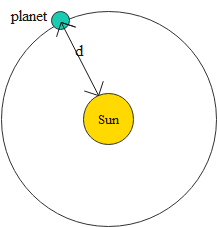
The rate of energy received by the planet is:
$\dfrac{P}{\pi {{d}^{2}}}\pi {{R}^{2}}$
Where, $R$ is the radius of the planet.
$d$ is the distance of the planet from the sun.
$P$ is the power radiated by the sun.
With the reference of Stefan's Law, the rate of energy radiated by the planet is given by;
$\begin{align}
& u=\sigma eA{{T}^{4}} \\
& u=\sigma e(4\pi {{R}^{2}}){{T}^{4}} \\
\end{align}$
Where, $\sigma $ is the constant of proportionality termed as Stefan-Boltzmann constant.
$e$ is emissivity which lies between 0 to 1.
$T$ is the temperature
As per thermal equilibrium or ideal situation, the energy radiated by the planet will be equivalent to e energy received by the planet. Mathematically,
$\begin{align}
& \dfrac{P}{\pi {{d}^{2}}}\pi {{R}^{2}}=\sigma e(4\pi {{R}^{2}}){{T}^{4}} \\
& {{T}^{4}}=\dfrac{P}{\pi {{d}^{2}}\sigma e} \\
\end{align}$
${{T}^{4}}\propto \dfrac{1}{{{d}^{2}}}$ (Because all the other terms are constant)
We can rewrite it as:
${{T}^{4}}\propto {{d}^{-2}}$
So,
$T\propto {{d}^{-\dfrac{1}{2}}}$
By comparing the given proportionally condition of, we can say that:
$n=\dfrac{1}{2}$
So, the correct answer is “Option C”.
Note: Stefan-Boltzmann law specifically describes the relationship between power radiated and the temperature. It is for black bodies. The bodies which are not black bodies do also follow this law but the radiated energy from the body is not equal to the absorbed energy.
Formula used: Energy received by the planet is $\dfrac{PA}{{{A}_{s}}}$
The rate of energy radiated by the planet (as it is not a black body) is $u=e\sigma A{{T}^{4}}$
Complete step by step answer:
When a planet orbits around the sun at and center and a radius d. The planet receives curtain energy from the sun.
The rate of energy received by the planet is:
$\dfrac{P}{\pi {{d}^{2}}}\pi {{R}^{2}}$
Where, $R$ is the radius of the planet.
$d$ is the distance of the planet from the sun.
$P$ is the power radiated by the sun.
With the reference of Stefan's Law, the rate of energy radiated by the planet is given by;
$\begin{align}
& u=\sigma eA{{T}^{4}} \\
& u=\sigma e(4\pi {{R}^{2}}){{T}^{4}} \\
\end{align}$
Where, $\sigma $ is the constant of proportionality termed as Stefan-Boltzmann constant.
$e$ is emissivity which lies between 0 to 1.
$T$ is the temperature
As per thermal equilibrium or ideal situation, the energy radiated by the planet will be equivalent to e energy received by the planet. Mathematically,
$\begin{align}
& \dfrac{P}{\pi {{d}^{2}}}\pi {{R}^{2}}=\sigma e(4\pi {{R}^{2}}){{T}^{4}} \\
& {{T}^{4}}=\dfrac{P}{\pi {{d}^{2}}\sigma e} \\
\end{align}$
${{T}^{4}}\propto \dfrac{1}{{{d}^{2}}}$ (Because all the other terms are constant)
We can rewrite it as:
${{T}^{4}}\propto {{d}^{-2}}$
So,
$T\propto {{d}^{-\dfrac{1}{2}}}$
By comparing the given proportionally condition of, we can say that:
$n=\dfrac{1}{2}$
So, the correct answer is “Option C”.
Note: Stefan-Boltzmann law specifically describes the relationship between power radiated and the temperature. It is for black bodies. The bodies which are not black bodies do also follow this law but the radiated energy from the body is not equal to the absorbed energy.
Recently Updated Pages
Master Class 11 Computer Science: Engaging Questions & Answers for Success

Master Class 11 Business Studies: Engaging Questions & Answers for Success
Master Class 11 Economics: Engaging Questions & Answers for Success
Master Class 11 English: Engaging Questions & Answers for Success
Master Class 11 Maths: Engaging Questions & Answers for Success
Master Class 11 Biology: Engaging Questions & Answers for Success
Trending doubts
One Metric ton is equal to kg A 10000 B 1000 C 100 class 11 physics CBSE
There are 720 permutations of the digits 1 2 3 4 5 class 11 maths CBSE
Discuss the various forms of bacteria class 11 biology CBSE
Draw a diagram of a plant cell and label at least eight class 11 biology CBSE
State the laws of reflection of light
Explain zero factorial class 11 maths CBSE