




A plane progressive wave of frequency 25 Hz, amplitude $2.5 \times {10^{ - 5}}$m and initial phase zero moves along the negative x-direction with a velocity of 300 ${\text{m}}{{\text{s}}^{ - 1}}$. A and B are two points 6 m apart on the line of propagation of the wave. At any instant the phase difference between A and B is $\theta $. Which of the following is true if the maximum difference between the displacement of the particles at A and B is $\Delta $?
(This question has multiple correct options)
$
{\text{A}}{\text{. }}\theta = \pi \\
{\text{B}}{\text{. }}\theta = 0 \\
{\text{C}}{\text{. }}\Delta = 0 \\
{\text{D}}{\text{. }}\Delta = 5 \times {10^{ - 5}}{\text{ m}} \\
$
Answer
 Verified
602.1k+ views
Hint: Here, we will proceed by firstly finding out the value corresponding to the wavelength of the given wave. Then, we will finally use the basic relationship between the phase difference and path difference.
Formula used:
${\text{v}} = \nu \lambda $ and $\theta = \dfrac{{2\pi }}{\lambda }\left( {\Delta x} \right)$.
Complete answer:
Given, Frequency of wave $\nu = 25$ Hz
Amplitude of wave a = $2.5 \times {10^{ - 5}}$ m
Initial phase of wave = 0
Velocity of wave v = 300 ${\text{m}}{{\text{s}}^{ - 1}}$
Path difference of Distance between points A and B $\Delta x$ = 6 m
Phase difference between A and B = $\theta $
As we know that the velocity of any wave is equal to the product of the frequency of the wave and the wavelength of the wave
${\text{v}} = \nu \lambda $ where v is the velocity of the wave, $\nu $ represents the frequency of the wave and $\lambda $ represents the wavelength of the wave
$
\Rightarrow \lambda = \dfrac{{\text{v}}}{\nu } \\
\Rightarrow \lambda = \dfrac{{{\text{300}}}}{{25}} = 12{\text{ m}} \\
$
The wavelength of the given wave is equal to 12 metres
Also we know that the phase difference between any two points can be written as
$\theta = \dfrac{{2\pi }}{\lambda }\left( {\Delta x} \right)$ where $\theta $ denotes the phase difference between the points, $\lambda $ represents the wavelength of the wave and $\Delta x$ denotes the path difference between the points
$ \Rightarrow \theta = \dfrac{{2\pi }}{{12}}\left( 6 \right) = \dfrac{{12\pi }}{{12}} = \pi $
So, the phase difference between the points A and B is $\theta = \pi $ or $\theta = {180^0}$
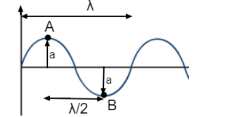
Let the two points A and B having a phase difference of $\pi $ or ${180^0}$ are as shown in the figure.
The maximum difference between the displacements of particles at A and B $\Delta $ = 2(Amplitude) = $2 \times 2.5 \times {10^{ - 5}} = 5 \times {10^{ - 5}}$ m
So, the correct answer is “Option A and D”.
Note:
Amplitude of any wave is defined as the distance between the midline and the crest or the trough of the wave. Amplitude usually signifies the amount of the energy transported by the wave. Wavelength of any wave is defined as the distance between two successive crests or troughs of the wave.
Formula used:
${\text{v}} = \nu \lambda $ and $\theta = \dfrac{{2\pi }}{\lambda }\left( {\Delta x} \right)$.
Complete answer:
Given, Frequency of wave $\nu = 25$ Hz
Amplitude of wave a = $2.5 \times {10^{ - 5}}$ m
Initial phase of wave = 0
Velocity of wave v = 300 ${\text{m}}{{\text{s}}^{ - 1}}$
Path difference of Distance between points A and B $\Delta x$ = 6 m
Phase difference between A and B = $\theta $
As we know that the velocity of any wave is equal to the product of the frequency of the wave and the wavelength of the wave
${\text{v}} = \nu \lambda $ where v is the velocity of the wave, $\nu $ represents the frequency of the wave and $\lambda $ represents the wavelength of the wave
$
\Rightarrow \lambda = \dfrac{{\text{v}}}{\nu } \\
\Rightarrow \lambda = \dfrac{{{\text{300}}}}{{25}} = 12{\text{ m}} \\
$
The wavelength of the given wave is equal to 12 metres
Also we know that the phase difference between any two points can be written as
$\theta = \dfrac{{2\pi }}{\lambda }\left( {\Delta x} \right)$ where $\theta $ denotes the phase difference between the points, $\lambda $ represents the wavelength of the wave and $\Delta x$ denotes the path difference between the points
$ \Rightarrow \theta = \dfrac{{2\pi }}{{12}}\left( 6 \right) = \dfrac{{12\pi }}{{12}} = \pi $
So, the phase difference between the points A and B is $\theta = \pi $ or $\theta = {180^0}$
Let the two points A and B having a phase difference of $\pi $ or ${180^0}$ are as shown in the figure.
The maximum difference between the displacements of particles at A and B $\Delta $ = 2(Amplitude) = $2 \times 2.5 \times {10^{ - 5}} = 5 \times {10^{ - 5}}$ m
So, the correct answer is “Option A and D”.
Note:
Amplitude of any wave is defined as the distance between the midline and the crest or the trough of the wave. Amplitude usually signifies the amount of the energy transported by the wave. Wavelength of any wave is defined as the distance between two successive crests or troughs of the wave.
Recently Updated Pages
Master Class 11 Social Science: Engaging Questions & Answers for Success

Master Class 11 Physics: Engaging Questions & Answers for Success
Master Class 11 Maths: Engaging Questions & Answers for Success
Master Class 11 Economics: Engaging Questions & Answers for Success
Master Class 11 Computer Science: Engaging Questions & Answers for Success
Master Class 11 Chemistry: Engaging Questions & Answers for Success
Trending doubts
One Metric ton is equal to kg A 10000 B 1000 C 100 class 11 physics CBSE
There are 720 permutations of the digits 1 2 3 4 5 class 11 maths CBSE
1 Quintal is equal to a 110 kg b 10 kg c 100kg d 1000 class 11 physics CBSE
State and prove Bernoullis theorem class 11 physics CBSE
Difference Between Prokaryotic Cells and Eukaryotic Cells
Which among the following are examples of coming together class 11 social science CBSE