




A plane mirror of length $8cm$ is moving with speed $3m{{s}^{-1}}$ towards a wall in the situation as shown in the figure. Size of the spot formed on the wall is $\dfrac{32}{x}cm$. Find the value of $x$.
Answer
 Verified
612.9k+ views
Hint: When light falls on a plane mirror, the light gets reflected. Reflection from a plane mirror is in such a way that the angle of incidence is equal to the angle of reflection. From the property of equality of angles in triangles, opposite sides subtended by equal angles of triangles will have equal lengths. Size of the spot is calculated using this principle and is finally equated to $\dfrac{32}{x}cm$, to get the value of $x$.
Complete answer:
We are given that a plane mirror of length $8cm$ is moving with speed $3m{{s}^{-1}}$ towards a wall in the situation as shown in the following figure.
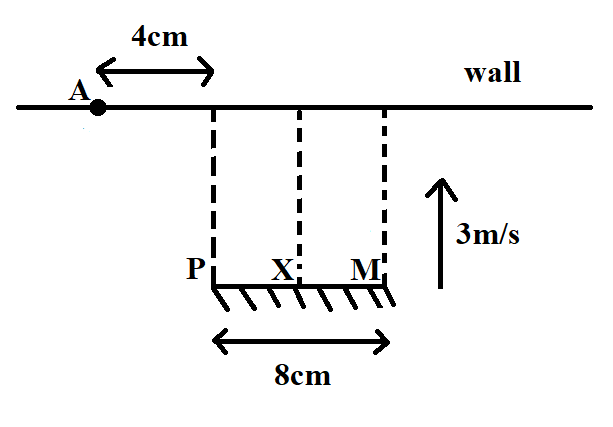
Clearly, the distance of the light source from the wall is $4cm$. We are required to find the size of the spot, projected on the wall, after reflection from the plane mirror.
According to the laws of reflection, the angle of incidence is equal to the angle of reflection. Angle of incidence is nothing but the angle between the incident ray of light source and the perpendicular tangent drawn at the point of incidence on the plane mirror. Similarly, angle of reflection is nothing but the angle between the reflected ray and the perpendicular tangent drawn at the point of reflection. Clearly, point of incidence is equal to point of reflection.
We also know that if two angles of two different triangles are equal, both these angles will subtend equal lengths on the opposite sides of these triangles.
Now, let us apply the law of reflection and the property of equal angles in triangles to each incident ray and its corresponding reflected ray. We consider three points of reflection-the first one being the extreme left point of the plane mirror, the second one being the midpoint of the plane mirror and the third one being the extreme right point of the plane mirror. Clearly, these points are $P,X$ and $M$, respectively, as can be seen from the figure given above.
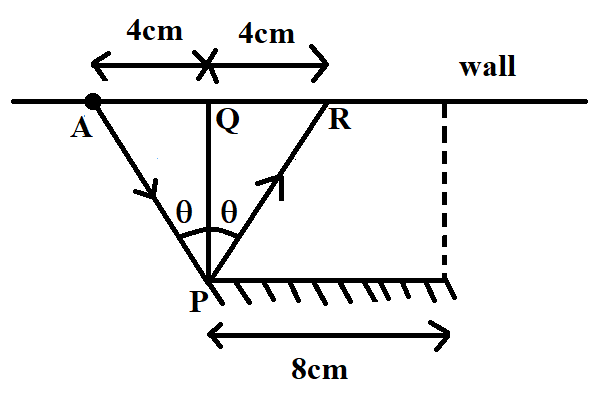
Let us take the case of reflection from point $P$. The incident ray coming from the light source gets reflected and forms a spot on the wall at a distance of $4cm$ from the extended perpendicular tangent, drawn from the point of reflection. This is because the angle of incidence is equal to the angle of reflection. Also, the opposite sides subtended by these angles in triangles $APQ$ and $RPQ$ have equal lengths. Since $AQ=4cm$, it turns out that $QR$ is also equal to $4cm$.
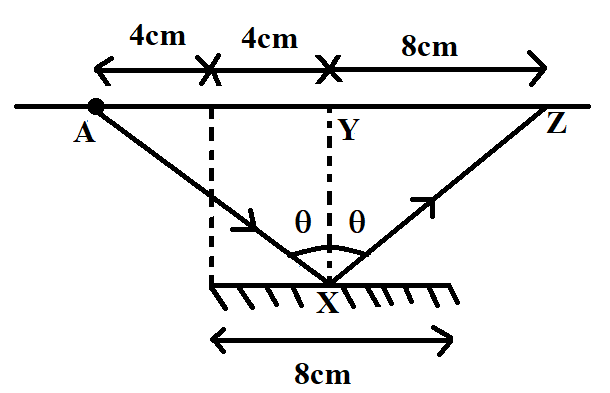
Now, let us take the reflection from point $X$. The incident ray coming from the light source gets reflected and forms a spot on the wall at a distance of $8cm$ from the extended perpendicular tangent, drawn from the point of reflection. This is because the angle of incidence is equal to the angle of reflection. Also, the opposite sides subtended by these angles in triangles $AXY$ and $ZXY$ have equal lengths. Since $AY=8cm$, it turns out that $YZ$ is also equal to $8cm$.
Similarly, let us take the reflection from point $M$. The incident ray coming from the light source gets reflected and forms a spot on the wall at a distance of $12cm$ from the extended perpendicular tangent, drawn from the point of reflection. This is because the angle of incidence is equal to the angle of reflection. Also, the opposite sides subtended by these angles in triangles $AMN$ and $OMN$ have equal lengths. Since $AN=12cm$, it turns out that $NO$ is also equal to $12cm$.
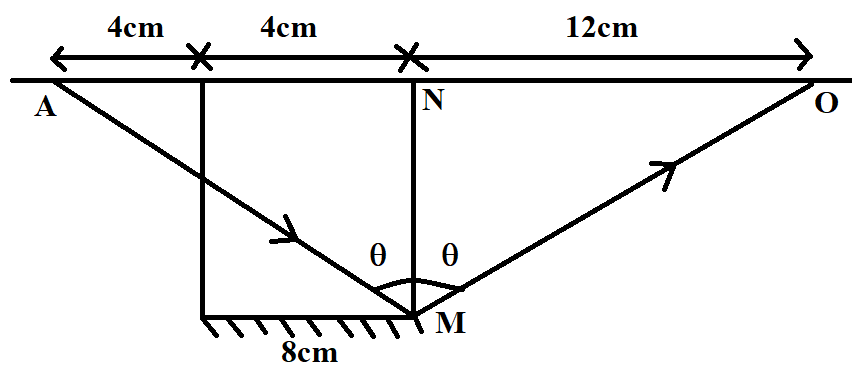
Now, if we combine all these diagrams and observe carefully, we can see that the spot of the light source has a size equal to the length between $Q$ and $O$. Length between $Q$ and $O$ is given by
$QO=24cm-8cm=16cm$
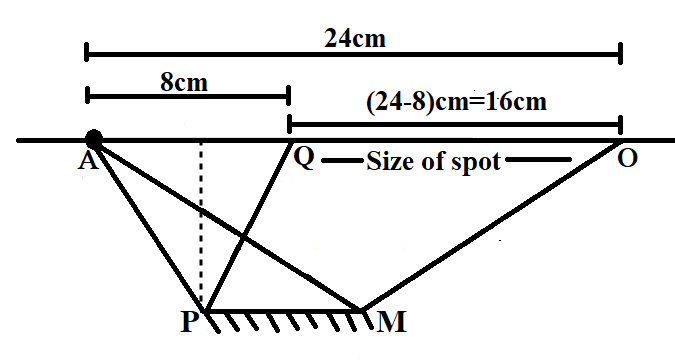
We are given that the size of the spot is equal to $\dfrac{32}{x}cm$.
Equating both the above expressions together, we have
$\dfrac{32cm}{x}=16cm\Rightarrow x=2cm$
Therefore, the value of $x$ is $2$
Note:
While approaching such questions, students need to keep in mind that it is important to draw diagrams. Diagrams can easily figure out distances, as done in the above solution. It is also important to know that the speed of mirror given in the question has nothing to do with the size of the spot, or the value of $x$, in this particular situation. Students need to recognise this at first and avoid further confusions.
Complete answer:
We are given that a plane mirror of length $8cm$ is moving with speed $3m{{s}^{-1}}$ towards a wall in the situation as shown in the following figure.
Clearly, the distance of the light source from the wall is $4cm$. We are required to find the size of the spot, projected on the wall, after reflection from the plane mirror.
According to the laws of reflection, the angle of incidence is equal to the angle of reflection. Angle of incidence is nothing but the angle between the incident ray of light source and the perpendicular tangent drawn at the point of incidence on the plane mirror. Similarly, angle of reflection is nothing but the angle between the reflected ray and the perpendicular tangent drawn at the point of reflection. Clearly, point of incidence is equal to point of reflection.
We also know that if two angles of two different triangles are equal, both these angles will subtend equal lengths on the opposite sides of these triangles.
Now, let us apply the law of reflection and the property of equal angles in triangles to each incident ray and its corresponding reflected ray. We consider three points of reflection-the first one being the extreme left point of the plane mirror, the second one being the midpoint of the plane mirror and the third one being the extreme right point of the plane mirror. Clearly, these points are $P,X$ and $M$, respectively, as can be seen from the figure given above.
Let us take the case of reflection from point $P$. The incident ray coming from the light source gets reflected and forms a spot on the wall at a distance of $4cm$ from the extended perpendicular tangent, drawn from the point of reflection. This is because the angle of incidence is equal to the angle of reflection. Also, the opposite sides subtended by these angles in triangles $APQ$ and $RPQ$ have equal lengths. Since $AQ=4cm$, it turns out that $QR$ is also equal to $4cm$.
Now, let us take the reflection from point $X$. The incident ray coming from the light source gets reflected and forms a spot on the wall at a distance of $8cm$ from the extended perpendicular tangent, drawn from the point of reflection. This is because the angle of incidence is equal to the angle of reflection. Also, the opposite sides subtended by these angles in triangles $AXY$ and $ZXY$ have equal lengths. Since $AY=8cm$, it turns out that $YZ$ is also equal to $8cm$.
Similarly, let us take the reflection from point $M$. The incident ray coming from the light source gets reflected and forms a spot on the wall at a distance of $12cm$ from the extended perpendicular tangent, drawn from the point of reflection. This is because the angle of incidence is equal to the angle of reflection. Also, the opposite sides subtended by these angles in triangles $AMN$ and $OMN$ have equal lengths. Since $AN=12cm$, it turns out that $NO$ is also equal to $12cm$.
Now, if we combine all these diagrams and observe carefully, we can see that the spot of the light source has a size equal to the length between $Q$ and $O$. Length between $Q$ and $O$ is given by
$QO=24cm-8cm=16cm$
We are given that the size of the spot is equal to $\dfrac{32}{x}cm$.
Equating both the above expressions together, we have
$\dfrac{32cm}{x}=16cm\Rightarrow x=2cm$
Therefore, the value of $x$ is $2$
Note:
While approaching such questions, students need to keep in mind that it is important to draw diagrams. Diagrams can easily figure out distances, as done in the above solution. It is also important to know that the speed of mirror given in the question has nothing to do with the size of the spot, or the value of $x$, in this particular situation. Students need to recognise this at first and avoid further confusions.
Recently Updated Pages
Master Class 12 Business Studies: Engaging Questions & Answers for Success

Master Class 12 Biology: Engaging Questions & Answers for Success
Master Class 12 Chemistry: Engaging Questions & Answers for Success
Class 12 Question and Answer - Your Ultimate Solutions Guide
Master Class 11 Social Science: Engaging Questions & Answers for Success
Master Class 11 English: Engaging Questions & Answers for Success
Trending doubts
What is the full form of NDA a National Democratic class 10 social science CBSE
Explain the Treaty of Vienna of 1815 class 10 social science CBSE
Who Won 36 Oscar Awards? Record Holder Revealed
Bharatiya Janata Party was founded in the year A 1979 class 10 social science CBSE
What is the median of the first 10 natural numbers class 10 maths CBSE
Why is it 530 pm in india when it is 1200 afternoon class 10 social science CBSE