




A pilot in an aeroplane observes that Vashi bridge is one side of a plane and Warli sea-link is on the opposite side. The angle of depression of Vashi bridge and Warli sea-link are \[60^\circ \] and \[30^\circ \] respectively. If the aeroplanes is at a height of 5500\[\sqrt 3 \]m at that time. What is the distance between Vashi bridge and Warli sea-link?
Answer
 Verified
677.1k+ views
Hint:- We can take variable x and y as the horizontal distance between the aeroplane and Vashi bridge and Warli sea-link. And then we can use trigonometric identity like \[\tan \theta = \dfrac{{{\text{Perpendicular}}}}{{{\text{Base}}}}\] to find the value of x and y as the angle of depression is given as \[60^\circ \] and \[30^\circ \].
Complete step-by-step answer:
Let us draw the diagram which will make it easy to solve the problem.
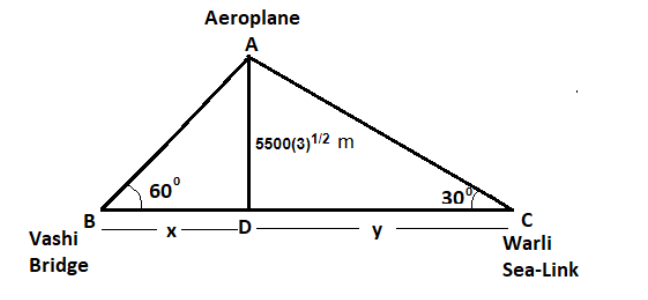
Now as seen from the above diagram Aeroplane is at point A, Vashi bridge is at point B and Warli sea-link is at point C.
So, now we have to find the value of x and y and then the distance between Vashi bridge and Warli sea link will be equal to x + y.
So, now as we know that \[\tan \theta = \dfrac{{{\text{Perpendicular}}}}{{{\text{Base}}}}\] .
So, in triangle ABD, \[\tan 60^\circ = \dfrac{{AD}}{{BD}}\]
As we know that \[\tan 60^\circ = \sqrt 3 \]
So, \[\sqrt 3 = \dfrac{{AD}}{{BD}}\]
Now cross multiplying the above equation.
\[BD = \dfrac{{AD}}{{\sqrt 3 }} = \dfrac{{5500\sqrt 3 }}{{\sqrt 3 }} = 5500\]m
So, x = 5500 metres
In triangle ADC, \[\tan 30^\circ = \dfrac{{AD}}{{DC}}\] and \[\tan 30^\circ = \dfrac{1}{{\sqrt 3 }}\]
So, \[\dfrac{1}{{\sqrt 3 }} = \dfrac{{AD}}{{DC}}\]
Now cross multiplying the above equation.
\[DC = AD\sqrt 3 = \left( {5500\sqrt 3 } \right)\sqrt 3 = 5500 \times 3 = 16500\]m
So, y = 16500 metres
Hence, the distance between Vashi bridge and Warli sea-link will be x + y = 5500 + 16500 = 22000 metres.
Note:- Whenever we come up with this type of problem then there is a trick to find the length of any side (here base) of the triangle if the length of any one side (here height) and one angle is given. Like if the height is given and asked the base length (distance between Vashi bridge and Warli sea-link) then we had to use the identity of \[\tan \theta \] or \[\cot \theta \] because these two identities involve base length and height. And if the hypotenuse of the triangle is given or asked then we have to use \[\sin \theta \] or \[\cos \theta \] because these two involve hypotenuses.
Complete step-by-step answer:
Let us draw the diagram which will make it easy to solve the problem.
Now as seen from the above diagram Aeroplane is at point A, Vashi bridge is at point B and Warli sea-link is at point C.
So, now we have to find the value of x and y and then the distance between Vashi bridge and Warli sea link will be equal to x + y.
So, now as we know that \[\tan \theta = \dfrac{{{\text{Perpendicular}}}}{{{\text{Base}}}}\] .
So, in triangle ABD, \[\tan 60^\circ = \dfrac{{AD}}{{BD}}\]
As we know that \[\tan 60^\circ = \sqrt 3 \]
So, \[\sqrt 3 = \dfrac{{AD}}{{BD}}\]
Now cross multiplying the above equation.
\[BD = \dfrac{{AD}}{{\sqrt 3 }} = \dfrac{{5500\sqrt 3 }}{{\sqrt 3 }} = 5500\]m
So, x = 5500 metres
In triangle ADC, \[\tan 30^\circ = \dfrac{{AD}}{{DC}}\] and \[\tan 30^\circ = \dfrac{1}{{\sqrt 3 }}\]
So, \[\dfrac{1}{{\sqrt 3 }} = \dfrac{{AD}}{{DC}}\]
Now cross multiplying the above equation.
\[DC = AD\sqrt 3 = \left( {5500\sqrt 3 } \right)\sqrt 3 = 5500 \times 3 = 16500\]m
So, y = 16500 metres
Hence, the distance between Vashi bridge and Warli sea-link will be x + y = 5500 + 16500 = 22000 metres.
Note:- Whenever we come up with this type of problem then there is a trick to find the length of any side (here base) of the triangle if the length of any one side (here height) and one angle is given. Like if the height is given and asked the base length (distance between Vashi bridge and Warli sea-link) then we had to use the identity of \[\tan \theta \] or \[\cot \theta \] because these two identities involve base length and height. And if the hypotenuse of the triangle is given or asked then we have to use \[\sin \theta \] or \[\cos \theta \] because these two involve hypotenuses.
Recently Updated Pages
Master Class 10 Computer Science: Engaging Questions & Answers for Success

Differentiate between voluntary action and reflex class 10 biology CBSE
The uses of bleaching powder are A It is used bleaching class 10 chemistry CBSE
Fill in the blanks with abstract nouns of the words class 10 english CBSE
How many threedigit numbers are there class 10 maths CBSE
What is a reflex arc class 10 biology CBSE
Trending doubts
Explain the Treaty of Vienna of 1815 class 10 social science CBSE
10 examples of evaporation in daily life with explanations
What is the full form of POSCO class 10 social science CBSE
Make a sketch of the human nerve cell What function class 10 biology CBSE
GST is a direct or indirect tax?
The sum of all even numbers between 21 and 51 is a class 10 maths CBSE