




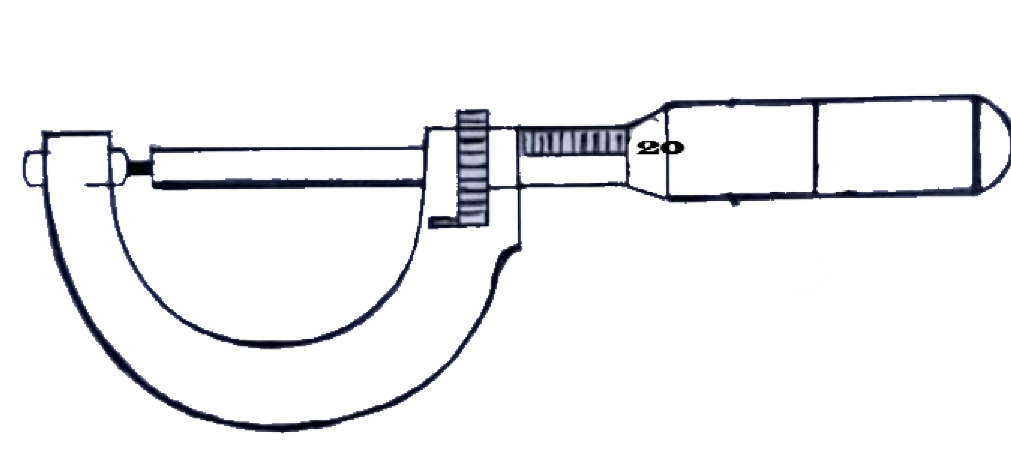
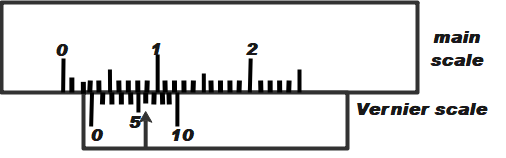
When a piece of wire is diametrically in a screw gauge [pitch = 1 mm, number of divisions on circular scale = 100], the readings obtained are as shown. Now, if we measure the same with help of vernier calliper [1 MSD = 1 mm, 10 divisions of vernier coinciding with 9 divisions of main scale], having a negative zero error of 0.5 mm, then which of the following correctly represents the reading?
A.
B.
C.
D.
Answer
 Verified
569.1k+ views
Hint: In this question, we have been given readings of measurement od diameter of a wire with two different instruments. We have also been given some figures of reading on vernier callipers in options. Therefore, we will first calculate the readings obtained by the screw gauge and then from option select the figure which correctly represents the similar reading on a vernier calliper.
Formula used:
\[R=LSR+(CSR\times LC)\]
\[R=[MSR+(VSR\times LC)]\]
Complete answer:
We know that least count of screw gauge is given by,
\[\dfrac{1mm}{100}=0.01mm\]
Now we know that if zero is on the left side and coincides with the reading on circular scale it is known as positive error. Therefore, from the figure the reading of the screw gauge has positive zero error. We also know that positive zero error is subtracted from the final reading.
Therefore,
\[20\times 0.01=0.2mm=0.02cm\] this should be subtracted from final reading.
We know that final reading of screw gauge is given by,
\[R=LSR+(CSR\times LC)\]
Therefore, after substituting the values
We get,
\[3+(50\times 0.01)=3.5mm\] i.e. 0.35cm
Now, we must subtract the zero error from final reading.
Therefore,
\[R=0.35-0.02=0.33cm\] ………………… (1)
Now, we must find the final reading with zero error for all the images of the vernier calliper.
We know that final reading of vernier calliper is given by,
\[R=[MSR+(VSR\times LC)]\]
Therefore,
For option A,
\[R=[MSR+(VSR\times LC)]+0.05cm\]
After substituting the values from the image given
We get,
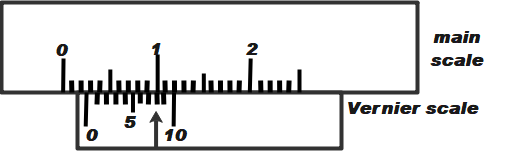
\[R=[0.2+(8\times 0.01)]+0.05=0.33cm\] …………………. (A)
Similarly, for B,
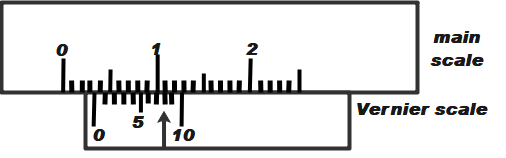
\[R=[0.3+(8\times 0.01)]+0.05=0.43cm\] ……………… (B)
Now, for C,
\[R=[0.2+(10\times 0.01)]+0.05=0.35cm\] ………………….. (C)
And for D,
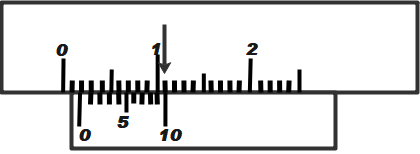
\[R=[0.3+(6\times 0.01)]+0.05=0.41cm\] …………………….. (D)
From 1 and (A) we can say that both reading match.
So, the correct answer is “Option A”.
Note:
A vernier calliper is a measuring instrument which is used to calculate the length of rod, diameter of a sphere or inner and outer radius of a hollow cylinder. A vernier calliper consists of Main scale and sliding vernier scale. The vernier scale allows reading to be accurate by the scale of 0.02 mm. The object to be measured is held in the jaws of the vernier calliper and the reading is taken.
Formula used:
\[R=LSR+(CSR\times LC)\]
\[R=[MSR+(VSR\times LC)]\]
Complete answer:
We know that least count of screw gauge is given by,
\[\dfrac{1mm}{100}=0.01mm\]
Now we know that if zero is on the left side and coincides with the reading on circular scale it is known as positive error. Therefore, from the figure the reading of the screw gauge has positive zero error. We also know that positive zero error is subtracted from the final reading.
Therefore,
\[20\times 0.01=0.2mm=0.02cm\] this should be subtracted from final reading.
We know that final reading of screw gauge is given by,
\[R=LSR+(CSR\times LC)\]
Therefore, after substituting the values
We get,
\[3+(50\times 0.01)=3.5mm\] i.e. 0.35cm
Now, we must subtract the zero error from final reading.
Therefore,
\[R=0.35-0.02=0.33cm\] ………………… (1)
Now, we must find the final reading with zero error for all the images of the vernier calliper.
We know that final reading of vernier calliper is given by,
\[R=[MSR+(VSR\times LC)]\]
Therefore,
For option A,
\[R=[MSR+(VSR\times LC)]+0.05cm\]
After substituting the values from the image given
We get,
\[R=[0.2+(8\times 0.01)]+0.05=0.33cm\] …………………. (A)
Similarly, for B,
\[R=[0.3+(8\times 0.01)]+0.05=0.43cm\] ……………… (B)
Now, for C,
\[R=[0.2+(10\times 0.01)]+0.05=0.35cm\] ………………….. (C)
And for D,
\[R=[0.3+(6\times 0.01)]+0.05=0.41cm\] …………………….. (D)
From 1 and (A) we can say that both reading match.
So, the correct answer is “Option A”.
Note:
A vernier calliper is a measuring instrument which is used to calculate the length of rod, diameter of a sphere or inner and outer radius of a hollow cylinder. A vernier calliper consists of Main scale and sliding vernier scale. The vernier scale allows reading to be accurate by the scale of 0.02 mm. The object to be measured is held in the jaws of the vernier calliper and the reading is taken.
Recently Updated Pages
Master Class 11 Computer Science: Engaging Questions & Answers for Success

Master Class 11 Business Studies: Engaging Questions & Answers for Success
Master Class 11 Economics: Engaging Questions & Answers for Success
Master Class 11 English: Engaging Questions & Answers for Success
Master Class 11 Maths: Engaging Questions & Answers for Success
Master Class 11 Biology: Engaging Questions & Answers for Success
Trending doubts
One Metric ton is equal to kg A 10000 B 1000 C 100 class 11 physics CBSE
There are 720 permutations of the digits 1 2 3 4 5 class 11 maths CBSE
Discuss the various forms of bacteria class 11 biology CBSE
Draw a diagram of a plant cell and label at least eight class 11 biology CBSE
State the laws of reflection of light
Explain zero factorial class 11 maths CBSE