




A piece of ice slides down an $45{}^\circ $incline in twice the time it takes to slide down a frictionless $45{}^\circ $ incline. What is the coefficient of friction between the ice and the incline?
(a) $\mu =2\sin \theta $
(b) $\mu =\dfrac{3}{4\cot \theta }$
(c)$\mu =2.5\cot \theta $
(d)$\mu =\dfrac{1}{4\tan \theta }$
Answer
 Verified
531.9k+ views
Hint: For this type of question, we should have knowledge of free body diagrams and should ask about Newton’s Law. Firstly, we will draw a free body diagram for both frictionless as well as surface having friction and for here, we will pull out the equation for forces acting on the body. After this we will calculate length for both types of surfaces. Now, we will equate all the equations and get the value of the coefficient of friction between the ice and the incline.
Complete step by step answer:
Firstly, we will draw the free body diagram for the frictionless surface,
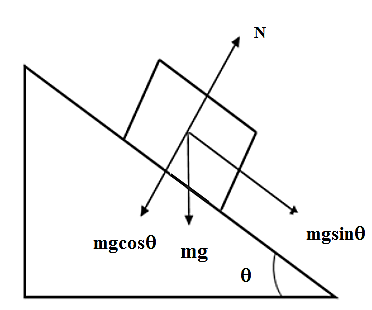
As acceleration is downwards so, from the above figure we can write by applying Newton’s second law as,
$m{{a}_{1}}=mg\sin \theta $
$\therefore {{a}_{1}}=g\sin \theta $ ………………….. (1)
Now, we will draw the free body diagram for the frictional surface,
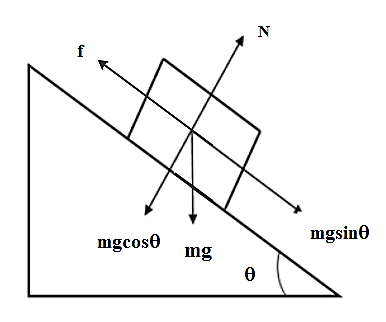
So, from above figure of frictional surface we can write:
$\begin{align}
& N=mg\cos \theta \\
& f=\mu N \\
& \Rightarrow f=\mu mg\cos \theta \\
\end{align}$
Again, by applying Newton’s second law of motion, we can write above equation as:
$m{{a}_{2}}=mg\sin \theta -f$
$\Rightarrow m{{a}_{2}}=mg\sin \theta -\mu mg\cos \theta $
$\Rightarrow {{a}_{2}}=g(sin\theta -\mu \cos \theta )$ …………………………. (2)
Now, we have to calculate the length of inclination for both surfaces:
For frictionless surface,
$\begin{align}
& l=0+\dfrac{1}{2}{{a}_{1}}{{t}_{1}}^{2} \\
& \therefore l=\dfrac{1}{2}{{a}_{1}}{{t}_{1}}^{2} \\
\end{align}$ …………………… (3)
For frictional surface,
$\begin{align}
& l=0+\dfrac{1}{2}{{a}_{2}}{{t}_{2}}^{2} \\
& \therefore l=\dfrac{1}{2}{{a}_{2}}{{t}_{2}}^{2} \\
\end{align}$ ……………………… (4)
As mentioned in the question the relation between time will be –
${{t}_{2}}=2{{t}_{1}}$ ……………………….. (5)
$\Rightarrow $ Dividing equation (3) and equation (4), we get,
$1=\dfrac{{{a}_{1}}{{t}_{1}}^{2}}{{{a}_{2}}{{t}_{2}}^{2}}$
$\Rightarrow {{(\dfrac{{{t}_{2}}}{{{t}_{1}}})}^{2}}=\dfrac{{{a}_{1}}}{{{a}_{2}}}$
Now we will put the value of acceleration for both the surfaces in above equation –
$\begin{align}
& \Rightarrow {{(2)}^{2}}=\dfrac{g\sin \theta }{g(sin\theta -\mu cos\theta )} \\
& \Rightarrow 4(sin\theta -\mu cos\theta )=\sin \theta \\
& \Rightarrow 3\sin \theta =4\mu \cos \theta \\
& \Rightarrow \mu =\dfrac{3}{4}\tan \theta \\
& \therefore \mu =\dfrac{3}{4\cot \theta } \\
\end{align}$
So, the correct answer is “Option b”.
Note: Keep in mind that on a frictionless surface there is no force present to balance the sine component of the mg but on a frictional surface the force present that balances the sine component of the mg acting downward. We must remember Newton’s Laws because while dealing with free body diagrams and force we need to apply it.
Complete step by step answer:
Firstly, we will draw the free body diagram for the frictionless surface,
As acceleration is downwards so, from the above figure we can write by applying Newton’s second law as,
$m{{a}_{1}}=mg\sin \theta $
$\therefore {{a}_{1}}=g\sin \theta $ ………………….. (1)
Now, we will draw the free body diagram for the frictional surface,
So, from above figure of frictional surface we can write:
$\begin{align}
& N=mg\cos \theta \\
& f=\mu N \\
& \Rightarrow f=\mu mg\cos \theta \\
\end{align}$
Again, by applying Newton’s second law of motion, we can write above equation as:
$m{{a}_{2}}=mg\sin \theta -f$
$\Rightarrow m{{a}_{2}}=mg\sin \theta -\mu mg\cos \theta $
$\Rightarrow {{a}_{2}}=g(sin\theta -\mu \cos \theta )$ …………………………. (2)
Now, we have to calculate the length of inclination for both surfaces:
For frictionless surface,
$\begin{align}
& l=0+\dfrac{1}{2}{{a}_{1}}{{t}_{1}}^{2} \\
& \therefore l=\dfrac{1}{2}{{a}_{1}}{{t}_{1}}^{2} \\
\end{align}$ …………………… (3)
For frictional surface,
$\begin{align}
& l=0+\dfrac{1}{2}{{a}_{2}}{{t}_{2}}^{2} \\
& \therefore l=\dfrac{1}{2}{{a}_{2}}{{t}_{2}}^{2} \\
\end{align}$ ……………………… (4)
As mentioned in the question the relation between time will be –
${{t}_{2}}=2{{t}_{1}}$ ……………………….. (5)
$\Rightarrow $ Dividing equation (3) and equation (4), we get,
$1=\dfrac{{{a}_{1}}{{t}_{1}}^{2}}{{{a}_{2}}{{t}_{2}}^{2}}$
$\Rightarrow {{(\dfrac{{{t}_{2}}}{{{t}_{1}}})}^{2}}=\dfrac{{{a}_{1}}}{{{a}_{2}}}$
Now we will put the value of acceleration for both the surfaces in above equation –
$\begin{align}
& \Rightarrow {{(2)}^{2}}=\dfrac{g\sin \theta }{g(sin\theta -\mu cos\theta )} \\
& \Rightarrow 4(sin\theta -\mu cos\theta )=\sin \theta \\
& \Rightarrow 3\sin \theta =4\mu \cos \theta \\
& \Rightarrow \mu =\dfrac{3}{4}\tan \theta \\
& \therefore \mu =\dfrac{3}{4\cot \theta } \\
\end{align}$
So, the correct answer is “Option b”.
Note: Keep in mind that on a frictionless surface there is no force present to balance the sine component of the mg but on a frictional surface the force present that balances the sine component of the mg acting downward. We must remember Newton’s Laws because while dealing with free body diagrams and force we need to apply it.
Recently Updated Pages
Master Class 11 Computer Science: Engaging Questions & Answers for Success

Master Class 11 Business Studies: Engaging Questions & Answers for Success
Master Class 11 Economics: Engaging Questions & Answers for Success
Master Class 11 English: Engaging Questions & Answers for Success
Master Class 11 Maths: Engaging Questions & Answers for Success
Master Class 11 Biology: Engaging Questions & Answers for Success
Trending doubts
One Metric ton is equal to kg A 10000 B 1000 C 100 class 11 physics CBSE
There are 720 permutations of the digits 1 2 3 4 5 class 11 maths CBSE
Discuss the various forms of bacteria class 11 biology CBSE
Draw a diagram of a plant cell and label at least eight class 11 biology CBSE
State the laws of reflection of light
Explain zero factorial class 11 maths CBSE