




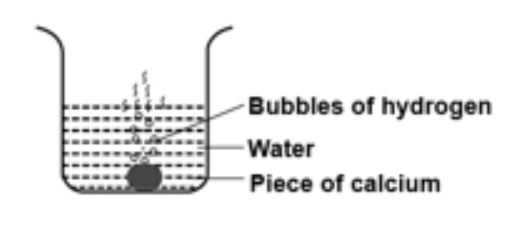
A piece of calcium metal is placed in water. A reaction takes place in which bubbles of hydrogen gas are seen. After the reaction stops, the solution is tested for its colour, temperature and action with litmus solution. Select the correct observation.
A.The solution is hot, milky white and turns red litmus blue
B.The solution is hot, colourless and turns blue litmus red
C.The solution is cold, milky and turns blue litmus red
D.The solution is cold, colourless and does not change the colour of litmus
Answer
 Verified
610.8k+ views
Hint: Calcium is a whitish – silver coloured metal, which belongs to a group on the periodic table, also known as alkaline earth metals. Calcium exists in the form of various stable compounds. But once isolated as just elemental Calcium, it is highly reactive. Especially when it comes to water, calcium reacts vigorously due to its highly reactive nature.
Complete step by step answer:
-Before we move forward with the solution of this question, let us understand a few basic important concepts.
-The reaction of calcium with water results in the formation of 2 products, viz. calcium hydroxide and hydrogen gas. The chemical equation for the reaction between calcium and water is given by:
\[C{a_{(s)}} + {H_2}{O_{(l)}} \to Ca{(OH)_{2(aq)}} + {H_{2(g)}}\]
-The experimental setup that has been given to us states that a piece of calcium metal is placed in water. A reaction takes place in which bubbles of hydrogen gas are seen. After the reaction stops, the solution is tested for its colour, temperature, and action with litmus solution.
-The experimental setup results in the formation of an aqueous solution of Calcium hydroxide. The formation of bonds between the calcium atom and the \[ - OH\] group releases some energy. This results in the heating of the solution. Also, the compound formed is basic in nature. Because of this, it would turn a red litmus paper blue. When this solution reacts with the atmospheric carbon dioxide, the solution turns milky. This gives it the milky white colour.
-Hence, from the above data, we can conclude that the solution is hot, milky white and turns red litmus blue
Hence, Option A is the correct option.
Note:
Calcium hydroxide is an odourless white powder. It is used in industrial settings, such as sewage treatment, paper production, construction, and food processing. It also has medical and dental uses.
Complete step by step answer:
-Before we move forward with the solution of this question, let us understand a few basic important concepts.
-The reaction of calcium with water results in the formation of 2 products, viz. calcium hydroxide and hydrogen gas. The chemical equation for the reaction between calcium and water is given by:
\[C{a_{(s)}} + {H_2}{O_{(l)}} \to Ca{(OH)_{2(aq)}} + {H_{2(g)}}\]
-The experimental setup that has been given to us states that a piece of calcium metal is placed in water. A reaction takes place in which bubbles of hydrogen gas are seen. After the reaction stops, the solution is tested for its colour, temperature, and action with litmus solution.
-The experimental setup results in the formation of an aqueous solution of Calcium hydroxide. The formation of bonds between the calcium atom and the \[ - OH\] group releases some energy. This results in the heating of the solution. Also, the compound formed is basic in nature. Because of this, it would turn a red litmus paper blue. When this solution reacts with the atmospheric carbon dioxide, the solution turns milky. This gives it the milky white colour.
-Hence, from the above data, we can conclude that the solution is hot, milky white and turns red litmus blue
Hence, Option A is the correct option.
Note:
Calcium hydroxide is an odourless white powder. It is used in industrial settings, such as sewage treatment, paper production, construction, and food processing. It also has medical and dental uses.
Recently Updated Pages
Master Class 12 Business Studies: Engaging Questions & Answers for Success

Master Class 12 Biology: Engaging Questions & Answers for Success
Master Class 12 Chemistry: Engaging Questions & Answers for Success
Class 12 Question and Answer - Your Ultimate Solutions Guide
Master Class 11 Social Science: Engaging Questions & Answers for Success
Master Class 11 English: Engaging Questions & Answers for Success
Trending doubts
Explain the Treaty of Vienna of 1815 class 10 social science CBSE
Which Indian city is known as the "City of Victory"?
Which instrument is used to measure the Blood Pressure?
Who Won 36 Oscar Awards? Record Holder Revealed
What is the median of the first 10 natural numbers class 10 maths CBSE
Why is it 530 pm in india when it is 1200 afternoon class 10 social science CBSE