



A picture 40cm by 20cm is to be formed with a frame of width 2cm. Find the area of the picture and the area of frame.
Answer
 Verified
597k+ views
Hint: Use the formula that the area of the rectangle is equal to product of the length and the breadth, $l\times b$ . Using this formula, find the area of the picture. For the frame increase the length and breadth of the picture by 4cm each, as 2cm wide from each end and find the area. Subtract the area of the picture from the area in the previous result to get the area of the frame.
Complete step-by-step answer:
Let us start the solution to the above question by drawing the diagram.
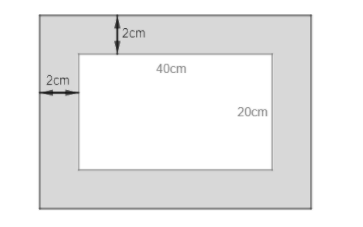
Let us start the solution by finding the area of the picture, which is the unpainted area in the above figure. Also, the length of the picture is 40cm and width is 20cm. Also, we know that the area of the rectangle is equal to the product of the length and the breadth, $l\times b$ .
$\text{Area of the picture}=l\times b=40\times 20=800c{{m}^{2}}$
Now let us move to the area of the frame, for which length is 4cm more than that of the picture, as 2cm wide from each end of the picture. Similar is the case with its breadth. So, length of the frame is 44cm and breadth is 24cm. Also, the area of the picture is to be subtracted from the area of the outer rectangle as the picture area has no part of frame over it.
$\text{Area of the frame}=\text{Area of the outer rectangle}-\text{Area of the inner rectangle}\text{. }$
$\Rightarrow \text{Area of the frame}=l\times b-800.\text{ }$
$\Rightarrow \text{Area of the frame}=44\times 24-800=1056-800=256c{{m}^{2}}\text{. }$
Therefore, the area of the picture and the area of frame is 800 sq cm and 256 sq cm, respectively.
Note:Be careful in the calculation part and learn all the formulas related to different types of quadrilaterals like kite, parallelogram etc. Also, don’t get confused and increase the length and breadth of the picture by 2 cm only for getting the length and breadth of the frame, as 2 cm from each side is increased.
Complete step-by-step answer:
Let us start the solution to the above question by drawing the diagram.
Let us start the solution by finding the area of the picture, which is the unpainted area in the above figure. Also, the length of the picture is 40cm and width is 20cm. Also, we know that the area of the rectangle is equal to the product of the length and the breadth, $l\times b$ .
$\text{Area of the picture}=l\times b=40\times 20=800c{{m}^{2}}$
Now let us move to the area of the frame, for which length is 4cm more than that of the picture, as 2cm wide from each end of the picture. Similar is the case with its breadth. So, length of the frame is 44cm and breadth is 24cm. Also, the area of the picture is to be subtracted from the area of the outer rectangle as the picture area has no part of frame over it.
$\text{Area of the frame}=\text{Area of the outer rectangle}-\text{Area of the inner rectangle}\text{. }$
$\Rightarrow \text{Area of the frame}=l\times b-800.\text{ }$
$\Rightarrow \text{Area of the frame}=44\times 24-800=1056-800=256c{{m}^{2}}\text{. }$
Therefore, the area of the picture and the area of frame is 800 sq cm and 256 sq cm, respectively.
Note:Be careful in the calculation part and learn all the formulas related to different types of quadrilaterals like kite, parallelogram etc. Also, don’t get confused and increase the length and breadth of the picture by 2 cm only for getting the length and breadth of the frame, as 2 cm from each side is increased.

Recently Updated Pages
Master Class 9 General Knowledge: Engaging Questions & Answers for Success

Master Class 9 Social Science: Engaging Questions & Answers for Success
Master Class 9 English: Engaging Questions & Answers for Success
Master Class 9 Maths: Engaging Questions & Answers for Success
Master Class 9 Science: Engaging Questions & Answers for Success
Class 9 Question and Answer - Your Ultimate Solutions Guide
Trending doubts
Difference Between Plant Cell and Animal Cell
Fill the blanks with the suitable prepositions 1 The class 9 english CBSE
Who is eligible for RTE class 9 social science CBSE
Which places in India experience sunrise first and class 9 social science CBSE
What is pollution? How many types of pollution? Define it
Name 10 Living and Non living things class 9 biology CBSE