




A person with a myopic eye cannot see objects beyond 1.2 meters distinctly. What should be the type of corrective lens used to restore proper vision?
Answer
 Verified
553.2k+ views
Hint: Myopia is an eye disorder which is also known as ‘Nearsightedness’. In this particular disorder, the person cannot see objects that are far from the eyes. For this kind of disorder, a person needs to wear spectacles.
Complete answer:
In myopia, the lens loses its elasticity and is unable to change its curvature. Failure to change the curvature of the cells leads to impaired or no accommodation. Accommodation is defined as the power of the lens to change its curvature and form an image of the object in the retina depending on the distance of the object from the eye.
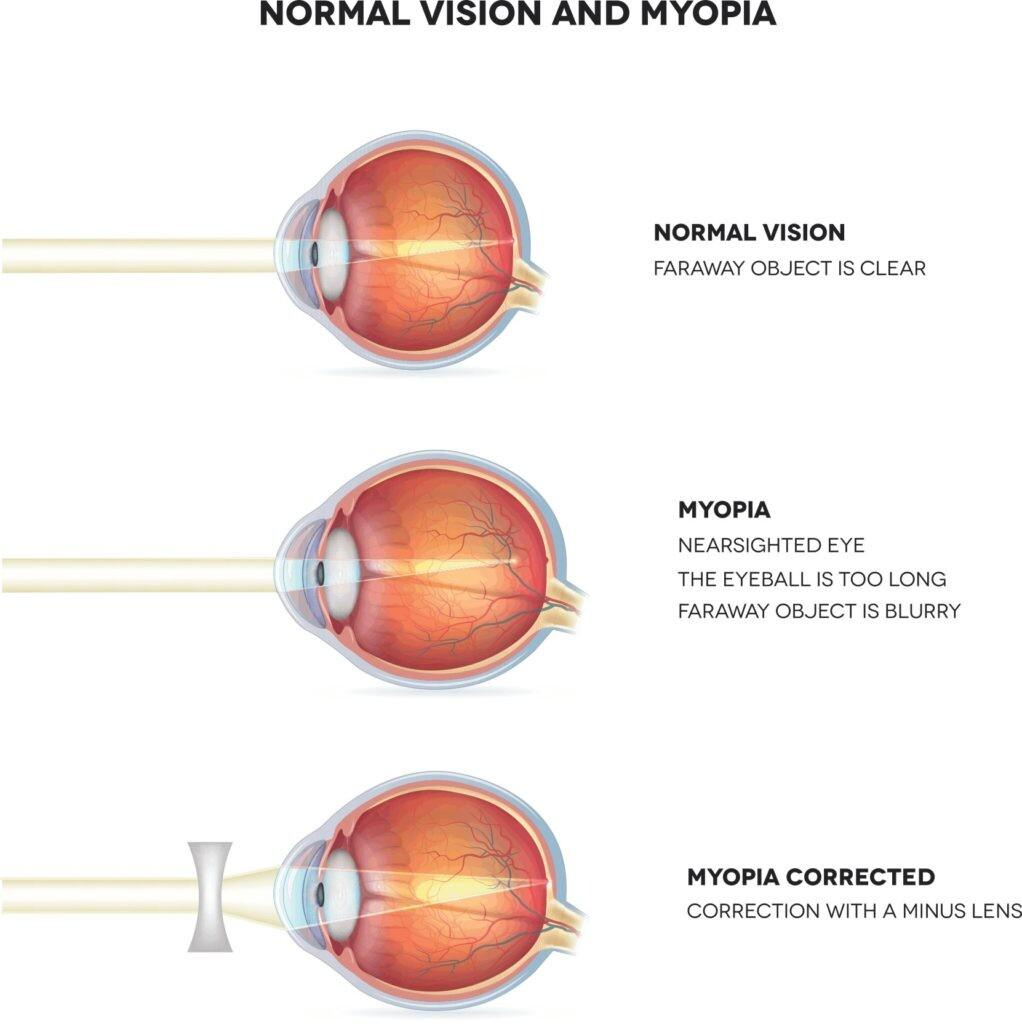
In myopia, the image is formed in front of the retina. It means the lens remains in convex form so the light cannot reach up to the retina. This kind of a person needs to wear concave lenses to make his/her vision corrected.
The concave lenses are diverging lenses which make the light rays coming from the object diverge. Thus, the object seems to be at a nearer distance from the eye, within the range of the defective eyesight. Thus, the person can easily see the far away objects.
Note:
Many people get confused by the term nearsightedness. They consider it as the disease in which a person cannot see the objects near to it. But we should take it in this way- Nearsightedness means the eye can only see things ‘nearer to the eye’. Similarly, hypermetropia or longsightedness means that the eye can only form images of distant objects.
Complete answer:
In myopia, the lens loses its elasticity and is unable to change its curvature. Failure to change the curvature of the cells leads to impaired or no accommodation. Accommodation is defined as the power of the lens to change its curvature and form an image of the object in the retina depending on the distance of the object from the eye.
In myopia, the image is formed in front of the retina. It means the lens remains in convex form so the light cannot reach up to the retina. This kind of a person needs to wear concave lenses to make his/her vision corrected.
The concave lenses are diverging lenses which make the light rays coming from the object diverge. Thus, the object seems to be at a nearer distance from the eye, within the range of the defective eyesight. Thus, the person can easily see the far away objects.
Note:
Many people get confused by the term nearsightedness. They consider it as the disease in which a person cannot see the objects near to it. But we should take it in this way- Nearsightedness means the eye can only see things ‘nearer to the eye’. Similarly, hypermetropia or longsightedness means that the eye can only form images of distant objects.
Recently Updated Pages
Basicity of sulphurous acid and sulphuric acid are

Master Class 10 Computer Science: Engaging Questions & Answers for Success
Master Class 10 Social Science: Engaging Questions & Answers for Success
Master Class 10 Science: Engaging Questions & Answers for Success
Class 10 Question and Answer - Your Ultimate Solutions Guide
Master Class 10 Maths: Engaging Questions & Answers for Success
Trending doubts
What is the Total Duration of Football Match?
Explain the Treaty of Vienna of 1815 class 10 social science CBSE
In football, which nation is called "La Roja"?
Why is there a time difference of about 5 hours between class 10 social science CBSE
10 examples of evaporation in daily life with explanations
What is the full form of POSCO class 10 social science CBSE