




A person walks $25.0^{\circ}$ north of east for $3.10\;km$. How far due north and how far due east would she have to walk to arrive at the same location?
Answer
 Verified
580.5k+ views
Hint: Begin by charting out a diagram with the necessary cardinal directions. Carefully trace the path the person takes in both cases keeping in mind the distance she travels as well as the direction in which she moves with respect to the horizontal and vertical axes. Once you’ve done this, you should be able to see that this problem can be trigonometrically solved since your map virtually entails a triangle.
Using the appropriate sine and cosine relations with respect to the perpendicular, base and hypotenuse of the triangle, arrive at the required distances she’d need to walk due north and due east.
Complete Step-by-Step Solution:
Let us deconstruct the problem and chart out what’s given to us. We are given that a person walks $3.10\;km$ from O, in a direction $25^{\circ}$ North of East, to reach a point P. This is given as the path $OP=3.10\;km$ in the following diagram, with $\angle POB = 25^\circ$
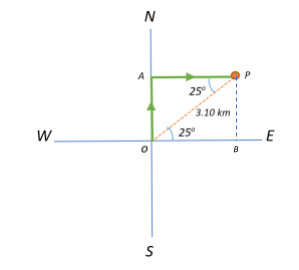
Now, if she was about to reach the point P by first walking due north from O and then due east, we are required to find the distance (OA and AP) she would have to travel in the respective directions.
From the figure, we see that $\angle OPA$ and $\angle POB$ are interior alternate angles.
$\Rightarrow \angle OPA=\angle POB = 25^{\circ}$
This is because:
$\angle POB = 25^{\circ} \Rightarrow \angle AOP = 90-25=65^{\circ} \Rightarrow \angle OPA = 180-(\angle OAP + \angle AOP) = 180-(90+65)=25^{\circ}$, since sum of all interior angles in a triangle is $180^{\circ}$
Now, we consider $\triangle OAP$ with $\angle OPA = 25^{\circ}$.
$\Rightarrow sin\;25^{\circ} = \dfrac{OA}{OP} \Rightarrow OA = OP \times sin\;25^{\circ} = 3.10 \times 0.42 \Rightarrow OA= 1.31\;km$
Similarly, $cos\;25^{\circ} = \dfrac{AP}{OP} \Rightarrow AP = OP \times cos\;25^{\circ} = 3.10 \times 0.91 \Rightarrow AP = 2.81\;km$
Therefore, the person would have to travel $1.31\;km$ due North and $2.81\;km$ due East to arrive at the same location P.
Note:
An alternate way to solve this would be to treat the distance she initially travels as a displacement vector and resolve it into its horizontal and vertical components to get the component of this vector in the east and north directions respectively.
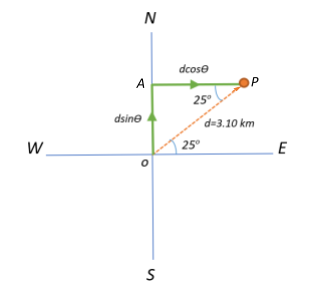
The horizontal component would be $AP =3.10\;cos25^{\circ}$ and the vertical component would be $OA = 3.10\;sin25^{\circ}$ which are similar to $cos25^{\circ}= \dfrac{AP}{OP}$ and $sin25^{\circ} = \dfrac{OA}{OP}$ which is what we got subsequently anyways.
Using the appropriate sine and cosine relations with respect to the perpendicular, base and hypotenuse of the triangle, arrive at the required distances she’d need to walk due north and due east.
Complete Step-by-Step Solution:
Let us deconstruct the problem and chart out what’s given to us. We are given that a person walks $3.10\;km$ from O, in a direction $25^{\circ}$ North of East, to reach a point P. This is given as the path $OP=3.10\;km$ in the following diagram, with $\angle POB = 25^\circ$
Now, if she was about to reach the point P by first walking due north from O and then due east, we are required to find the distance (OA and AP) she would have to travel in the respective directions.
From the figure, we see that $\angle OPA$ and $\angle POB$ are interior alternate angles.
$\Rightarrow \angle OPA=\angle POB = 25^{\circ}$
This is because:
$\angle POB = 25^{\circ} \Rightarrow \angle AOP = 90-25=65^{\circ} \Rightarrow \angle OPA = 180-(\angle OAP + \angle AOP) = 180-(90+65)=25^{\circ}$, since sum of all interior angles in a triangle is $180^{\circ}$
Now, we consider $\triangle OAP$ with $\angle OPA = 25^{\circ}$.
$\Rightarrow sin\;25^{\circ} = \dfrac{OA}{OP} \Rightarrow OA = OP \times sin\;25^{\circ} = 3.10 \times 0.42 \Rightarrow OA= 1.31\;km$
Similarly, $cos\;25^{\circ} = \dfrac{AP}{OP} \Rightarrow AP = OP \times cos\;25^{\circ} = 3.10 \times 0.91 \Rightarrow AP = 2.81\;km$
Therefore, the person would have to travel $1.31\;km$ due North and $2.81\;km$ due East to arrive at the same location P.
Note:
An alternate way to solve this would be to treat the distance she initially travels as a displacement vector and resolve it into its horizontal and vertical components to get the component of this vector in the east and north directions respectively.
The horizontal component would be $AP =3.10\;cos25^{\circ}$ and the vertical component would be $OA = 3.10\;sin25^{\circ}$ which are similar to $cos25^{\circ}= \dfrac{AP}{OP}$ and $sin25^{\circ} = \dfrac{OA}{OP}$ which is what we got subsequently anyways.
Recently Updated Pages
Three beakers labelled as A B and C each containing 25 mL of water were taken A small amount of NaOH anhydrous CuSO4 and NaCl were added to the beakers A B and C respectively It was observed that there was an increase in the temperature of the solutions contained in beakers A and B whereas in case of beaker C the temperature of the solution falls Which one of the following statements isarecorrect i In beakers A and B exothermic process has occurred ii In beakers A and B endothermic process has occurred iii In beaker C exothermic process has occurred iv In beaker C endothermic process has occurred

Master Class 11 Social Science: Engaging Questions & Answers for Success
Master Class 11 Physics: Engaging Questions & Answers for Success
Master Class 11 Maths: Engaging Questions & Answers for Success
Master Class 11 Economics: Engaging Questions & Answers for Success
Master Class 11 Computer Science: Engaging Questions & Answers for Success
Three beakers labelled as A B and C each containing 25 mL of water were taken A small amount of NaOH anhydrous CuSO4 and NaCl were added to the beakers A B and C respectively It was observed that there was an increase in the temperature of the solutions contained in beakers A and B whereas in case of beaker C the temperature of the solution falls Which one of the following statements isarecorrect i In beakers A and B exothermic process has occurred ii In beakers A and B endothermic process has occurred iii In beaker C exothermic process has occurred iv In beaker C endothermic process has occurred
Master Class 11 Social Science: Engaging Questions & Answers for Success
Master Class 11 Physics: Engaging Questions & Answers for Success
Trending doubts
One Metric ton is equal to kg A 10000 B 1000 C 100 class 11 physics CBSE
There are 720 permutations of the digits 1 2 3 4 5 class 11 maths CBSE
State and prove Bernoullis theorem class 11 physics CBSE
Draw a diagram of a plant cell and label at least eight class 11 biology CBSE
Difference Between Prokaryotic Cells and Eukaryotic Cells
Discuss the various forms of bacteria class 11 biology CBSE