




A person walking along a straight road towards a hill observes at two points distance \[\sqrt{3}\]km, the angle of elevation of the hill to be ${{30}^{\circ }}$ and ${{60}^{\circ }}$. The height of the hill is:
A. $\dfrac{3}{2}\text{ km}$
B. $\sqrt{\dfrac{21}{32}}\text{ km}$
C. $\dfrac{\left( \sqrt{3}+1 \right)}{2}\text{ km}$
D. $\sqrt{3}\text{ km}$
Answer
 Verified
613.2k+ views
Hint: First we will analyze the question and draw the diagram according to the conditions given in the question and then we will see that two right angled triangle will form we will then take the triangle one by one and find out the tan of the given by $\tan \theta =\dfrac{\text{Perpendicular}}{\text{Base}}$ such that we will get two equations in $h\text{ and }x$ and then solve them to find the height of the hill.
Complete step-by-step answer:
It is given that the person observes the point from two points and the angle of elevation be ${{30}^{\circ }}$ and ${{60}^{\circ }}$ respectively,
Let the point observed be $D$ from $A$ and $B$ at an angle of ${{30}^{\circ }}$ and ${{60}^{\circ }}$ respectively, it is given the distance between the two points that is $AB=\sqrt{3}\text{ km}$
Now let the height of the hill be $h$ that is the distance $CD$ and the distance from point $B$ to the foot of the hill that is the point $C$ be $x\text{ km}$. Then we will have the following figure according to the condition given in the question:
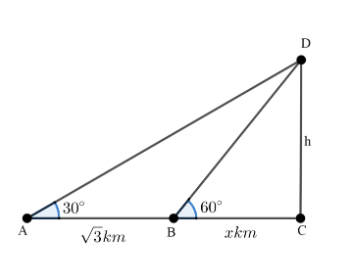
Let’s take the triangle $\Delta DBC$ ,
Now as we see that it a right angled triangle now we know that $\tan \theta =\dfrac{\text{Perpendicular}}{\text{Base}}$ :
Therefore, $\tan {{60}^{\circ }}=\dfrac{h}{x}\text{ }$ , we know that the value of $\tan {{60}^{\circ }}=\sqrt{3}$ , therefore:
$\sqrt{3}=\dfrac{h}{x}\text{ }\Rightarrow h=\sqrt{3}x\text{ }........\text{Equation 1}\text{.}$
Similarly, Let’s take the triangle $\Delta DAC$,
$\tan {{30}^{\circ }}=\dfrac{h}{\sqrt{3}+x}\text{ }$ , we know that the value of $\tan {{30}^{\circ }}=\dfrac{1}{\sqrt{3}}$ , therefore:
$\dfrac{1}{\sqrt{3}}=\dfrac{h}{\sqrt{3}+x}\text{ }.......\text{Equation 2}\text{.}$
We will now put the value of $h$ from equation 1 into equation 2:
So, we will have:
$\begin{align}
& \Rightarrow \dfrac{1}{\sqrt{3}}=\dfrac{h}{\sqrt{3}+x}\Rightarrow \dfrac{1}{\sqrt{3}}=\dfrac{\sqrt{3}x}{\sqrt{3}+x}\Rightarrow \sqrt{3}+x=3x \\
& \Rightarrow 3x-x=\sqrt{3}\Rightarrow 2x=\sqrt{3} \\
& \Rightarrow x=\dfrac{\sqrt{3}}{2} \\
\end{align}$
Now we will put this value in equation 1 to find the value of $h$ :
$\begin{align}
& \Rightarrow h=\sqrt{3}x\Rightarrow h=\left( \sqrt{3}\times \dfrac{\sqrt{3}}{2} \right) \\
& \Rightarrow h=\dfrac{3}{2} \\
\end{align}$
Hence, the correct option is A.
Note: Student can make the mistake while writing down the values of $\tan {{60}^{\circ }}\text{ and }\tan {{30}^{\circ }}$ because there values are reciprocal of each other. It is always better to draw diagrams in questions like this as it will cause less mistakes and will help the examiner to better the solution and variables that you have assumed.
Complete step-by-step answer:
It is given that the person observes the point from two points and the angle of elevation be ${{30}^{\circ }}$ and ${{60}^{\circ }}$ respectively,
Let the point observed be $D$ from $A$ and $B$ at an angle of ${{30}^{\circ }}$ and ${{60}^{\circ }}$ respectively, it is given the distance between the two points that is $AB=\sqrt{3}\text{ km}$
Now let the height of the hill be $h$ that is the distance $CD$ and the distance from point $B$ to the foot of the hill that is the point $C$ be $x\text{ km}$. Then we will have the following figure according to the condition given in the question:
Let’s take the triangle $\Delta DBC$ ,
Now as we see that it a right angled triangle now we know that $\tan \theta =\dfrac{\text{Perpendicular}}{\text{Base}}$ :
Therefore, $\tan {{60}^{\circ }}=\dfrac{h}{x}\text{ }$ , we know that the value of $\tan {{60}^{\circ }}=\sqrt{3}$ , therefore:
$\sqrt{3}=\dfrac{h}{x}\text{ }\Rightarrow h=\sqrt{3}x\text{ }........\text{Equation 1}\text{.}$
Similarly, Let’s take the triangle $\Delta DAC$,
$\tan {{30}^{\circ }}=\dfrac{h}{\sqrt{3}+x}\text{ }$ , we know that the value of $\tan {{30}^{\circ }}=\dfrac{1}{\sqrt{3}}$ , therefore:
$\dfrac{1}{\sqrt{3}}=\dfrac{h}{\sqrt{3}+x}\text{ }.......\text{Equation 2}\text{.}$
We will now put the value of $h$ from equation 1 into equation 2:
So, we will have:
$\begin{align}
& \Rightarrow \dfrac{1}{\sqrt{3}}=\dfrac{h}{\sqrt{3}+x}\Rightarrow \dfrac{1}{\sqrt{3}}=\dfrac{\sqrt{3}x}{\sqrt{3}+x}\Rightarrow \sqrt{3}+x=3x \\
& \Rightarrow 3x-x=\sqrt{3}\Rightarrow 2x=\sqrt{3} \\
& \Rightarrow x=\dfrac{\sqrt{3}}{2} \\
\end{align}$
Now we will put this value in equation 1 to find the value of $h$ :
$\begin{align}
& \Rightarrow h=\sqrt{3}x\Rightarrow h=\left( \sqrt{3}\times \dfrac{\sqrt{3}}{2} \right) \\
& \Rightarrow h=\dfrac{3}{2} \\
\end{align}$
Hence, the correct option is A.
Note: Student can make the mistake while writing down the values of $\tan {{60}^{\circ }}\text{ and }\tan {{30}^{\circ }}$ because there values are reciprocal of each other. It is always better to draw diagrams in questions like this as it will cause less mistakes and will help the examiner to better the solution and variables that you have assumed.
Recently Updated Pages
Master Class 12 Business Studies: Engaging Questions & Answers for Success

Master Class 12 Biology: Engaging Questions & Answers for Success
Master Class 12 Chemistry: Engaging Questions & Answers for Success
Class 12 Question and Answer - Your Ultimate Solutions Guide
Master Class 11 Social Science: Engaging Questions & Answers for Success
Master Class 11 English: Engaging Questions & Answers for Success
Trending doubts
Explain the Treaty of Vienna of 1815 class 10 social science CBSE
Which Indian city is known as the "City of Victory"?
Which instrument is used to measure the Blood Pressure?
Who Won 36 Oscar Awards? Record Holder Revealed
What is the median of the first 10 natural numbers class 10 maths CBSE
Why is it 530 pm in india when it is 1200 afternoon class 10 social science CBSE