




A person travelled a distance of 3 km along a straight line in the North direction. Then he travelled 2 km in the west direction and then 5 km in the south direction. The magnitude of the displacement of this person would be _ _ _ _ _ _ _ _.
A. \[2\sqrt 2 \,{\text{km}}\]
B. \[3\sqrt 2 \,{\text{km}}\]
C. \[4\sqrt 2 \,{\text{km}}\]
D. \[10\,{\text{km}}\]
Answer
 Verified
594.9k+ views
Hint: Denote the direction along the East as \[\hat i\] and the direction along the North as \[\hat j\]. Express the final position of the person using the formula for position vector. Determine its magnitude to get the displacement of the person.
Formula used:
\[d = x\hat i + y\hat j\]
Here, x is the x-coordinate and y is the y-coordinate.
Complete step by step answer:
Let the direction along the East is \[\hat i\] and the direction along the North is \[\hat j\]. We can map the journey of the person as shown in the figure below.
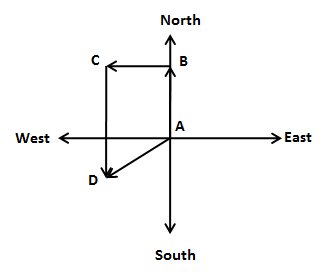
In the above figure, the person has started its journey from the point A and D is the final point of his journey. The distance AD is the displacement of the person.
Let’s express the displacement of the person in the vector form as follows,
\[AD = x\hat i + y\hat j\]
Here, x is the total displacement along the East and West direction and y is the total displacement along the North and South direction.
Therefore,
\[AD = \left( { - 2} \right)\hat i + \left( {3 - 5} \right)\hat j\]
\[ \Rightarrow AD = - 2\hat i - 2\hat j\]
Now, let’s determine the magnitude of the displacement as follows,
\[\left| {AD} \right| = \sqrt {{x^2} + {y^2}} \]
\[ \Rightarrow \left| {AD} \right| = \sqrt {{{\left( { - 2} \right)}^2} + {{\left( { - 2} \right)}^2}} \]
\[ \Rightarrow \left| {AD} \right| = \sqrt 8 \]
\[ \Rightarrow \left| {AD} \right| = 2\sqrt 2 \,{\text{km}}\]
Therefore, the displacement of the person is \[2\sqrt 2 \,{\text{km}}\].
So, the correct answer is “Option A”.
Note:
Students must remember the important difference between distance and displacement. The distance is the total distance travelled by the body along every direction that he travels but the displacement is the difference in the final position and initial position of the body. in the given question, the distance travelled by the person is \[3 + 2 + 5 = 10\,{\text{km}}\]but the displacement is \[2\sqrt 2 \,{\text{km}}\].
Formula used:
\[d = x\hat i + y\hat j\]
Here, x is the x-coordinate and y is the y-coordinate.
Complete step by step answer:
Let the direction along the East is \[\hat i\] and the direction along the North is \[\hat j\]. We can map the journey of the person as shown in the figure below.
In the above figure, the person has started its journey from the point A and D is the final point of his journey. The distance AD is the displacement of the person.
Let’s express the displacement of the person in the vector form as follows,
\[AD = x\hat i + y\hat j\]
Here, x is the total displacement along the East and West direction and y is the total displacement along the North and South direction.
Therefore,
\[AD = \left( { - 2} \right)\hat i + \left( {3 - 5} \right)\hat j\]
\[ \Rightarrow AD = - 2\hat i - 2\hat j\]
Now, let’s determine the magnitude of the displacement as follows,
\[\left| {AD} \right| = \sqrt {{x^2} + {y^2}} \]
\[ \Rightarrow \left| {AD} \right| = \sqrt {{{\left( { - 2} \right)}^2} + {{\left( { - 2} \right)}^2}} \]
\[ \Rightarrow \left| {AD} \right| = \sqrt 8 \]
\[ \Rightarrow \left| {AD} \right| = 2\sqrt 2 \,{\text{km}}\]
Therefore, the displacement of the person is \[2\sqrt 2 \,{\text{km}}\].
So, the correct answer is “Option A”.
Note:
Students must remember the important difference between distance and displacement. The distance is the total distance travelled by the body along every direction that he travels but the displacement is the difference in the final position and initial position of the body. in the given question, the distance travelled by the person is \[3 + 2 + 5 = 10\,{\text{km}}\]but the displacement is \[2\sqrt 2 \,{\text{km}}\].
Recently Updated Pages
Master Class 11 Social Science: Engaging Questions & Answers for Success

Master Class 11 English: Engaging Questions & Answers for Success
Master Class 11 Maths: Engaging Questions & Answers for Success
Master Class 11 Chemistry: Engaging Questions & Answers for Success
Master Class 11 Biology: Engaging Questions & Answers for Success
Master Class 11 Physics: Engaging Questions & Answers for Success
Trending doubts
Differentiate between an exothermic and an endothermic class 11 chemistry CBSE
One Metric ton is equal to kg A 10000 B 1000 C 100 class 11 physics CBSE
Difference Between Prokaryotic Cells and Eukaryotic Cells
There are 720 permutations of the digits 1 2 3 4 5 class 11 maths CBSE
Draw a diagram of a plant cell and label at least eight class 11 biology CBSE
Two of the body parts which do not appear in MRI are class 11 biology CBSE