




A person standing on the bank of a river, observes that the angle subtended by a tree on the opposite bank is $60^\circ $ when it retreats $20m$ from the bank, he finds the angle to be $30^\circ $ then the height of the tree and the breadth of the river is:
A. $10\sqrt 3 m,10m$
B. $10,10\sqrt 3 m$
C. $20m,30m$
D. none of these
Answer
 Verified
607.8k+ views
Hint:
Let us assume the height of the tree be $h$ and the breadth of the river be $x$
Now draw the diagram using the above statement. Two right angle triangles will be formed and in any right angle triangle $\tan \theta = \dfrac{{{\text{perpendicular}}}}{{{\text{base}}}}$
Using this in the two triangles we will get our answer.
Complete step by step solution:
Here in the question we are given that person standing on the bank of a river, observes that the angle subtended by a tree on the opposite bank is $60^\circ $ when it retreats $20m$ from the bank, he finds the angle to be $30^\circ $
Now let us assume that height of the tree be $h$ and the breadth of the river be $x$
Now let us understand by drawing the diagram
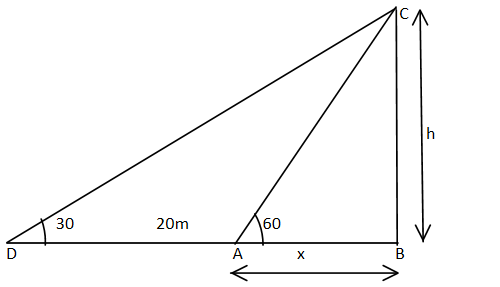
Here in the figure we can see that $BC$ is the tree of height $h$ so it means that $BC = h$ and $AB$ is the breadth of the river which means$AB = x$.
Now initially the person is at point A and he observes that the tree which is $BC$ subtends the angle of $60^\circ $ so we can say that $\angle BAC = 60^\circ $
Now we are also given in the question that when it is $20m$ away from the bank then he reaches at the point D and then he observes the angle subtended to be $30^\circ $on the opposite bank so it means that $\angle CDB = 30^\circ $
Now it is clear from the figure that there are two right angles triangles which are $\Delta ABC,\Delta DBC$
$\tan A = \dfrac{{{\text{perpendicular}}}}{{{\text{base}}}}$$ = \dfrac{{BC}}{{AB}} = \dfrac{h}{x}$
And $\angle A = 60^\circ $ so $\tan 60^\circ = \dfrac{h}{x}$
So we get that $\sqrt 3 x = h - - - - - - (1)$
Now in $\Delta DBC$
$\tan D = \dfrac{{{\text{perpendicular}}}}{{{\text{base}}}}$$ = \dfrac{{BC}}{{BD}} = \dfrac{h}{{20 + x}}$
So we get that $\tan 30^\circ = \dfrac{h}{{20 + x}}$
$\dfrac{1}{{\sqrt 3 }} = \dfrac{h}{{20 + x}}$
$\Rightarrow 20 + x = \sqrt 3 h - - - - - - (2)$
And we know that $\sqrt 3 x = h$
So putting the value of $h$in the equation (2)
$\Rightarrow 20 + x = \sqrt 3 (\sqrt 3 x)$
$\Rightarrow 20 + x = 3x$
$\Rightarrow 2x = 20$
$\Rightarrow x = 10$
So we get that $h = \sqrt 3 x = 10\sqrt 3 m$
So we get that breadth of the river is $10m$ and the height of the tree as $10\sqrt 3 m$
So option A is correct.
Note:
For any triangle $\Delta ABC$
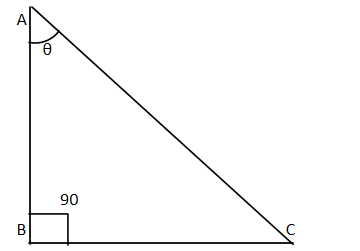
Given that $\angle B = 90^\circ ,\angle A = \theta $
$\sin \theta = \dfrac{{{\text{perpendicular}}}}{{{\text{hypotenuse}}}}$$ = \dfrac{{BC}}{{AC}}$
And perpendicular is the length opposite to that of the angle and hypotenuse is the side opposite to $90^\circ $ and similarly we must know the formula of other trigonometric functions.
Let us assume the height of the tree be $h$ and the breadth of the river be $x$
Now draw the diagram using the above statement. Two right angle triangles will be formed and in any right angle triangle $\tan \theta = \dfrac{{{\text{perpendicular}}}}{{{\text{base}}}}$
Using this in the two triangles we will get our answer.
Complete step by step solution:
Here in the question we are given that person standing on the bank of a river, observes that the angle subtended by a tree on the opposite bank is $60^\circ $ when it retreats $20m$ from the bank, he finds the angle to be $30^\circ $
Now let us assume that height of the tree be $h$ and the breadth of the river be $x$
Now let us understand by drawing the diagram
Here in the figure we can see that $BC$ is the tree of height $h$ so it means that $BC = h$ and $AB$ is the breadth of the river which means$AB = x$.
Now initially the person is at point A and he observes that the tree which is $BC$ subtends the angle of $60^\circ $ so we can say that $\angle BAC = 60^\circ $
Now we are also given in the question that when it is $20m$ away from the bank then he reaches at the point D and then he observes the angle subtended to be $30^\circ $on the opposite bank so it means that $\angle CDB = 30^\circ $
Now it is clear from the figure that there are two right angles triangles which are $\Delta ABC,\Delta DBC$
$\tan A = \dfrac{{{\text{perpendicular}}}}{{{\text{base}}}}$$ = \dfrac{{BC}}{{AB}} = \dfrac{h}{x}$
And $\angle A = 60^\circ $ so $\tan 60^\circ = \dfrac{h}{x}$
So we get that $\sqrt 3 x = h - - - - - - (1)$
Now in $\Delta DBC$
$\tan D = \dfrac{{{\text{perpendicular}}}}{{{\text{base}}}}$$ = \dfrac{{BC}}{{BD}} = \dfrac{h}{{20 + x}}$
So we get that $\tan 30^\circ = \dfrac{h}{{20 + x}}$
$\dfrac{1}{{\sqrt 3 }} = \dfrac{h}{{20 + x}}$
$\Rightarrow 20 + x = \sqrt 3 h - - - - - - (2)$
And we know that $\sqrt 3 x = h$
So putting the value of $h$in the equation (2)
$\Rightarrow 20 + x = \sqrt 3 (\sqrt 3 x)$
$\Rightarrow 20 + x = 3x$
$\Rightarrow 2x = 20$
$\Rightarrow x = 10$
So we get that $h = \sqrt 3 x = 10\sqrt 3 m$
So we get that breadth of the river is $10m$ and the height of the tree as $10\sqrt 3 m$
So option A is correct.
Note:
For any triangle $\Delta ABC$
Given that $\angle B = 90^\circ ,\angle A = \theta $
$\sin \theta = \dfrac{{{\text{perpendicular}}}}{{{\text{hypotenuse}}}}$$ = \dfrac{{BC}}{{AC}}$
And perpendicular is the length opposite to that of the angle and hypotenuse is the side opposite to $90^\circ $ and similarly we must know the formula of other trigonometric functions.
Recently Updated Pages
Master Class 9 General Knowledge: Engaging Questions & Answers for Success

Master Class 9 Maths: Engaging Questions & Answers for Success
Master Class 9 Science: Engaging Questions & Answers for Success
Master Class 9 English: Engaging Questions & Answers for Success
Master Class 9 Social Science: Engaging Questions & Answers for Success
Class 9 Question and Answer - Your Ultimate Solutions Guide
Trending doubts
Explain the Treaty of Vienna of 1815 class 10 social science CBSE
Who Won 36 Oscar Awards? Record Holder Revealed
What is the median of the first 10 natural numbers class 10 maths CBSE
Why is it 530 pm in india when it is 1200 afternoon class 10 social science CBSE
Make a sketch of the human nerve cell What function class 10 biology CBSE
Define Potential, Developed, Stock and Reserved resources