




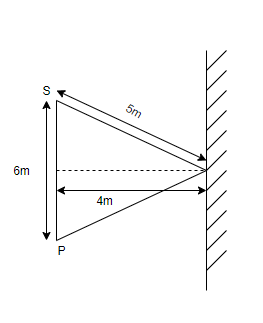
A person standing at a distance of 6m from a source receives sound waves in two ways, one directly from the source and other after reflection from a rigid boundary as shown in the figure. The maximum wavelength for which, the person will receive maximum sound intensity is:
$
A. 4 m \\
B. \dfrac{{16}}{3} m \\
C. 2 m \\
D. \dfrac{8}{3} m \\
$
Answer
 Verified
611.1k+ views
- Hint – Here we will proceed by using the formula for wavelength. It is inversely related to frequency, which refers to the number of wave cycles per second. The higher the frequency of the signal, the shorter the wavelength.
Formula used : $\lambda = \dfrac{v}{f}$
Where wavelength is denoted by $\lambda $
V= velocity of the wave
F= frequency.
Complete step-by-step solution -
Here it is given that distance between the person and the source receives sound waves $ = 6m$.
And it is also given that the sound waves received from a source in two ways. One is directly from the source and the other is after reflection from a rigid boundary.
We have to find out the maximum wavelength for which, the person will receive maximum sound intensity
For the intensity to be maximum after interference, the path difference between the two waves must be an integral multiple of wavelength.
Therefore, $\left( {5 + 5} \right) - 6 = n\lambda $ ($\because $ intensity is given by $n\lambda $)
$ \Rightarrow \left( {10 - 6} \right) = n\lambda $
$
\Rightarrow 4 = n\lambda \\
\Rightarrow \lambda = \dfrac{4}{n} \\
$
The value of wavelength $\left( \lambda \right)$ is maximum for a minimum value of $n$, which is 1.
Therefore, the maximum value of $\lambda $ will be,
$\lambda \max = \dfrac{4}{1}$
$ \Rightarrow \lambda \max = 4m$
Note – Whenever we come up with this type of question, where we are asked to find out the maximum wavelength. Then we first write the formula and then in place of the formula we put the values of the quantity. After solving that we will get the maximum sound intensity. In this way we will get our answer.
Formula used : $\lambda = \dfrac{v}{f}$
Where wavelength is denoted by $\lambda $
V= velocity of the wave
F= frequency.
Complete step-by-step solution -
Here it is given that distance between the person and the source receives sound waves $ = 6m$.
And it is also given that the sound waves received from a source in two ways. One is directly from the source and the other is after reflection from a rigid boundary.
We have to find out the maximum wavelength for which, the person will receive maximum sound intensity
For the intensity to be maximum after interference, the path difference between the two waves must be an integral multiple of wavelength.
Therefore, $\left( {5 + 5} \right) - 6 = n\lambda $ ($\because $ intensity is given by $n\lambda $)
$ \Rightarrow \left( {10 - 6} \right) = n\lambda $
$
\Rightarrow 4 = n\lambda \\
\Rightarrow \lambda = \dfrac{4}{n} \\
$
The value of wavelength $\left( \lambda \right)$ is maximum for a minimum value of $n$, which is 1.
Therefore, the maximum value of $\lambda $ will be,
$\lambda \max = \dfrac{4}{1}$
$ \Rightarrow \lambda \max = 4m$
Note – Whenever we come up with this type of question, where we are asked to find out the maximum wavelength. Then we first write the formula and then in place of the formula we put the values of the quantity. After solving that we will get the maximum sound intensity. In this way we will get our answer.
Recently Updated Pages
Master Class 11 Computer Science: Engaging Questions & Answers for Success

Master Class 11 Business Studies: Engaging Questions & Answers for Success
Master Class 11 Economics: Engaging Questions & Answers for Success
Master Class 11 English: Engaging Questions & Answers for Success
Master Class 11 Maths: Engaging Questions & Answers for Success
Master Class 11 Biology: Engaging Questions & Answers for Success
Trending doubts
One Metric ton is equal to kg A 10000 B 1000 C 100 class 11 physics CBSE
There are 720 permutations of the digits 1 2 3 4 5 class 11 maths CBSE
Discuss the various forms of bacteria class 11 biology CBSE
Draw a diagram of a plant cell and label at least eight class 11 biology CBSE
State the laws of reflection of light
Explain zero factorial class 11 maths CBSE