




A person moves from pole to equator, then the value of his weight will-
A. Decrease
B. Increase
C. Remain same
D. First increase and then decrease
Answer
 Verified
611.4k+ views
Hint: So, at first we need to understand the question and draw a pictorial representation of the person, now we know that if we move far from the center of the earth then the gravitational pull of the earth decreases which affects the weight of a body.
Formula used: W=mg
Complete step by step answer:
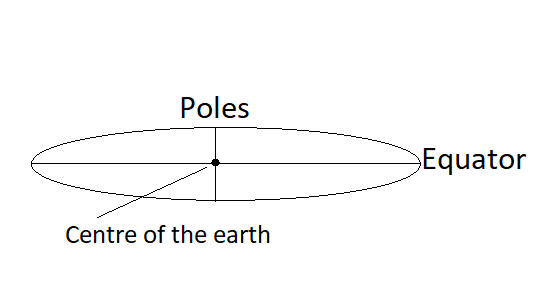
According to the question we know that the person is moving from the pole to the equator, here in the diagram I represented a 2-dimensional diagram of the earth and at one end there is a pole and at another side there is the equator.
We know that the earth is not fully a circle, it is a bit wider at the equator, so we can say that when a person is at the equator he is more farther from the center of the earth compared to the person standing in the poles.
So, from the above explanation we can say that the person will feel maximum weight at the poles as it is near to the center of the earth and at the equator the person will feel minimum weight because it is far from the center of the earth when compared to the poles.
We know that weight on the earth depends on mg, but ‘m’ is a constant value so weight (W) will depend on g.
So we know that the value of g at equator is $9.78m/{{s}^{2}}$
And the value of g at the poles is $9.83m/{{s}^{2}}$.
So, we can now clearly say that the value of weight in the equator is minimum and maximum at the poles.
So when the person moves from poles to the equators its weight decreases.
So, the correct answer is “Option A”.
Note: In the formula W = m g, ‘m’ is the mass of the person and ‘g’ is the acceleration due to gravity, and ‘W’ is the weight of the person or the force with which center of the earth pulls a body towards itself.
Formula used: W=mg
Complete step by step answer:
According to the question we know that the person is moving from the pole to the equator, here in the diagram I represented a 2-dimensional diagram of the earth and at one end there is a pole and at another side there is the equator.
We know that the earth is not fully a circle, it is a bit wider at the equator, so we can say that when a person is at the equator he is more farther from the center of the earth compared to the person standing in the poles.
So, from the above explanation we can say that the person will feel maximum weight at the poles as it is near to the center of the earth and at the equator the person will feel minimum weight because it is far from the center of the earth when compared to the poles.
We know that weight on the earth depends on mg, but ‘m’ is a constant value so weight (W) will depend on g.
So we know that the value of g at equator is $9.78m/{{s}^{2}}$
And the value of g at the poles is $9.83m/{{s}^{2}}$.
So, we can now clearly say that the value of weight in the equator is minimum and maximum at the poles.
So when the person moves from poles to the equators its weight decreases.
So, the correct answer is “Option A”.
Note: In the formula W = m g, ‘m’ is the mass of the person and ‘g’ is the acceleration due to gravity, and ‘W’ is the weight of the person or the force with which center of the earth pulls a body towards itself.
Recently Updated Pages
Master Class 12 Economics: Engaging Questions & Answers for Success

Master Class 12 English: Engaging Questions & Answers for Success
Master Class 12 Social Science: Engaging Questions & Answers for Success
Master Class 12 Maths: Engaging Questions & Answers for Success
Master Class 12 Physics: Engaging Questions & Answers for Success
Master Class 11 Social Science: Engaging Questions & Answers for Success
Trending doubts
One Metric ton is equal to kg A 10000 B 1000 C 100 class 11 physics CBSE
Difference Between Prokaryotic Cells and Eukaryotic Cells
Two of the body parts which do not appear in MRI are class 11 biology CBSE
1 ton equals to A 100 kg B 1000 kg C 10 kg D 10000 class 11 physics CBSE
Draw a diagram of nephron and explain its structur class 11 biology CBSE
10 examples of friction in our daily life