




A person is painting his house walls. He stands on a ladder with a bucket containing paint in one hand and a brush in another. Suddenly the bucket slips from his hand and falls down on the floor. If the bucket with paint has a mass of 0.6kg and was at a height of 2.0m at the time it slipped, how much gravitational potential energy was lost together with the paint?
Answer
 Verified
580.2k+ views
Hint: When the bucket is in rest position, it has the potential energy. When it slipped from the hand then, it possessed loss of gravitational potential energy. We use the energy conservation of a freely falling body, in which potential energy changes to kinetic energy.
Formula used:
Potential energy is given as:
\[P.E=mgh\]
Kinetic energy is given by:
$K.E.=(1/2)M{{v}^{2}}$
Complete answer:
When the bucket is in rest position, kinetic energy is zero. Also, when the bucket touches the surface then its potential energy is zero.
By using energy conservation of a freely falling body, the bucket of mass is falling under the acceleration due to gravity and it strikes the surface.
Here, we will explain the given terms with the help of a fig. shown below:
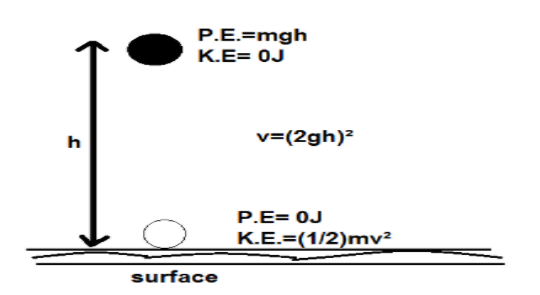
In the above figure, it shows the amount of energies at rest position and at final position.
We make use of 3rd equation of motion given as:
$\begin{align}
& {{u}^{2}}-{{v}^{2}}=2aS \\
& {{u}^{2}}-{{v}^{2}}=-2hg(a=-g,S=h) \\
& 0-{{v}^{2}}=-2gh \\
& {{v}^{2}}=2gh \\
& \\
\end{align}$
Now the kinetic energy can be calculated as:
$\begin{align}
& K.E=1/2\times m\times {{v}^{2}} \\
& K.E=1/2\times m\times 2gh \\
& K.E=mgh \\
\end{align}$
So, the loss in gravitational equals to the gain in kinetic energy. The potential energy when the bucket strikes the surface is zero.
Also, P.E at height h is given as:
$\begin{align}
& P.E.=mgh \\
& P.E.=0.6\times (9.8)\times 2 \\
& P.E.=17.64J \\
\end{align}$
Then, the total loss in gravitational potential energy is given as:
$\begin{align}
& P.E=17.64J-0J \\
& (\because P.E=0J, final position) \\
& \Rightarrow P.E.=17.64J \\
\end{align}$
We conclude that, when the bucket slipped the loss of gravitational potential energy is 17.64J.
Note:
The gravitational loss in potential energy when the object falls from a height h is always equal to the gain in kinetic energy. By the use of energy conservation of the freely falling body, the potential energy gets converted into kinetic energy under the effect of gravity.
Formula used:
Potential energy is given as:
\[P.E=mgh\]
Kinetic energy is given by:
$K.E.=(1/2)M{{v}^{2}}$
Complete answer:
When the bucket is in rest position, kinetic energy is zero. Also, when the bucket touches the surface then its potential energy is zero.
By using energy conservation of a freely falling body, the bucket of mass is falling under the acceleration due to gravity and it strikes the surface.
Here, we will explain the given terms with the help of a fig. shown below:
In the above figure, it shows the amount of energies at rest position and at final position.
We make use of 3rd equation of motion given as:
$\begin{align}
& {{u}^{2}}-{{v}^{2}}=2aS \\
& {{u}^{2}}-{{v}^{2}}=-2hg(a=-g,S=h) \\
& 0-{{v}^{2}}=-2gh \\
& {{v}^{2}}=2gh \\
& \\
\end{align}$
Now the kinetic energy can be calculated as:
$\begin{align}
& K.E=1/2\times m\times {{v}^{2}} \\
& K.E=1/2\times m\times 2gh \\
& K.E=mgh \\
\end{align}$
So, the loss in gravitational equals to the gain in kinetic energy. The potential energy when the bucket strikes the surface is zero.
Also, P.E at height h is given as:
$\begin{align}
& P.E.=mgh \\
& P.E.=0.6\times (9.8)\times 2 \\
& P.E.=17.64J \\
\end{align}$
Then, the total loss in gravitational potential energy is given as:
$\begin{align}
& P.E=17.64J-0J \\
& (\because P.E=0J, final position) \\
& \Rightarrow P.E.=17.64J \\
\end{align}$
We conclude that, when the bucket slipped the loss of gravitational potential energy is 17.64J.
Note:
The gravitational loss in potential energy when the object falls from a height h is always equal to the gain in kinetic energy. By the use of energy conservation of the freely falling body, the potential energy gets converted into kinetic energy under the effect of gravity.
Recently Updated Pages
Master Class 11 Computer Science: Engaging Questions & Answers for Success

Master Class 11 Business Studies: Engaging Questions & Answers for Success
Master Class 11 Economics: Engaging Questions & Answers for Success
Master Class 11 English: Engaging Questions & Answers for Success
Master Class 11 Maths: Engaging Questions & Answers for Success
Master Class 11 Biology: Engaging Questions & Answers for Success
Trending doubts
One Metric ton is equal to kg A 10000 B 1000 C 100 class 11 physics CBSE
There are 720 permutations of the digits 1 2 3 4 5 class 11 maths CBSE
Discuss the various forms of bacteria class 11 biology CBSE
Draw a diagram of a plant cell and label at least eight class 11 biology CBSE
State the laws of reflection of light
Explain zero factorial class 11 maths CBSE