




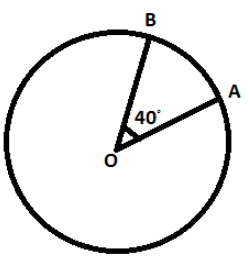
A person is moving in a circle of radius r with constant speed v. The change in velocity in moving from A to B is
Answer
 Verified
598.4k+ views
Hint:We can find the change in velocity of the person while moving from point A to B using the cosine law of vector considering the angle between the velocity vectors as ${40^\circ }$. Since, the velocity of the person will be constant, the value of velocity at both the points will be the same. And, accordingly we need to find the resultant of the two vectors considering the given angle which will be the value of change in velocity.
Complete step by step answer:
To solve this question we need to understand the meaning of vector and uniform circular motion.Vector means a quantity which has both direction and magnitude. There are many different types of vector like null vector, parallel vector, antiparallel vector, orthogonal vector.
Accordingly, the resultant of two vectors can be found using the cosine law of vectors.i.e. $R = \sqrt {{P^2} + {Q^2} - 2PQ\cos \theta } $ ; where P and Q are two different vectors.Uniform circular motion is a motion in which a body moves around a fixed point or on a circular track with uniform speed. When an object is in uniform circular motion, its speed doesn't change during its complete cycle.
Now let ${\vec v_1}$ and ${\vec v_2}$ be the velocities of the person at point A and B respectively.Since, the speed of person $|\vec v|$ is constant.Therefore, $|{\vec v_1}| = |{\vec v_2}| = v$
Now since $\angle AOB = {40^\circ }$ , therefore the angle between the velocity vectors is also ${40^\circ }$.
Now, change in vector $\left( {\Delta \vec v} \right) = {\vec v_2} - {\vec v_1}$
And, $|\Delta \vec v| = \sqrt {|{{\vec v}_2}{|^2} + |{{\vec v}_1}{|^2} - 2{v_2}{v_1}\operatorname{Cos} \theta } $
$\Delta v = \sqrt {{v^2} + {v^2} - 2vv\cos {{40}^o}} $
$\Rightarrow\Delta v = \sqrt {2{v^2} - 2{v^2}\cos {{40}^o}} $
$\Rightarrow\Delta v = \sqrt {2{v^2}(1 - \cos {{40}^o})} $
Now, since $\cos 40^\circ = 1 - 2{\sin ^2}{20^\circ }$
Hence, $\Delta v = \sqrt {2{v^2}(1 - (1 - 2{{\sin }^2}{{20}^\circ })} $
$\Delta v = \sqrt {2{v^2}(1 - 1 + 2{{\sin }^2}{{20}^\circ })} $
$\Rightarrow\Delta v = \sqrt {2{v^2}(2{{\sin }^2}{{20}^\circ })} $
$\Rightarrow\Delta v = \sqrt {4{v^2}{{\sin }^2}{{20}^\circ })} $
$\therefore\Delta v = 2v\sin 20^\circ $
Hence, the magnitude of change in velocity in moving from point A to B is $2v\sin 20^\circ $.
Note: The Law of Cosines is used to calculate the magnitude (r) and the Law of Sines is used to calculate the angle (α) of two vectors. Hence, don’t confuse between the two laws and apply accordingly. The value obtained using the Law of Cosines is the resultant of the two vectors and its direction is decided accordingly depending on the direction of the two vectors.
Complete step by step answer:
To solve this question we need to understand the meaning of vector and uniform circular motion.Vector means a quantity which has both direction and magnitude. There are many different types of vector like null vector, parallel vector, antiparallel vector, orthogonal vector.
Accordingly, the resultant of two vectors can be found using the cosine law of vectors.i.e. $R = \sqrt {{P^2} + {Q^2} - 2PQ\cos \theta } $ ; where P and Q are two different vectors.Uniform circular motion is a motion in which a body moves around a fixed point or on a circular track with uniform speed. When an object is in uniform circular motion, its speed doesn't change during its complete cycle.
Now let ${\vec v_1}$ and ${\vec v_2}$ be the velocities of the person at point A and B respectively.Since, the speed of person $|\vec v|$ is constant.Therefore, $|{\vec v_1}| = |{\vec v_2}| = v$
Now since $\angle AOB = {40^\circ }$ , therefore the angle between the velocity vectors is also ${40^\circ }$.
Now, change in vector $\left( {\Delta \vec v} \right) = {\vec v_2} - {\vec v_1}$
And, $|\Delta \vec v| = \sqrt {|{{\vec v}_2}{|^2} + |{{\vec v}_1}{|^2} - 2{v_2}{v_1}\operatorname{Cos} \theta } $
$\Delta v = \sqrt {{v^2} + {v^2} - 2vv\cos {{40}^o}} $
$\Rightarrow\Delta v = \sqrt {2{v^2} - 2{v^2}\cos {{40}^o}} $
$\Rightarrow\Delta v = \sqrt {2{v^2}(1 - \cos {{40}^o})} $
Now, since $\cos 40^\circ = 1 - 2{\sin ^2}{20^\circ }$
Hence, $\Delta v = \sqrt {2{v^2}(1 - (1 - 2{{\sin }^2}{{20}^\circ })} $
$\Delta v = \sqrt {2{v^2}(1 - 1 + 2{{\sin }^2}{{20}^\circ })} $
$\Rightarrow\Delta v = \sqrt {2{v^2}(2{{\sin }^2}{{20}^\circ })} $
$\Rightarrow\Delta v = \sqrt {4{v^2}{{\sin }^2}{{20}^\circ })} $
$\therefore\Delta v = 2v\sin 20^\circ $
Hence, the magnitude of change in velocity in moving from point A to B is $2v\sin 20^\circ $.
Note: The Law of Cosines is used to calculate the magnitude (r) and the Law of Sines is used to calculate the angle (α) of two vectors. Hence, don’t confuse between the two laws and apply accordingly. The value obtained using the Law of Cosines is the resultant of the two vectors and its direction is decided accordingly depending on the direction of the two vectors.
Recently Updated Pages
If x a + bt + ct2 where x is in meters and t is in class 11 physics CBSE

A car covers the first half distance between two places class 11 physics CBSE
The resultant of two vectors overrightarrow P and overrightarrow class 11 physics CBSE
Find the value of cos 135 class 11 maths CBSE
A mass M is held in place by an applied force F and class 11 physics CBSE
A solution of glucose in water is labelled as 10 dfracwv class 11 chemistry CBSE
Trending doubts
One Metric ton is equal to kg A 10000 B 1000 C 100 class 11 physics CBSE
Find the value of the expression given below sin 30circ class 11 maths CBSE
What do you mean by retardation What is its SI uni class 11 physics CBSE
Draw a diagram of nephron and explain its structur class 11 biology CBSE
10 examples of friction in our daily life
Difference between physical and chemical change class 11 chemistry CBSE