




A person in flying a kite at an angle of elevation α and the length of thread from his hand to kite is l draw diagram for the following situation
Answer
 Verified
627.9k+ views
Hint: Kite attached to thread flies in the sky making some angle with the horizontal and this particular angle made is called the angle of elevation and when we see any object on ground from the upper side then the angle made is called the angle of depression.
The line along which this kite is being seen in the sky is called line of sight.
Complete step by step solution:
Properties of kite:
The two angles are equal where the unequal sides meet.
It can be viewed as a pair of congruent triangles with a common base.
It has 2 diagonals that intersect each other at right angles.
The longer or main diagonal bisects the other diagonal.
A kite is symmetrical about its main diagonal.
The shorter diagonal divides the kite into 2 isosceles triangles.
The angle of elevation is the angle between the horizontal line of sight and the line of sight up to an object. For example, if you are standing on the ground looking up at the top of a mountain, you could measure the angle of elevation. The angle of depression is the angle between the horizontal line of sight and the line of sight down to an object. For example, if you were standing on top of a hill or a building, looking down at an object, you could measure the angle of depression. You can measure these angles using a clinometer or a theodolite. People tend to use clinometers or theodolites to measure the height of trees and other tall objects.
To make the diagram use the concept of height and distance.
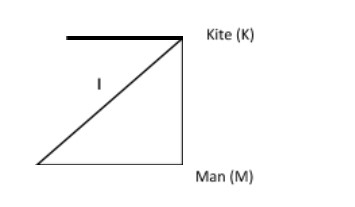
\[\alpha \to \]angle of elevation
\[l \to \]Length of thread
Note:This question is solved only with the help of the height and distance concept.
The angle of elevation is the angle between the horizontal line of sight and the line of sight up to an object.
The line along which this kite is being seen in the sky is called line of sight.
Complete step by step solution:
Properties of kite:
The two angles are equal where the unequal sides meet.
It can be viewed as a pair of congruent triangles with a common base.
It has 2 diagonals that intersect each other at right angles.
The longer or main diagonal bisects the other diagonal.
A kite is symmetrical about its main diagonal.
The shorter diagonal divides the kite into 2 isosceles triangles.
The angle of elevation is the angle between the horizontal line of sight and the line of sight up to an object. For example, if you are standing on the ground looking up at the top of a mountain, you could measure the angle of elevation. The angle of depression is the angle between the horizontal line of sight and the line of sight down to an object. For example, if you were standing on top of a hill or a building, looking down at an object, you could measure the angle of depression. You can measure these angles using a clinometer or a theodolite. People tend to use clinometers or theodolites to measure the height of trees and other tall objects.
To make the diagram use the concept of height and distance.
\[\alpha \to \]angle of elevation
\[l \to \]Length of thread
Note:This question is solved only with the help of the height and distance concept.
The angle of elevation is the angle between the horizontal line of sight and the line of sight up to an object.
Recently Updated Pages
Master Class 11 English: Engaging Questions & Answers for Success

Master Class 11 Social Science: Engaging Questions & Answers for Success
Master Class 11 Maths: Engaging Questions & Answers for Success
Master Class 11 Biology: Engaging Questions & Answers for Success
Master Class 11 Physics: Engaging Questions & Answers for Success
Master Class 11 Chemistry: Engaging Questions & Answers for Success
Trending doubts
Explain the Treaty of Vienna of 1815 class 10 social science CBSE
What is the Total Duration of Football Match?
First Cotton Mill of India
In which year voting age was reduced from 21 to 18?
10 examples of evaporation in daily life with explanations
What planets have no moons Which one has only one moon class 10 physics CBSE