




A person draws water from a \[5m\] deep well and bucket of mass \[2kg\] of capacity \[8litre\] by a rope of mass \[1kg\] . What is the total work done by the person? $\left( {{\text{Assume}}\,\,g = 10m/{{\sec }^2}} \right)$
Answer
 Verified
598.8k+ views
Hint: Work is said to be done on a body by a force, when the force acting on the body produces a displacement in any direction except in a direction perpendicular to direction of force. It measures the energy transfer that takes place. Work is a scalar product. There are positive work done, negative work done and zero work done.
Formula:
Work done,
\[W = F \cdot S\]
Where
$F$ , is the force
And $S$ , is the displacement
Force can be written as \[f = mg\]
Where $m$ , is the mass of body and $g$ is the acceleration of body
Complete Step by Step Answer:
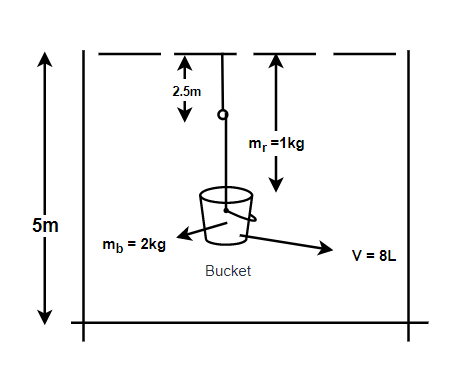
According to question, the height of well, \[h = 5cm\] , Mass of bucket, \[{m_b} = 2kg\] , Mass of rope, \[{m_r} = 1kg\] and Volume of bucket, \[V = 8litre\]
We know that, Density of water is \[1000kg{m^{ - 3}}\] or \[1gc{m^{ - 3}}\]
As density = mass/ volume
To convert liters to kilogram, we will use above formula of density to calculate mass of water in \[kg\] which is ${\text{Mass}}\,\,{\text{ = }}\,\,{\text{Density \times Volume}}$
$ \Rightarrow 1\dfrac{{kg}}{{{m^3}}} \times 8{m^3} = 8kg$
Mass of water is equal to \[8kg\]
Total mass of bucket and water, \[m = \left( {8 + 2} \right)kg = 10kg\]
So, Total work done \[\left( w \right)\] will be equal to, Work done to lift bucket \[{W_o}\] and the addition of Work done to lift rope \[{W_r}\]
Work done to lift bucket, ${W_ \circ } = Mgh = 10 \times 10 \times 5 = 500J$
As use know that work done to lift rope will depend on Centre of mass of rope which is at \[2.5m\]
(We must consider the bucket to be of negligible height)
Then, only the Centre of mass of rope will lie at \[2.5m\] which is half the height.
Work done to lift rope \[\left( {{W_r}} \right) = {M_r}g\dfrac{h}{2} = 1 \times 10 \times 2.5 = 25J\]
So, total work done, $W = 500 + 25 = 525J$
Therefore, option \[\left( b \right)\] is correct answer
Note: The unit of work done is Joule \[\left( J \right)\] . Also, if more than one force is acting on a body, the work done by all the forces together is the sum of work done by each of them separately.
Formula:
Work done,
\[W = F \cdot S\]
Where
$F$ , is the force
And $S$ , is the displacement
Force can be written as \[f = mg\]
Where $m$ , is the mass of body and $g$ is the acceleration of body
Complete Step by Step Answer:
According to question, the height of well, \[h = 5cm\] , Mass of bucket, \[{m_b} = 2kg\] , Mass of rope, \[{m_r} = 1kg\] and Volume of bucket, \[V = 8litre\]
We know that, Density of water is \[1000kg{m^{ - 3}}\] or \[1gc{m^{ - 3}}\]
As density = mass/ volume
To convert liters to kilogram, we will use above formula of density to calculate mass of water in \[kg\] which is ${\text{Mass}}\,\,{\text{ = }}\,\,{\text{Density \times Volume}}$
$ \Rightarrow 1\dfrac{{kg}}{{{m^3}}} \times 8{m^3} = 8kg$
Mass of water is equal to \[8kg\]
Total mass of bucket and water, \[m = \left( {8 + 2} \right)kg = 10kg\]
So, Total work done \[\left( w \right)\] will be equal to, Work done to lift bucket \[{W_o}\] and the addition of Work done to lift rope \[{W_r}\]
Work done to lift bucket, ${W_ \circ } = Mgh = 10 \times 10 \times 5 = 500J$
As use know that work done to lift rope will depend on Centre of mass of rope which is at \[2.5m\]
(We must consider the bucket to be of negligible height)
Then, only the Centre of mass of rope will lie at \[2.5m\] which is half the height.
Work done to lift rope \[\left( {{W_r}} \right) = {M_r}g\dfrac{h}{2} = 1 \times 10 \times 2.5 = 25J\]
So, total work done, $W = 500 + 25 = 525J$
Therefore, option \[\left( b \right)\] is correct answer
Note: The unit of work done is Joule \[\left( J \right)\] . Also, if more than one force is acting on a body, the work done by all the forces together is the sum of work done by each of them separately.
Recently Updated Pages
Master Class 11 English: Engaging Questions & Answers for Success

Master Class 11 Physics: Engaging Questions & Answers for Success
Master Class 11 Computer Science: Engaging Questions & Answers for Success
Master Class 11 Chemistry: Engaging Questions & Answers for Success
Master Class 11 Social Science: Engaging Questions & Answers for Success
Master Class 11 Accountancy: Engaging Questions & Answers for Success
Trending doubts
Difference Between Prokaryotic Cells and Eukaryotic Cells
Two of the body parts which do not appear in MRI are class 11 biology CBSE
One Metric ton is equal to kg A 10000 B 1000 C 100 class 11 physics CBSE
10 examples of friction in our daily life
Draw a diagram of nephron and explain its structur class 11 biology CBSE
Draw a diagram of a plant cell and label at least eight class 11 biology CBSE