




A perpendicular is drawn from a point \[P(1,6,3)\] on the line $\dfrac{x}{1} = \dfrac{{y - 1}}{2} = \dfrac{{z - 2}}{3}$. Find the coordinates of the foot and length of perpendicular?
Answer
 Verified
483.3k+ views
Hint: The equation of the given line which is given to us is its Cartesian equation. Let us consider O to be the foot of the perpendicular. Let $\dfrac{x}{1} = \dfrac{{y - 1}}{2} = \dfrac{{z - 2}}{3} = k$. Use this particular equation to compute the direction ratio of the perpendicular which is drawn.
To solve this question, use the direction ratios of the given line and the fact that its dot product with the direction ratio of the perpendicular will give the value as 0 to find the coordinates of O. Then, use the distance formula.
$d = \sqrt {{{({x_2} - {x_1})}^2} + {{({y_2} - {y_1})}^2} + {{({z_2} - {z_1})}^2}} $to find the perpendicular distance between the point O and \[P(1,6,3)\].
Complete step by step answer:
Given an equation of a line$\dfrac{x}{1} = \dfrac{{y - 1}}{2} = \dfrac{{z - 2}}{3}$ and a point\[P(1,6,3)\]
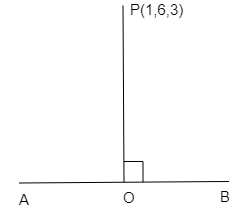
Let us look at the diagrammatic representation of this problem.
Let \[P(1,6,3)\] and AB be the line which is represented by the equation $\dfrac{x}{1} = \dfrac{{y - 1}}{2} = \dfrac{{z - 2}}{3}$
Also, let the point O be the foot of the perpendicular which is drawn from point P to the line AB.
Thus, the figure we get is:
There are two parts which we need to find in the given question.
1) The Coordinates of foot of the perpendicular and
2) The perpendicular distance
The equation given to us is $\dfrac{x}{1} = \dfrac{{y - 1}}{2} = \dfrac{{z - 2}}{3}$. This is basically the Cartesian equation of the line passing through the point $(0,1,2)$ and the direction ratios as $1,2,3$.
Let us consider $O \equiv (x,y,z)$.
We will use the above Cartesian equation in order to find out the coordinates of the point O.
Let $\dfrac{x}{1} = \dfrac{{y - 1}}{2} = \dfrac{{z - 2}}{3} = k$
Hence, for any point $(x,y,z)$ on the line AB:
$x = k$
$y = 2k + 1$
$z = 3k + 2$
Therefore, we have $O(k,2k + 1,3k + 2)$.
Now, let us consider the direction ratios of the two points $O(k,2k + 1,3k + 2)$ and \[P(1,6,3)\]. The direction ratios of these two points are $\overline {OP} \equiv (k - 1,2k - 5,3k - 1)$
Also, we are given that the direction ratios of $\dfrac{x}{1} = \dfrac{{y - 1}}{2} = \dfrac{{z - 2}}{3}$ is given by.
As OP is perpendicular to the line AB, we know that $\overline {OP} \cdot \overline {AB} = 0$
Therefore, $(k - 1,2k - 5,3k - 1) \cdot (1,2,3) = 0$
$\Rightarrow (k - 1)1 + (2k - 5)2 + (3k - 1)3 = 0$
$\Rightarrow k - 1 + 4k - 10 + 9k - 3 = 0$
$14k = 14$
$k = 1$
On putting the value in O, we get,
$O(1,3,5)$
Therefore, $O(1,3,5)$ are the coordinates of the foot of the perpendicular.
To answer the second part, we will only need the distance formula for two points.
Let the length of OP be equal to ‘d’. So,
$d = \sqrt {{{(1 - 1)}^2} + {{(3 - 6)}^2} + {{(5 - 3)}^2}} $
$d = \sqrt {{{(0)}^2} + {{( - 3)}^2} + {{(2)}^2}} $
$d = \sqrt {9 + 4} $
$d = \sqrt {13} $
Therefore, the length of the perpendicular is $d = \sqrt {13} $.
Note:
Students often tend to make substitution errors and in the end they get wrong answers. In this case, the point O has 3 coordinates, therefore, we have modified the distance formula in a way that we are able to compute the distance between 2 points which have 3 coordinates.
To solve this question, use the direction ratios of the given line and the fact that its dot product with the direction ratio of the perpendicular will give the value as 0 to find the coordinates of O. Then, use the distance formula.
$d = \sqrt {{{({x_2} - {x_1})}^2} + {{({y_2} - {y_1})}^2} + {{({z_2} - {z_1})}^2}} $to find the perpendicular distance between the point O and \[P(1,6,3)\].
Complete step by step answer:
Given an equation of a line$\dfrac{x}{1} = \dfrac{{y - 1}}{2} = \dfrac{{z - 2}}{3}$ and a point\[P(1,6,3)\]
Let us look at the diagrammatic representation of this problem.
Let \[P(1,6,3)\] and AB be the line which is represented by the equation $\dfrac{x}{1} = \dfrac{{y - 1}}{2} = \dfrac{{z - 2}}{3}$
Also, let the point O be the foot of the perpendicular which is drawn from point P to the line AB.
Thus, the figure we get is:
There are two parts which we need to find in the given question.
1) The Coordinates of foot of the perpendicular and
2) The perpendicular distance
The equation given to us is $\dfrac{x}{1} = \dfrac{{y - 1}}{2} = \dfrac{{z - 2}}{3}$. This is basically the Cartesian equation of the line passing through the point $(0,1,2)$ and the direction ratios as $1,2,3$.
Let us consider $O \equiv (x,y,z)$.
We will use the above Cartesian equation in order to find out the coordinates of the point O.
Let $\dfrac{x}{1} = \dfrac{{y - 1}}{2} = \dfrac{{z - 2}}{3} = k$
Hence, for any point $(x,y,z)$ on the line AB:
$x = k$
$y = 2k + 1$
$z = 3k + 2$
Therefore, we have $O(k,2k + 1,3k + 2)$.
Now, let us consider the direction ratios of the two points $O(k,2k + 1,3k + 2)$ and \[P(1,6,3)\]. The direction ratios of these two points are $\overline {OP} \equiv (k - 1,2k - 5,3k - 1)$
Also, we are given that the direction ratios of $\dfrac{x}{1} = \dfrac{{y - 1}}{2} = \dfrac{{z - 2}}{3}$ is given by.
As OP is perpendicular to the line AB, we know that $\overline {OP} \cdot \overline {AB} = 0$
Therefore, $(k - 1,2k - 5,3k - 1) \cdot (1,2,3) = 0$
$\Rightarrow (k - 1)1 + (2k - 5)2 + (3k - 1)3 = 0$
$\Rightarrow k - 1 + 4k - 10 + 9k - 3 = 0$
$14k = 14$
$k = 1$
On putting the value in O, we get,
$O(1,3,5)$
Therefore, $O(1,3,5)$ are the coordinates of the foot of the perpendicular.
To answer the second part, we will only need the distance formula for two points.
Let the length of OP be equal to ‘d’. So,
$d = \sqrt {{{(1 - 1)}^2} + {{(3 - 6)}^2} + {{(5 - 3)}^2}} $
$d = \sqrt {{{(0)}^2} + {{( - 3)}^2} + {{(2)}^2}} $
$d = \sqrt {9 + 4} $
$d = \sqrt {13} $
Therefore, the length of the perpendicular is $d = \sqrt {13} $.
Note:
Students often tend to make substitution errors and in the end they get wrong answers. In this case, the point O has 3 coordinates, therefore, we have modified the distance formula in a way that we are able to compute the distance between 2 points which have 3 coordinates.
Recently Updated Pages
Master Class 11 Computer Science: Engaging Questions & Answers for Success

Master Class 11 Business Studies: Engaging Questions & Answers for Success
Master Class 11 Economics: Engaging Questions & Answers for Success
Master Class 11 English: Engaging Questions & Answers for Success
Master Class 11 Maths: Engaging Questions & Answers for Success
Master Class 11 Biology: Engaging Questions & Answers for Success
Trending doubts
One Metric ton is equal to kg A 10000 B 1000 C 100 class 11 physics CBSE
There are 720 permutations of the digits 1 2 3 4 5 class 11 maths CBSE
Discuss the various forms of bacteria class 11 biology CBSE
Draw a diagram of a plant cell and label at least eight class 11 biology CBSE
State the laws of reflection of light
Explain zero factorial class 11 maths CBSE