




A pendulum of 14cm long oscillates through an angle of ${{18}^{\circ }}$ . Find the length (in cm) of the path described by its extremities.
Answer
 Verified
578.1k+ views
Hint: Now we know that the pendulum moves in a circular motion. Hence we can say that the angle is the angle of arc and the length of arc is the radius of the circular motion. Hence we are given with the angle and radius of the circular motion. Now we know that the formula for length of an arc with a given angle and radius is given by $2\pi r\times \dfrac{\theta }{360}$ . Hence we have the length of the required arc.
Complete step by step answer:
Now let us consider the pendulum.
We know that the motion of a pendulum is somewhat circular hence we can say that the extremity of the pendulum will make a circular arc.
Now we are given that the angle of the circular arc will be ${{18}^{\circ }}$ and the radius of the arc is 14cm.
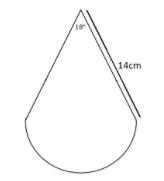
Now we know that the circumference of the arc is given by $2\pi r\times \dfrac{\theta }{360}$ where $\theta $ is the angle made by the arc and r is the radius.
Now we have the radius is 14cm and the angle is ${{18}^{\circ }}$ .
Now substituting the values of angle and radius we get,
The length of arc is
$\begin{align}
& \Rightarrow l=2\pi \left( 14 \right)\times \dfrac{18}{360} \\
& \Rightarrow l=28\pi \dfrac{1}{20} \\
& \Rightarrow l=\dfrac{28\pi }{20} \\
\end{align}$
Hence the length of the arc is $\dfrac{28\pi }{20}$ .
Note: Now note that if the angle is in radians then the length of arc is given by angle × radius. Hence if the angle is given by degree then we can convert the angle into radians and then multiply the angle with radius. Hence we will have the length of the arc.
Complete step by step answer:
Now let us consider the pendulum.
We know that the motion of a pendulum is somewhat circular hence we can say that the extremity of the pendulum will make a circular arc.
Now we are given that the angle of the circular arc will be ${{18}^{\circ }}$ and the radius of the arc is 14cm.
Now we know that the circumference of the arc is given by $2\pi r\times \dfrac{\theta }{360}$ where $\theta $ is the angle made by the arc and r is the radius.
Now we have the radius is 14cm and the angle is ${{18}^{\circ }}$ .
Now substituting the values of angle and radius we get,
The length of arc is
$\begin{align}
& \Rightarrow l=2\pi \left( 14 \right)\times \dfrac{18}{360} \\
& \Rightarrow l=28\pi \dfrac{1}{20} \\
& \Rightarrow l=\dfrac{28\pi }{20} \\
\end{align}$
Hence the length of the arc is $\dfrac{28\pi }{20}$ .
Note: Now note that if the angle is in radians then the length of arc is given by angle × radius. Hence if the angle is given by degree then we can convert the angle into radians and then multiply the angle with radius. Hence we will have the length of the arc.
Recently Updated Pages
Master Class 12 Business Studies: Engaging Questions & Answers for Success

Master Class 12 Biology: Engaging Questions & Answers for Success
Master Class 12 Chemistry: Engaging Questions & Answers for Success
Class 12 Question and Answer - Your Ultimate Solutions Guide
Master Class 11 Social Science: Engaging Questions & Answers for Success
Master Class 11 English: Engaging Questions & Answers for Success
Trending doubts
Explain the Treaty of Vienna of 1815 class 10 social science CBSE
Who Won 36 Oscar Awards? Record Holder Revealed
What is the median of the first 10 natural numbers class 10 maths CBSE
Why is it 530 pm in india when it is 1200 afternoon class 10 social science CBSE
What is the full form of POSCO class 10 social science CBSE
The highest temperature in Karnataka is recorded in class 10 social science CBSE