




A pendulum is oscillating on either side of its rest position. The correct statement is:
A. It has only the kinetic energy
B. It has the maximum kinetic energy at its extreme position
C. It has the maximum potential energy at its rest position
D. The sum of its kinetic energy and potential energy remains constant throughout the motion
Answer
 Verified
658.5k+ views
Hint: A pendulum possesses both the kinetic energy and the potential energy when it is undergoing oscillations about its mean position. The variation of one energy is inverse to the variation of the other energy such that the total energy remains conserved.
Complete step by step answer:
The kinetic energy is defined as the energy possessed by an object by the virtue of its motion while the potential energy is the energy possessed by an object by the virtue of its position.
When a pendulum undergoes oscillatory motion about its mean position then it possesses both the kinetic energy and the potential energy.
The kinetic energy of the bob of the pendulum is zero at the extreme positions while its value is maximum when it passes through its mean position.
The behaviour of the potential energy is opposite to that of the kinetic energy. The potential energy of the bob of the pendulum is maximum at the extreme positions and zero when it passes through its mean position.
The following graph shows the variation of the kinetic energy and the potential energy of a pendulum oscillating about its mean position.
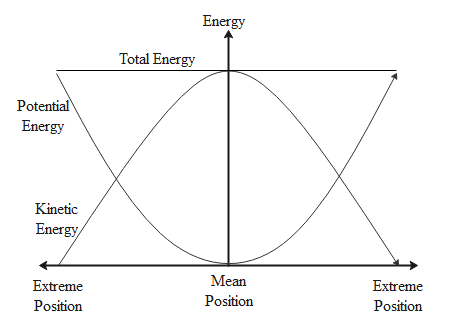
The total energy of the pendulum is equal to the sum of the kinetic energy and potential energy and its value remains constant throughout the motion of the pendulum.
Based on the above discussion, we can say that the correct answer is option D only.
Note:
1. The opposite variation of the kinetic energy and the potential energy ensures that the total energy of the pendulum remains constant.
2. When the pendulum is at its extreme position, it momentarily comes to rest due to which the kinetic energy becomes zero at the extreme positions.
Complete step by step answer:
The kinetic energy is defined as the energy possessed by an object by the virtue of its motion while the potential energy is the energy possessed by an object by the virtue of its position.
When a pendulum undergoes oscillatory motion about its mean position then it possesses both the kinetic energy and the potential energy.
The kinetic energy of the bob of the pendulum is zero at the extreme positions while its value is maximum when it passes through its mean position.
The behaviour of the potential energy is opposite to that of the kinetic energy. The potential energy of the bob of the pendulum is maximum at the extreme positions and zero when it passes through its mean position.
The following graph shows the variation of the kinetic energy and the potential energy of a pendulum oscillating about its mean position.
The total energy of the pendulum is equal to the sum of the kinetic energy and potential energy and its value remains constant throughout the motion of the pendulum.
Based on the above discussion, we can say that the correct answer is option D only.
Note:
1. The opposite variation of the kinetic energy and the potential energy ensures that the total energy of the pendulum remains constant.
2. When the pendulum is at its extreme position, it momentarily comes to rest due to which the kinetic energy becomes zero at the extreme positions.
Recently Updated Pages
Master Class 11 Business Studies: Engaging Questions & Answers for Success

Master Class 11 Social Science: Engaging Questions & Answers for Success
Master Class 11 Accountancy: Engaging Questions & Answers for Success
Master Class 11 Computer Science: Engaging Questions & Answers for Success
Master Class 11 Chemistry: Engaging Questions & Answers for Success
Master Class 11 English: Engaging Questions & Answers for Success
Trending doubts
Find the value of the expression given below sin 30circ class 11 maths CBSE
One Metric ton is equal to kg A 10000 B 1000 C 100 class 11 physics CBSE
10 examples of friction in our daily life
Draw a diagram of a plant cell and label at least eight class 11 biology CBSE
Difference between physical and chemical change class 11 chemistry CBSE
Proton was discovered by A Thomson B Rutherford C Chadwick class 11 chemistry CBSE