




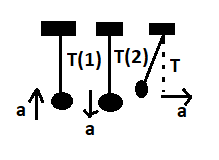
A pendulum is hanging from the ceiling of a cage. If the cage moves up with constant acceleration a, its tension is $ {T_1} $ and if it moves down with the same acceleration, the corresponding tension is $ {T_2} $ . The tension in the string if the cage moves horizontally with same acceleration $ a $ is
(A) $ \dfrac{{\sqrt {T_1^2 + T_2^2} }}{2} $
(B) $ \dfrac{{\sqrt {T_1^2 - T_2^2} }}{2} $
(C) $ \sqrt {\dfrac{{T_1^2 + T_2^2}}{2}} $
(D) None of the above
Answer
 Verified
568.8k+ views
Hint
We draw the free-body diagrams for the three cases. We find the tension in all three cases with the help of the free body diagram. Adding the square of tension (1) and tension (2) we get an equation equal to that of the tension in the third case. Further simplifying we get the relation between all the three tensions.
Complete step by step answer
The free-body diagrams of the three pendulums are
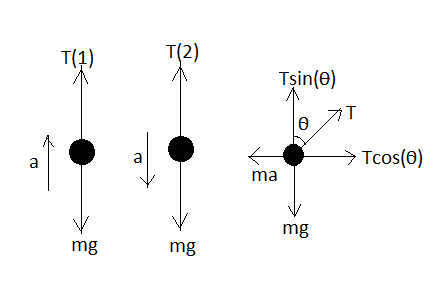
From the free-body diagrams of pendulum 1, pendulum 2, pendulum 3
The force acting on the pendulum due to acceleration is the difference between the tension force and the weight.
The tension in pendulum one is
$ {T_1} - mg = ma $
$ \Rightarrow {T_1} = m\left( {g + a} \right)\; $
$ \Rightarrow \dfrac{{{T_1}}}{m} = g + a.....(1) $
The tension in pendulum 2 is
$ {T_2} - mg = - ma $
$ \Rightarrow {T_2} = m\left( {g - a} \right)\; $
$ \Rightarrow \dfrac{{{T_2}}}{m} = g - a.....(2) $
When the cage moves horizontally with an acceleration $ a $ , let the tension be $ \;T $ .
From the free body diagram,
$ \Rightarrow T\cos\theta = ma $
$ \Rightarrow \;T\sin\theta =mg $
Squaring and adding the above equations,
$ \Rightarrow {\left( {T\sin\theta } \right)^2} + {\left( {T\cos\theta } \right)^2} = {\left( {ma} \right)^2} + {\left( {mg} \right)^2} $
$ (\because {\sin ^2}(\theta ) + {\cos^2}(\theta ) = 1) $
$ \Rightarrow {T^2} = {m^2}\left( {{g^2} + {a^2}} \right)\; .....(3) $
Squaring (1) and (2) and adding
$ {\left( {\dfrac{{{T_1}}}{m}} \right)^2} + {\left( {\dfrac{{{T_2}}}{m}} \right)^2} = {\left( {g + a} \right)^2} + {\left( {g - a} \right)^2} $
$ \because{(a + b)^2} - {(a - b)^2} = 2({a^2} + {b^2}) $
$ \Rightarrow \dfrac{{{T_1}^2 + T_2^2}}{{{m^2}}} = 2({g^2} + {a^2}) $
$ \Rightarrow \dfrac{{T_1^2 + T_2^2}}{2} = \left( {{g^2} + {a^2}} \right){m^2}\;.....(4) $
Equations (3) and (4) are equal, equating (3) and (4)
$ {T^2} = \dfrac{1}{2}(T_1^2 + T_2^2) $
$ \Rightarrow T = \sqrt {\dfrac{1}{2}(T_1^2 + T_2^2)} $
Hence the tension in pendulum three is $ T = \sqrt {\dfrac{1}{2}(T_1^2 + T_2^2)} $
Option (B) $ T = \sqrt {\dfrac{1}{2}(T_1^2 + T_2^2)} $ is the correct answer.
Additional Information
Tension is defined as a pulling force transmitted axially by a rope, string, chain, and rod. A good elastic material can withstand a greater tension force without breaking.
Note
Students may get confused to find if a force is positive or negative. While solving the problem we have considered all the forces acting upwards as positive and all the forces acting downwards as negative, which uses nothing but adding all the forces acting in the direction and subtracting them with the forces acting in the opposite direction.
We draw the free-body diagrams for the three cases. We find the tension in all three cases with the help of the free body diagram. Adding the square of tension (1) and tension (2) we get an equation equal to that of the tension in the third case. Further simplifying we get the relation between all the three tensions.
Complete step by step answer
The free-body diagrams of the three pendulums are
From the free-body diagrams of pendulum 1, pendulum 2, pendulum 3
The force acting on the pendulum due to acceleration is the difference between the tension force and the weight.
The tension in pendulum one is
$ {T_1} - mg = ma $
$ \Rightarrow {T_1} = m\left( {g + a} \right)\; $
$ \Rightarrow \dfrac{{{T_1}}}{m} = g + a.....(1) $
The tension in pendulum 2 is
$ {T_2} - mg = - ma $
$ \Rightarrow {T_2} = m\left( {g - a} \right)\; $
$ \Rightarrow \dfrac{{{T_2}}}{m} = g - a.....(2) $
When the cage moves horizontally with an acceleration $ a $ , let the tension be $ \;T $ .
From the free body diagram,
$ \Rightarrow T\cos\theta = ma $
$ \Rightarrow \;T\sin\theta =mg $
Squaring and adding the above equations,
$ \Rightarrow {\left( {T\sin\theta } \right)^2} + {\left( {T\cos\theta } \right)^2} = {\left( {ma} \right)^2} + {\left( {mg} \right)^2} $
$ (\because {\sin ^2}(\theta ) + {\cos^2}(\theta ) = 1) $
$ \Rightarrow {T^2} = {m^2}\left( {{g^2} + {a^2}} \right)\; .....(3) $
Squaring (1) and (2) and adding
$ {\left( {\dfrac{{{T_1}}}{m}} \right)^2} + {\left( {\dfrac{{{T_2}}}{m}} \right)^2} = {\left( {g + a} \right)^2} + {\left( {g - a} \right)^2} $
$ \because{(a + b)^2} - {(a - b)^2} = 2({a^2} + {b^2}) $
$ \Rightarrow \dfrac{{{T_1}^2 + T_2^2}}{{{m^2}}} = 2({g^2} + {a^2}) $
$ \Rightarrow \dfrac{{T_1^2 + T_2^2}}{2} = \left( {{g^2} + {a^2}} \right){m^2}\;.....(4) $
Equations (3) and (4) are equal, equating (3) and (4)
$ {T^2} = \dfrac{1}{2}(T_1^2 + T_2^2) $
$ \Rightarrow T = \sqrt {\dfrac{1}{2}(T_1^2 + T_2^2)} $
Hence the tension in pendulum three is $ T = \sqrt {\dfrac{1}{2}(T_1^2 + T_2^2)} $
Option (B) $ T = \sqrt {\dfrac{1}{2}(T_1^2 + T_2^2)} $ is the correct answer.
Additional Information
Tension is defined as a pulling force transmitted axially by a rope, string, chain, and rod. A good elastic material can withstand a greater tension force without breaking.
Note
Students may get confused to find if a force is positive or negative. While solving the problem we have considered all the forces acting upwards as positive and all the forces acting downwards as negative, which uses nothing but adding all the forces acting in the direction and subtracting them with the forces acting in the opposite direction.
Recently Updated Pages
Master Class 11 Computer Science: Engaging Questions & Answers for Success

Master Class 11 Business Studies: Engaging Questions & Answers for Success
Master Class 11 Economics: Engaging Questions & Answers for Success
Master Class 11 English: Engaging Questions & Answers for Success
Master Class 11 Maths: Engaging Questions & Answers for Success
Master Class 11 Biology: Engaging Questions & Answers for Success
Trending doubts
One Metric ton is equal to kg A 10000 B 1000 C 100 class 11 physics CBSE
There are 720 permutations of the digits 1 2 3 4 5 class 11 maths CBSE
Discuss the various forms of bacteria class 11 biology CBSE
Draw a diagram of a plant cell and label at least eight class 11 biology CBSE
State the laws of reflection of light
Explain zero factorial class 11 maths CBSE