




A passenger is at a distance of x from a bus when the bus begins to move with constant acceleration a. What is the minimum velocity with which the passenger should run towards the bus so as to reach it?
A) $\sqrt {2ax} $
B) 2ax
C) $\sqrt {ax} $
D) ax
Answer
 Verified
597.9k+ views
Hint:The initial velocity of the bus will be zero and starts moving with acceleration a. The passenger has to cover x meters and the distance before he catches the bus. Using the laws of motion for distance we will find out the expression for distance for the bus and equate it with the distance covered by the passenger and hence find out the minimum velocity needed by man to catch the bus.
Complete step by step answer:
Step 1:
We are given:
A passenger is at a distance of x from a bus.
The bus just starts to move this implies the initial velocity u of the bus is equal to zero.
It began to move with constant acceleration a.
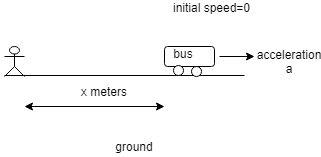
The diagram depicts the conditions given in the question.
We need to find the minimum velocity with which the passenger should run towards the bus so as to reach it.
The passenger is x meters away from the bus and the bus has started to move. Let say when the bus has started to move at time t
The passenger starts running in the direction of the bus and catches it when the bus has travelled some distance.
Let the distance covered by the bus when a passenger caught it is A meters.
The passenger has caught the bus so the distance covered by him will be the addition of x meters and the A meters.
Then the total distance covered by passenger is x + A = A’
Step 2:
The distance covered by the bus is A=ut+$\dfrac{1}{2}a{t^2}$
Initial velocity is zero, so distance is A=$\dfrac{1}{2}a{t^2}$…….. (1)
The passenger has velocity v so distance travelled by passenger is x+ A = v × t ………. (2), here T is the time taken by passenger to catch bus
$\left( {\therefore dis\tan ce = speed \times time} \right)$
Putting value of equation 1 in 2
$ \rightarrow x + \dfrac{1}{2}a{t^2} = vt$, or we can write it as$ \Rightarrow x + \dfrac{1}{2}a{t^2} - vt = 0$….. (3)
Modifying the equation 3 we get, $a{t^2} - 2vt + 2x = 0$ …… (4)
The equation (4) looks like a quadratic equation in terms of t
$\left( {\therefore \dfrac{{ - b \pm \sqrt {{b^2} - 4ac} }}{{2a}}} \right)$ are the roots of quadratic equation.
Applying it on (4) $t = \dfrac{{2v \pm \sqrt {4{v^2} - 8ax} }}{{2a}}$
For time to be real then the discriminator should be greater than zero.
This implies, $4{v^2} - 8ax > 0$, or ${v^2} > 2ad$
From here we can say that velocity v >$\sqrt {2ax} $
This means velocity of the passenger should be greater than $\sqrt {2ax} $ or equal to this in order to catch the bus.
Hence option A is the correct answer.
Note:While solving such problems a very useful method is to assume that the event (catching the bus in this case) happened at time t. Solve for t and find the condition that t is not a real value. Then use it and find the minimum velocity.
Complete step by step answer:
Step 1:
We are given:
A passenger is at a distance of x from a bus.
The bus just starts to move this implies the initial velocity u of the bus is equal to zero.
It began to move with constant acceleration a.
The diagram depicts the conditions given in the question.
We need to find the minimum velocity with which the passenger should run towards the bus so as to reach it.
The passenger is x meters away from the bus and the bus has started to move. Let say when the bus has started to move at time t
The passenger starts running in the direction of the bus and catches it when the bus has travelled some distance.
Let the distance covered by the bus when a passenger caught it is A meters.
The passenger has caught the bus so the distance covered by him will be the addition of x meters and the A meters.
Then the total distance covered by passenger is x + A = A’
Step 2:
The distance covered by the bus is A=ut+$\dfrac{1}{2}a{t^2}$
Initial velocity is zero, so distance is A=$\dfrac{1}{2}a{t^2}$…….. (1)
The passenger has velocity v so distance travelled by passenger is x+ A = v × t ………. (2), here T is the time taken by passenger to catch bus
$\left( {\therefore dis\tan ce = speed \times time} \right)$
Putting value of equation 1 in 2
$ \rightarrow x + \dfrac{1}{2}a{t^2} = vt$, or we can write it as$ \Rightarrow x + \dfrac{1}{2}a{t^2} - vt = 0$….. (3)
Modifying the equation 3 we get, $a{t^2} - 2vt + 2x = 0$ …… (4)
The equation (4) looks like a quadratic equation in terms of t
$\left( {\therefore \dfrac{{ - b \pm \sqrt {{b^2} - 4ac} }}{{2a}}} \right)$ are the roots of quadratic equation.
Applying it on (4) $t = \dfrac{{2v \pm \sqrt {4{v^2} - 8ax} }}{{2a}}$
For time to be real then the discriminator should be greater than zero.
This implies, $4{v^2} - 8ax > 0$, or ${v^2} > 2ad$
From here we can say that velocity v >$\sqrt {2ax} $
This means velocity of the passenger should be greater than $\sqrt {2ax} $ or equal to this in order to catch the bus.
Hence option A is the correct answer.
Note:While solving such problems a very useful method is to assume that the event (catching the bus in this case) happened at time t. Solve for t and find the condition that t is not a real value. Then use it and find the minimum velocity.
Recently Updated Pages
Master Class 11 Social Science: Engaging Questions & Answers for Success

Master Class 11 Physics: Engaging Questions & Answers for Success
Master Class 11 Maths: Engaging Questions & Answers for Success
Master Class 11 Economics: Engaging Questions & Answers for Success
Master Class 11 Computer Science: Engaging Questions & Answers for Success
Master Class 11 Chemistry: Engaging Questions & Answers for Success
Trending doubts
One Metric ton is equal to kg A 10000 B 1000 C 100 class 11 physics CBSE
There are 720 permutations of the digits 1 2 3 4 5 class 11 maths CBSE
1 Quintal is equal to a 110 kg b 10 kg c 100kg d 1000 class 11 physics CBSE
State and prove Bernoullis theorem class 11 physics CBSE
Difference Between Prokaryotic Cells and Eukaryotic Cells
Which among the following are examples of coming together class 11 social science CBSE