




A particle starts S.H.M. from the mean position as shown in the figure below. Its amplitude is $ A $ , its time period is $ T $ . At what displacement, its speed is half of its maximum speed?
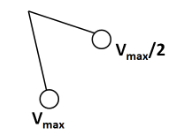
(A) $ \dfrac{{\sqrt 3 }}{2}A $
(B) $ \dfrac{{\sqrt 2 }}{3}A $
(C) $ \dfrac{2}{{\sqrt 3 }}A $
(D) $ \dfrac{3}{{\sqrt 2 }}A $
Answer
 Verified
559k+ views
Hint : To solve this question, we need to use the relation between the speed and the displacement of a particle performing S.H.M. On substituting the value of maximum speed in that formula, we will get the required displacement of the particle from the mean position.
Formula used: The formula used to solve this question is
$ v = \omega \sqrt {{A^2} - {x^2}} $ , $ v $ is the speed, $ A $ is the amplitude, $ \omega $ is the angular velocity, and $ x $ is the displacement of a particle performing S.H.M.
Complete step by step answer
Let the displacement be $ d $ of the particle from the mean position be at which its speed is half of its maximum.
We know that the speed and the displacement in the simple harmonic motion are related by the formula
$ v = \omega \sqrt {{A^2} - {x^2}} $ (1)
We also know that the speed of the particle is maximum at the mean position. At the mean position its displacement is equal to zero. Therefore, substituting $ x = 0 $ in (1) we get the maximum speed of the particle as
$ {V_0} = \omega \sqrt {{A^2} - {0^2}} $
$ {V_0} = \omega A $ (2)
Now, according to the question, the speed of the particle is equal to the half of the maximum, that is,
$ v = \dfrac{{{V_0}}}{2} $
From (2)
$ v = \dfrac{{\omega A}}{2} $
Substituting this in (1) we get
$ \dfrac{{\omega A}}{2} = \omega \sqrt {{A^2} - {x^2}} $
According to our assumption, $ x = d $ . Therefore
$ \dfrac{{\omega A}}{2} = \omega \sqrt {{A^2} - {d^2}} $
Cancelling $ \omega $ from both the sides, we have
$ \dfrac{A}{2} = \sqrt {{A^2} - {d^2}} $
On squaring both the sides, we get
$ \dfrac{{{A^2}}}{4} = {A^2} - {d^2} $
$ \Rightarrow {d^2} = {A^2} - \dfrac{{{A^2}}}{4} $
Taking the LCM
$ {d^2} = \dfrac{{4{A^2} - {A^2}}}{4} $
$ \Rightarrow {d^2} = \dfrac{{3{A^2}}}{4} $
Taking the square root both the sides, we finally get
$ d = \dfrac{{\sqrt 3 A}}{2} $
Thus, the displacement of the particle from the mean position, at which its speed is equal to the half of the maximum, is equal to $ \dfrac{{\sqrt 3 }}{2}A $ .
Hence, the correct answer is option A.
Note
While solving for the displacement, we will have one negative and one positive value. But we have only considered the positive root. This is because there were only positive displacements mentioned in the options. Also, the positive and negative sign of the displacement depends upon our choice.
Formula used: The formula used to solve this question is
$ v = \omega \sqrt {{A^2} - {x^2}} $ , $ v $ is the speed, $ A $ is the amplitude, $ \omega $ is the angular velocity, and $ x $ is the displacement of a particle performing S.H.M.
Complete step by step answer
Let the displacement be $ d $ of the particle from the mean position be at which its speed is half of its maximum.
We know that the speed and the displacement in the simple harmonic motion are related by the formula
$ v = \omega \sqrt {{A^2} - {x^2}} $ (1)
We also know that the speed of the particle is maximum at the mean position. At the mean position its displacement is equal to zero. Therefore, substituting $ x = 0 $ in (1) we get the maximum speed of the particle as
$ {V_0} = \omega \sqrt {{A^2} - {0^2}} $
$ {V_0} = \omega A $ (2)
Now, according to the question, the speed of the particle is equal to the half of the maximum, that is,
$ v = \dfrac{{{V_0}}}{2} $
From (2)
$ v = \dfrac{{\omega A}}{2} $
Substituting this in (1) we get
$ \dfrac{{\omega A}}{2} = \omega \sqrt {{A^2} - {x^2}} $
According to our assumption, $ x = d $ . Therefore
$ \dfrac{{\omega A}}{2} = \omega \sqrt {{A^2} - {d^2}} $
Cancelling $ \omega $ from both the sides, we have
$ \dfrac{A}{2} = \sqrt {{A^2} - {d^2}} $
On squaring both the sides, we get
$ \dfrac{{{A^2}}}{4} = {A^2} - {d^2} $
$ \Rightarrow {d^2} = {A^2} - \dfrac{{{A^2}}}{4} $
Taking the LCM
$ {d^2} = \dfrac{{4{A^2} - {A^2}}}{4} $
$ \Rightarrow {d^2} = \dfrac{{3{A^2}}}{4} $
Taking the square root both the sides, we finally get
$ d = \dfrac{{\sqrt 3 A}}{2} $
Thus, the displacement of the particle from the mean position, at which its speed is equal to the half of the maximum, is equal to $ \dfrac{{\sqrt 3 }}{2}A $ .
Hence, the correct answer is option A.
Note
While solving for the displacement, we will have one negative and one positive value. But we have only considered the positive root. This is because there were only positive displacements mentioned in the options. Also, the positive and negative sign of the displacement depends upon our choice.
Recently Updated Pages
Master Class 12 Economics: Engaging Questions & Answers for Success

Master Class 12 English: Engaging Questions & Answers for Success
Master Class 12 Social Science: Engaging Questions & Answers for Success
Master Class 12 Maths: Engaging Questions & Answers for Success
Master Class 12 Physics: Engaging Questions & Answers for Success
Master Class 11 Social Science: Engaging Questions & Answers for Success
Trending doubts
One Metric ton is equal to kg A 10000 B 1000 C 100 class 11 physics CBSE
Difference Between Prokaryotic Cells and Eukaryotic Cells
Two of the body parts which do not appear in MRI are class 11 biology CBSE
1 ton equals to A 100 kg B 1000 kg C 10 kg D 10000 class 11 physics CBSE
Draw a diagram of nephron and explain its structur class 11 biology CBSE
10 examples of friction in our daily life