




A particle starts moving from rest with uniform acceleration. It travels a distance $x$ in first 3 seconds and distance $y$ in next two seconds .Then:
A. $y = 3x$
B. $y = 4x$
C. $y = x$
D. $y = 2x$
Answer
 Verified
657.6k+ views
Hint: We have to first find the displacement travelled in first 2 seconds which is our $x$ .Then we have to find the displacement travelled in first 4 seconds which will be the total displacement denoted by $s$ Taking their difference will give us the displacement travelled in 3rd and 4th seconds which is denoted here as y. Finally we have found their relationship.
Formula used:
$s = ut + \dfrac{1}{2}a{t^2}$ , where $s$ is the total displacement travelled in t time,$u$ is the initial velocity, $t$ is the time taken, $a$ is the acceleration.
Complete step by step answer:
The displacement travelled in the first two seconds can be found using the equation $s = ut + \dfrac{1}{2}a{t^2}$, where $s$ is the total displacement travelled in t time, $u$ is the initial velocity, $t$ is the time taken, $a$ is the acceleration.
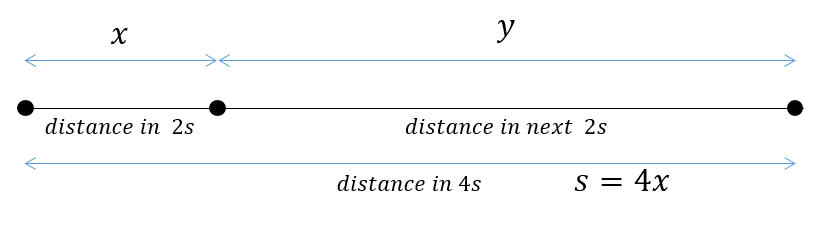
Substituting the values given in the question that the initial velocity $u$ is zero and $t = 2s$ in $s = ut + \dfrac{1}{2}a{t^2}$, we get
$x = \dfrac{1}{2}a{(2)^2}$
$x = 2a$
Similarly substituting the value of $u$=0 and $t$=4s, we get the total displacement s.
$s = \dfrac{1}{2}a{(4)^2}$
$\Rightarrow s = 8a$
To find the displacement travelled in 3 and 4th second, we take their difference.
$y = s - x$
$\Rightarrow y = 8a - 2a$
$\Rightarrow y = 6a$
We can see that $y$ is three times $x$ .Therefore $y = 3x$
The correct option is A.
Note: The distance travelled in a uniformly accelerated motion follows a simple ratio. The total distance travelled from $t = 0$ to $t = t$ follows the ratio of ${1:4:9:16......}$ If we want the ratio of distances travelled from a certain time to t(like in this question) i.e. suppose the ratio of the distance covered in first 3 seconds to the next three seconds etc. the ratio will be ${1:3:5:7....}$
Formula used:
$s = ut + \dfrac{1}{2}a{t^2}$ , where $s$ is the total displacement travelled in t time,$u$ is the initial velocity, $t$ is the time taken, $a$ is the acceleration.
Complete step by step answer:
The displacement travelled in the first two seconds can be found using the equation $s = ut + \dfrac{1}{2}a{t^2}$, where $s$ is the total displacement travelled in t time, $u$ is the initial velocity, $t$ is the time taken, $a$ is the acceleration.
Substituting the values given in the question that the initial velocity $u$ is zero and $t = 2s$ in $s = ut + \dfrac{1}{2}a{t^2}$, we get
$x = \dfrac{1}{2}a{(2)^2}$
$x = 2a$
Similarly substituting the value of $u$=0 and $t$=4s, we get the total displacement s.
$s = \dfrac{1}{2}a{(4)^2}$
$\Rightarrow s = 8a$
To find the displacement travelled in 3 and 4th second, we take their difference.
$y = s - x$
$\Rightarrow y = 8a - 2a$
$\Rightarrow y = 6a$
We can see that $y$ is three times $x$ .Therefore $y = 3x$
The correct option is A.
Note: The distance travelled in a uniformly accelerated motion follows a simple ratio. The total distance travelled from $t = 0$ to $t = t$ follows the ratio of ${1:4:9:16......}$ If we want the ratio of distances travelled from a certain time to t(like in this question) i.e. suppose the ratio of the distance covered in first 3 seconds to the next three seconds etc. the ratio will be ${1:3:5:7....}$
Recently Updated Pages
Master Class 11 Social Science: Engaging Questions & Answers for Success

Master Class 11 English: Engaging Questions & Answers for Success
Master Class 11 Accountancy: Engaging Questions & Answers for Success
Master Class 11 Physics: Engaging Questions & Answers for Success
Master Class 11 Computer Science: Engaging Questions & Answers for Success
Master Class 11 Business Studies: Engaging Questions & Answers for Success
Trending doubts
Find the value of the expression given below sin 30circ class 11 maths CBSE
One Metric ton is equal to kg A 10000 B 1000 C 100 class 11 physics CBSE
Draw a diagram of nephron and explain its structur class 11 biology CBSE
10 examples of friction in our daily life
Proton was discovered by A Thomson B Rutherford C Chadwick class 11 chemistry CBSE
The teeth used for biting and cutting food are called class 11 biology CBSE