




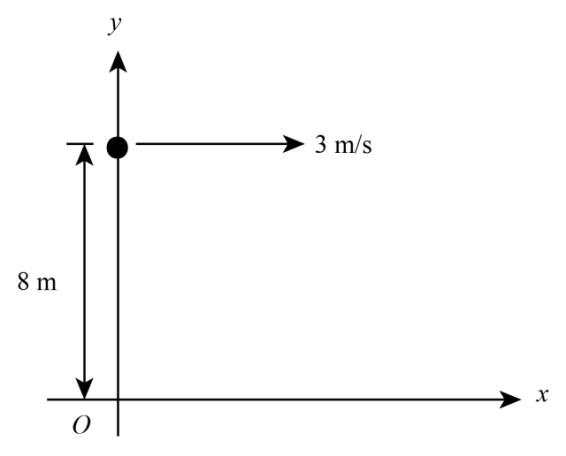
A particle starts from the point $\left( {0m,8m} \right)$and moves with uniform velocity of 3.$\vec i$$m/s$.. After 5 seconds, angular velocity of the particle about the origin will be
A. \[\dfrac{8}{{289}}\;rad/s\]
B. $\dfrac{3}{8}rad/s$
C. $\dfrac{{24}}{{289}}rad/s$
D. $\dfrac{8}{{17}}rad/s$
Answer
 Verified
611.4k+ views
Hint: To solve this problem first we know about linear velocity and angular velocity. Linear velocity means the rate of change of the position of an object that is traveling along a straight line and angular velocity is defined as the rate of change of angular position of a rotating body. Also, $\hat i$ here represents the direction along the x-axis.
Complete step by step answer:
According to the given figure:
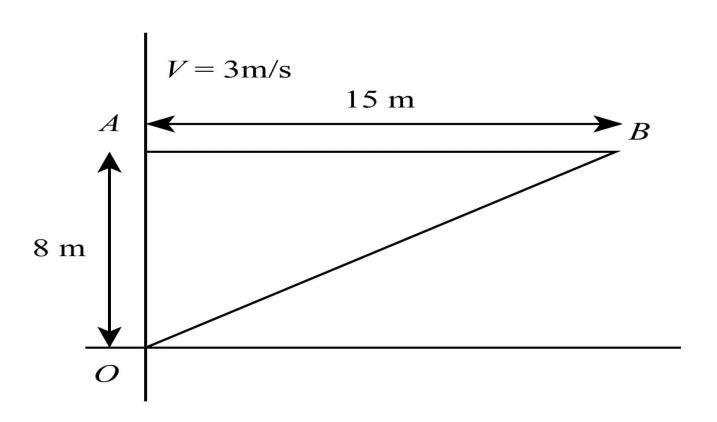
After 5seconds, the particle is at point B and has travelled a linear distance
$x{\rm{ }} = {\rm{ }}v \times t$
$x = 5 \times 3m$
$x = 15m$
Now by using Pythagoras theorem we find distance of OB
${\rm{OB = }}\sqrt {{8^2} + {{15}^2}} $
${\rm{OB = 17m}}$.
It is from the origin O.
Therefore, the angular velocity about the origin.
$\omega = v \times r$
(Where $v$ is the velocity, $r$ is the radius, $\omega $ is angular velocity.)
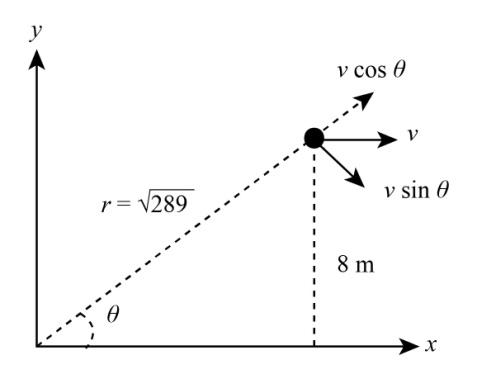
We find the value of $\sin \theta $ from a right angled triangle shown in above figure by using trigonometric ratio.
$\sin \theta = \dfrac{{\rm{P}}}{{\rm{H}}}$
($P$ is the perpendicular, and $H$ is the Hypotenuse.)
$\Rightarrow \sin \theta = \dfrac{8}{{17}}$ (By using trigonometric ratio)
When body rotate about origin then we find out angular velocity
$\Rightarrow\omega = \dfrac{{v\sin \theta }}{r}$
$\Rightarrow \omega = \dfrac{{3 \times 8}}{{{r^2}}}$
$\Rightarrow \omega = \dfrac{{24}}{{{{17}^2}}}$
$\Rightarrow \omega = \dfrac{{24}}{{289}}\;rad/s$
$\therefore \omega = \dfrac{{24}}{{289}}\;rad/s$
Therefore, the correct option is (C).
Additional information:
An object rotating about its axis, every point on the object has the same angular velocity. Tangential velocity at any point is proportional to its distance from the axis of rotation. And the rate of change of angular velocity is also called angular acceleration.
Note:
Angular velocity plays a very important role in the rotational motion of an object. If an object showing rotational motion all particles move in a circle. The linear velocity is directly related to the angular velocity of the whole object.
Complete step by step answer:
According to the given figure:
After 5seconds, the particle is at point B and has travelled a linear distance
$x{\rm{ }} = {\rm{ }}v \times t$
$x = 5 \times 3m$
$x = 15m$
Now by using Pythagoras theorem we find distance of OB
${\rm{OB = }}\sqrt {{8^2} + {{15}^2}} $
${\rm{OB = 17m}}$.
It is from the origin O.
Therefore, the angular velocity about the origin.
$\omega = v \times r$
(Where $v$ is the velocity, $r$ is the radius, $\omega $ is angular velocity.)
We find the value of $\sin \theta $ from a right angled triangle shown in above figure by using trigonometric ratio.
$\sin \theta = \dfrac{{\rm{P}}}{{\rm{H}}}$
($P$ is the perpendicular, and $H$ is the Hypotenuse.)
$\Rightarrow \sin \theta = \dfrac{8}{{17}}$ (By using trigonometric ratio)
When body rotate about origin then we find out angular velocity
$\Rightarrow\omega = \dfrac{{v\sin \theta }}{r}$
$\Rightarrow \omega = \dfrac{{3 \times 8}}{{{r^2}}}$
$\Rightarrow \omega = \dfrac{{24}}{{{{17}^2}}}$
$\Rightarrow \omega = \dfrac{{24}}{{289}}\;rad/s$
$\therefore \omega = \dfrac{{24}}{{289}}\;rad/s$
Therefore, the correct option is (C).
Additional information:
An object rotating about its axis, every point on the object has the same angular velocity. Tangential velocity at any point is proportional to its distance from the axis of rotation. And the rate of change of angular velocity is also called angular acceleration.
Note:
Angular velocity plays a very important role in the rotational motion of an object. If an object showing rotational motion all particles move in a circle. The linear velocity is directly related to the angular velocity of the whole object.
Recently Updated Pages
Master Class 11 Social Science: Engaging Questions & Answers for Success

Master Class 11 English: Engaging Questions & Answers for Success
Master Class 11 Maths: Engaging Questions & Answers for Success
Master Class 11 Chemistry: Engaging Questions & Answers for Success
Master Class 11 Biology: Engaging Questions & Answers for Success
Master Class 11 Physics: Engaging Questions & Answers for Success
Trending doubts
Differentiate between an exothermic and an endothermic class 11 chemistry CBSE
One Metric ton is equal to kg A 10000 B 1000 C 100 class 11 physics CBSE
Difference Between Prokaryotic Cells and Eukaryotic Cells
There are 720 permutations of the digits 1 2 3 4 5 class 11 maths CBSE
Draw a diagram of a plant cell and label at least eight class 11 biology CBSE
Which chemical is known as king of chemicals A H 2 class 11 chemistry CBSE