




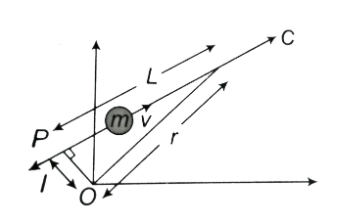
A particle of mass m moves along a line PC with velocity v, as shown in the figure above. What is the angular momentum of the particle about P?
A. mvL
B. mvI
C. mvr
D. Zero
Answer
 Verified
637.8k+ views
Hint: At first try to concentrate on the values that are given in the question and try to find the relationships between them. Now we have to write the general formula for angular momentum and then change it from vector form to scalar. Then we will have to figure out the angle between v and r. And then replace it in the main equation to get the required result.
Formula Used:
$\vec{L}=\vec{r}\times \left( m\vec{v} \right)$
Complete step-by-step answer:
In the question it says that there is a particle which has a mass ‘m’.
The particle is moving along a line that is PC.
The particle has a velocity v.
Now we are asked to find the angular momentum about point P.
Now, to solve this question we know that angular momentum vector can be represented by,
$\vec{L}=\vec{r}\times \left( m\vec{v} \right)$,
Now if we remove the vector sign then we can write the same thing as,
$L=rmv\sin \theta $
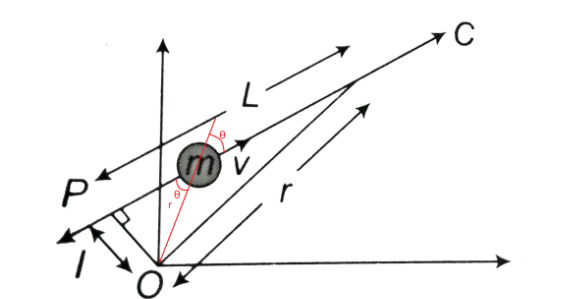
We can now figure out the angle between ‘r’ and ‘v’ from this diagram.
Now, we can say that $r\sin \theta =l$
So,
We already know that $L=mv\left( r\sin \theta \right)$.
So, on replacing this equation with $r\sin \theta =l$, we get,
$L=mvl$
which is actually written as,
$\text{angular momentum = linear momentum }\times \text{ lever arm}$
Therefore option B, mvl is the correct option.
Note: In the equation $L=rmv\sin \theta $, $\theta $ is the angle between r and v, m is the mass of the particle, r is actually the position vector of the particle and v is the velocity. Students must do all the substitution correctly to get the required answer, and must not do step jumping as each step contains marks.
Formula Used:
$\vec{L}=\vec{r}\times \left( m\vec{v} \right)$
Complete step-by-step answer:
In the question it says that there is a particle which has a mass ‘m’.
The particle is moving along a line that is PC.
The particle has a velocity v.
Now we are asked to find the angular momentum about point P.
Now, to solve this question we know that angular momentum vector can be represented by,
$\vec{L}=\vec{r}\times \left( m\vec{v} \right)$,
Now if we remove the vector sign then we can write the same thing as,
$L=rmv\sin \theta $
We can now figure out the angle between ‘r’ and ‘v’ from this diagram.
Now, we can say that $r\sin \theta =l$
So,
We already know that $L=mv\left( r\sin \theta \right)$.
So, on replacing this equation with $r\sin \theta =l$, we get,
$L=mvl$
which is actually written as,
$\text{angular momentum = linear momentum }\times \text{ lever arm}$
Therefore option B, mvl is the correct option.
Note: In the equation $L=rmv\sin \theta $, $\theta $ is the angle between r and v, m is the mass of the particle, r is actually the position vector of the particle and v is the velocity. Students must do all the substitution correctly to get the required answer, and must not do step jumping as each step contains marks.
Recently Updated Pages
Basicity of sulphurous acid and sulphuric acid are

Master Class 11 English: Engaging Questions & Answers for Success
Master Class 11 Physics: Engaging Questions & Answers for Success
Master Class 11 Computer Science: Engaging Questions & Answers for Success
Master Class 11 Chemistry: Engaging Questions & Answers for Success
Master Class 11 Social Science: Engaging Questions & Answers for Success
Trending doubts
Difference Between Prokaryotic Cells and Eukaryotic Cells
Two of the body parts which do not appear in MRI are class 11 biology CBSE
One Metric ton is equal to kg A 10000 B 1000 C 100 class 11 physics CBSE
10 examples of friction in our daily life
Draw a diagram of nephron and explain its structur class 11 biology CBSE
What will happen if the mucus is not secreted by the class 11 biology CBSE