




A particle of mass M is situated at the center of a spherical shell of mass and radius a. The magnitude of gravitational potential at a point situated at a/2 distance from the center will be:
(A) $ \dfrac{2GM}{a} $
(B) $ \dfrac{3GM}{a} $
(C) $ \dfrac{4GM}{a} $
(D) $ \dfrac{GM}{a} $
Answer
 Verified
593.1k+ views
Hint: As we know that the potential in the interior of the spherical shell does not change so adding the potential of the spherical shell to the potential generated by the mass at the center gives the potential at the required point.
Formula used: $ V=\dfrac{GM}{r} $
Here, V is the gravitational potential of the spherical shell of mass M and radius r, G is the gravitational constant.
Complete step by step answer:
Let P be the point at a distance a/2 from the center of the spherical shell where gravitational potential is needed to be found.
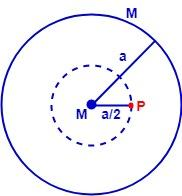
Potential at point P due to spherical shell is given by:
$\Rightarrow V_sphere=\dfrac{GM}{a} $ (Potential is same at every point inside the shell)
Potential at point P due to the particle of mass M at the center is given by:
$\Rightarrow V_particle=GM $ (Here, a/2 is the distance of point P from the mass M)
Total gravitational potential at point P = Sum of all potentials
i.e.
$\Rightarrow V_P=V_sphere+V_particle $
$ \begin{align}
&\Rightarrow\dfrac{GM}{a}+\dfrac{GM}{{}^{a}/{}_{2}} \\
&\Rightarrow\dfrac{GM}{a}+\dfrac{2GM}{a} \\
&\Rightarrow\dfrac{3GM}{a} \\
\end{align} $.
Note:
Do not confuse the electric field of the spherical shell with the potential inside it. As the electric field inside is zero so using the relation $ E=-\dfrac{dV}{dx} $ we find that the potential at the surface and inside the shell is same and constant.
Formula used: $ V=\dfrac{GM}{r} $
Here, V is the gravitational potential of the spherical shell of mass M and radius r, G is the gravitational constant.
Complete step by step answer:
Let P be the point at a distance a/2 from the center of the spherical shell where gravitational potential is needed to be found.
Potential at point P due to spherical shell is given by:
$\Rightarrow V_sphere=\dfrac{GM}{a} $ (Potential is same at every point inside the shell)
Potential at point P due to the particle of mass M at the center is given by:
$\Rightarrow V_particle=GM $ (Here, a/2 is the distance of point P from the mass M)
Total gravitational potential at point P = Sum of all potentials
i.e.
$\Rightarrow V_P=V_sphere+V_particle $
$ \begin{align}
&\Rightarrow\dfrac{GM}{a}+\dfrac{GM}{{}^{a}/{}_{2}} \\
&\Rightarrow\dfrac{GM}{a}+\dfrac{2GM}{a} \\
&\Rightarrow\dfrac{3GM}{a} \\
\end{align} $.
Note:
Do not confuse the electric field of the spherical shell with the potential inside it. As the electric field inside is zero so using the relation $ E=-\dfrac{dV}{dx} $ we find that the potential at the surface and inside the shell is same and constant.
Recently Updated Pages
Master Class 11 Social Science: Engaging Questions & Answers for Success

Master Class 11 English: Engaging Questions & Answers for Success
Master Class 11 Maths: Engaging Questions & Answers for Success
Master Class 11 Chemistry: Engaging Questions & Answers for Success
Master Class 11 Biology: Engaging Questions & Answers for Success
Master Class 11 Physics: Engaging Questions & Answers for Success
Trending doubts
Differentiate between an exothermic and an endothermic class 11 chemistry CBSE
One Metric ton is equal to kg A 10000 B 1000 C 100 class 11 physics CBSE
Difference Between Prokaryotic Cells and Eukaryotic Cells
There are 720 permutations of the digits 1 2 3 4 5 class 11 maths CBSE
Draw a diagram of a plant cell and label at least eight class 11 biology CBSE
Which chemical is known as king of chemicals A H 2 class 11 chemistry CBSE