




A particle of mass m is moving with speed 2v and collides with a mass 2m moving with speed v in the same direction. After collision, the first mass is stopped completely while the second one splits into two particles each of mass m which moves at an angle of 45 degree with respect to the original direction. The speed of the moving particle will be?
A. $\dfrac{v}{{2\sqrt 2 }}$
B. $2\sqrt 2 v$
C. $\sqrt 2 v$
D. $\dfrac{v}{{\sqrt 2 }}$
Answer
 Verified
597.6k+ views
Hint- For solving this numerical we will mainly use the momentum conservation which is nothing but simply a statement of Newton's third law of motion. During a collision the forces on the colliding bodies are always equal and opposite at each instant.
Step-By-Step answer:
As we know the forces cannot be anything but equal and opposite at each instant during collision. Hence the impulses (force multiplied by time) on each body are equal and opposite at each instant and also for the entire duration of the collision.
Impulses of the colliding bodies are nothing but changes in momentum of colliding bodies. Hence changes in momentum are always equal and opposite for colliding bodies. If the momentum of one body increases then the momentum of the other must decrease by the same magnitude. Therefore the momentum is always conserved.
By applying the momentum conservation in horizontal direction
Momentum of the body before collision
=$2mv + 2mv$
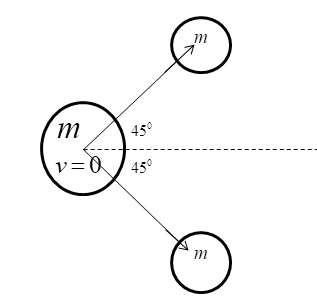
$mv'\cos {45^0} + mv'\cos {45^0}$
Momentum of the body after collision
=
Since the momentum of the body is conserved
Momentum before collision = momentum after collision
$2mv + 2mv$ = $mv'\cos {45^0} + mv'\cos {45^0}$
$
4v = \sqrt 2 v' \\
v' = 2\sqrt 2 v \\
$
Hence, the correct option is “B”.
Note- If the two bodies collide in a way that some energy changes from kinetic to something else or if the deformation of the bodies takes place in a way that they cannot recover fully then energy is not conserved. Also remember we can apply momentum conservation only when the net external force on the body is zero.
Step-By-Step answer:
As we know the forces cannot be anything but equal and opposite at each instant during collision. Hence the impulses (force multiplied by time) on each body are equal and opposite at each instant and also for the entire duration of the collision.
Impulses of the colliding bodies are nothing but changes in momentum of colliding bodies. Hence changes in momentum are always equal and opposite for colliding bodies. If the momentum of one body increases then the momentum of the other must decrease by the same magnitude. Therefore the momentum is always conserved.
By applying the momentum conservation in horizontal direction
Momentum of the body before collision
=$2mv + 2mv$
$mv'\cos {45^0} + mv'\cos {45^0}$
Momentum of the body after collision
=
Since the momentum of the body is conserved
Momentum before collision = momentum after collision
$2mv + 2mv$ = $mv'\cos {45^0} + mv'\cos {45^0}$
$
4v = \sqrt 2 v' \\
v' = 2\sqrt 2 v \\
$
Hence, the correct option is “B”.
Note- If the two bodies collide in a way that some energy changes from kinetic to something else or if the deformation of the bodies takes place in a way that they cannot recover fully then energy is not conserved. Also remember we can apply momentum conservation only when the net external force on the body is zero.
Recently Updated Pages
Master Class 11 Computer Science: Engaging Questions & Answers for Success

Master Class 11 Business Studies: Engaging Questions & Answers for Success
Master Class 11 Economics: Engaging Questions & Answers for Success
Master Class 11 English: Engaging Questions & Answers for Success
Master Class 11 Maths: Engaging Questions & Answers for Success
Master Class 11 Biology: Engaging Questions & Answers for Success
Trending doubts
One Metric ton is equal to kg A 10000 B 1000 C 100 class 11 physics CBSE
There are 720 permutations of the digits 1 2 3 4 5 class 11 maths CBSE
Discuss the various forms of bacteria class 11 biology CBSE
Draw a diagram of a plant cell and label at least eight class 11 biology CBSE
State the laws of reflection of light
Explain zero factorial class 11 maths CBSE