




A particle of mass $m$ is moving in a plane along a circular path of radius $r$. its angular momentum along the axis of rotation is $L$. the centripetal force acting on the particle is:
A. $\dfrac{{{L}^{2}}}{mr}$
B. $\dfrac{{{L}^{2}}m}{r}$
C. $\dfrac{{{L}^{2}}}{m{{r}^{3}}}$
D. $\dfrac{{{L}^{2}}}{m{{r}^{2}}}$
Answer
 Verified
570k+ views
Hint: The concept to be used here is of angular momentum and its formula and how it can be changed to represent the centripetal force which is acting on the particle.
Shuffle the terms in the formula of angular momentum and bring it in the form of any one term present in the formula of centripetal force.
Then substitute the whole value of the term in the formula of centripetal force and solving it will give the required answer.
Complete step by step answer:
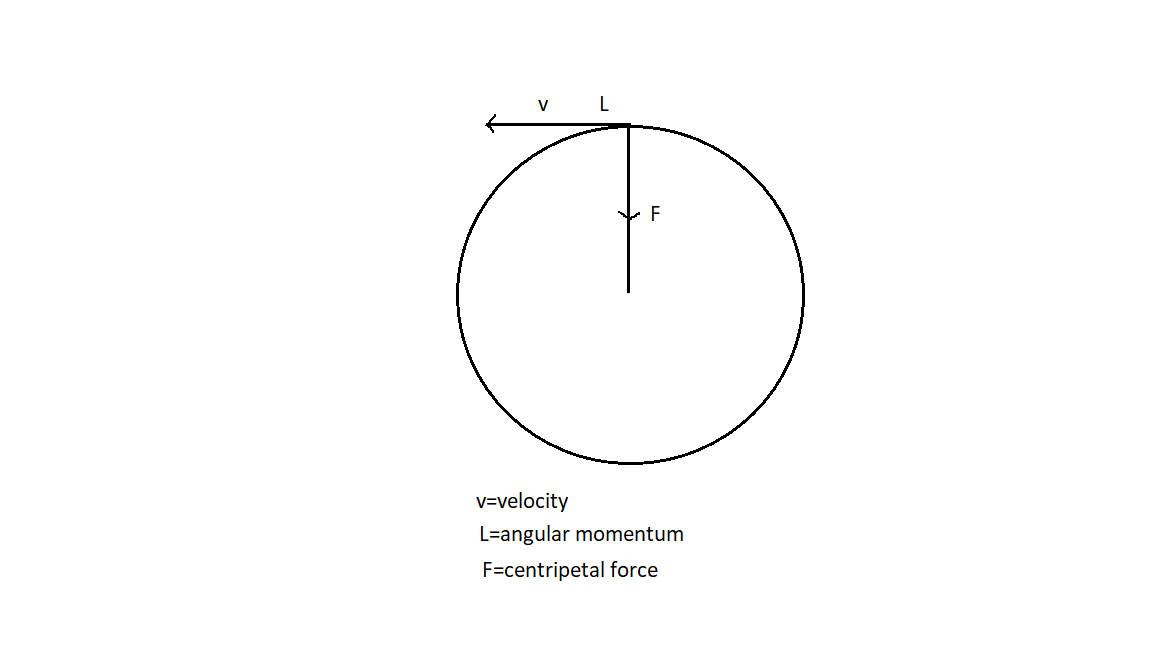
We can see in the figure that the body is moving in a circular path with velocity perpendicular to the centripetal force. Also, it has angular momentum $L$ which can be found using its formula as velocity is perpendicular to position vector which is radius from the rotating axis so momentum vector is perpendicular to radius vector so
$L=rp\sin \theta $ where $\overset{\to }{\mathop{r}}\,$is position vector and $\overset{\to }{\mathop{p}}\,$ is linear momentum
and$\theta $ is the angle between both which in our case is ${{90}^{0}}$.
So $L=m\times v\times r......\left( 1 \right)$
And centripetal force
$F=\dfrac{m{{v}^{2}}}{r}$
Replacing value of $v$ from $\left( 1 \right)$
$v=\dfrac{L}{mr}$
Now putting this value in centripetal force equation to find its value in terms of angular momentum
$F{{=}^{{}}}\dfrac{m}{r}{{\left( \dfrac{L}{mr} \right)}^{2}}=\dfrac{{{L}^{2}}}{m{{r}^{3}}}......\left( 2 \right)$
So, we can see that centripetal force is expressed in terms of angular momentum and the correct option is C.
Note:
Angular momentum can be expressed for both linear and rotational motion as well as for both combined too. $L=I\times w$ where $I$ is moment of inertia and $w$ is angular velocity of rotational motion.
Centripetal force is the force responsible for rotating a body in a circular motion.it arise due to other forces which act on the body in a circular path. Its direction is always towards the centre. It also gives rise to centripetal acceleration.
Centrifugal force is opposite in direction to centripetal force but equal in magnitude.it is a fictitious force.
Shuffle the terms in the formula of angular momentum and bring it in the form of any one term present in the formula of centripetal force.
Then substitute the whole value of the term in the formula of centripetal force and solving it will give the required answer.
Complete step by step answer:
We can see in the figure that the body is moving in a circular path with velocity perpendicular to the centripetal force. Also, it has angular momentum $L$ which can be found using its formula as velocity is perpendicular to position vector which is radius from the rotating axis so momentum vector is perpendicular to radius vector so
$L=rp\sin \theta $ where $\overset{\to }{\mathop{r}}\,$is position vector and $\overset{\to }{\mathop{p}}\,$ is linear momentum
and$\theta $ is the angle between both which in our case is ${{90}^{0}}$.
So $L=m\times v\times r......\left( 1 \right)$
And centripetal force
$F=\dfrac{m{{v}^{2}}}{r}$
Replacing value of $v$ from $\left( 1 \right)$
$v=\dfrac{L}{mr}$
Now putting this value in centripetal force equation to find its value in terms of angular momentum
$F{{=}^{{}}}\dfrac{m}{r}{{\left( \dfrac{L}{mr} \right)}^{2}}=\dfrac{{{L}^{2}}}{m{{r}^{3}}}......\left( 2 \right)$
So, we can see that centripetal force is expressed in terms of angular momentum and the correct option is C.
Note:
Angular momentum can be expressed for both linear and rotational motion as well as for both combined too. $L=I\times w$ where $I$ is moment of inertia and $w$ is angular velocity of rotational motion.
Centripetal force is the force responsible for rotating a body in a circular motion.it arise due to other forces which act on the body in a circular path. Its direction is always towards the centre. It also gives rise to centripetal acceleration.
Centrifugal force is opposite in direction to centripetal force but equal in magnitude.it is a fictitious force.
Recently Updated Pages
Master Class 11 Computer Science: Engaging Questions & Answers for Success

Master Class 11 Business Studies: Engaging Questions & Answers for Success
Master Class 11 Economics: Engaging Questions & Answers for Success
Master Class 11 English: Engaging Questions & Answers for Success
Master Class 11 Maths: Engaging Questions & Answers for Success
Master Class 11 Biology: Engaging Questions & Answers for Success
Trending doubts
One Metric ton is equal to kg A 10000 B 1000 C 100 class 11 physics CBSE
There are 720 permutations of the digits 1 2 3 4 5 class 11 maths CBSE
Discuss the various forms of bacteria class 11 biology CBSE
Draw a diagram of a plant cell and label at least eight class 11 biology CBSE
State the laws of reflection of light
Explain zero factorial class 11 maths CBSE