




A particle of mass m is fixed to the end of a light spring of force constant k and unstretched length l. The system is rotated about the other end of the spring with an angular $\omega $ ,in gravity free space. The increase in length of the spring will be
A. $\dfrac{{m{\omega ^2}l}}{k}$
B. $\dfrac{{m{\omega ^2}l}}{{k - m{\omega ^2}}}$
C. $\dfrac{{m{\omega ^2}l}}{{k + m{\omega ^2}}}$
D. $None$
Answer
 Verified
552.9k+ views
Hint: Mass of the particles is given, spring constant is also given to us and the system is rotating in an angular frequency hence we can calculate the above problem by equating the centripetal force with the elastic force. Solving further we can get the value of increase in length of the spring.
Complete step by step answer:
As per the given problem,mass of the particle is given by $m$ which is fixed at end of a light spring of force constant $k$ and it unstretched length is $l$ and if the system is rotated about the other end of the spring the there will be a stretched in the spring which is represented as $x$ hence the radius of the ruated system will be $l+x$ and also the angular frequency of the rotated system is $\omega $.
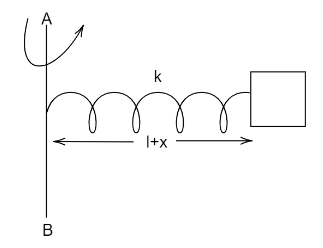
According to the given condition we can conclude that the electric force will provide the required centripetal force or in other word we can say that electric force is equal to centripetal force of the rotated system. We know,
Elastic force of a spring= $kx$
Centripetal force= $m{\omega ^2}r$
Equating both of them we get,
$kx = m{\omega ^2}r$
Here $r=l+x$
Putting the changed r value in the above equation we get,
$kx = m{\omega ^2}\left( {l + x} \right)$
$ \Rightarrow kx = m{\omega ^2}l + m{\omega ^2}x$
Here x is the increased in length of the spring due to rotation of the system
Hence by further solving the [problem we get,
$kx - m{\omega ^2}x = m{\omega ^2}l$
Taking x as common term from LHS side we get,
$x\left( {k - m{\omega ^2}} \right) = m{\omega ^2}l$
Rearranging the above equation we get,
$\therefore x = \dfrac{{m{\omega ^2}l}}{{\left( {k - m{\omega ^2}} \right)}}$
Hence we get the increases in length of the spring is $x = \dfrac{{m{\omega ^2}l}}{{\left( {k - m{\omega ^2}} \right)}}$ .
Therefore the correct option is $\left( B \right)$.
Note: Before solving this kind of problem, first change the length of the spring because if a spring is rotated then their length must change its length. If you don’t change the length of the spring after the system is rotated then you will get the wrong answer.
Complete step by step answer:
As per the given problem,mass of the particle is given by $m$ which is fixed at end of a light spring of force constant $k$ and it unstretched length is $l$ and if the system is rotated about the other end of the spring the there will be a stretched in the spring which is represented as $x$ hence the radius of the ruated system will be $l+x$ and also the angular frequency of the rotated system is $\omega $.
According to the given condition we can conclude that the electric force will provide the required centripetal force or in other word we can say that electric force is equal to centripetal force of the rotated system. We know,
Elastic force of a spring= $kx$
Centripetal force= $m{\omega ^2}r$
Equating both of them we get,
$kx = m{\omega ^2}r$
Here $r=l+x$
Putting the changed r value in the above equation we get,
$kx = m{\omega ^2}\left( {l + x} \right)$
$ \Rightarrow kx = m{\omega ^2}l + m{\omega ^2}x$
Here x is the increased in length of the spring due to rotation of the system
Hence by further solving the [problem we get,
$kx - m{\omega ^2}x = m{\omega ^2}l$
Taking x as common term from LHS side we get,
$x\left( {k - m{\omega ^2}} \right) = m{\omega ^2}l$
Rearranging the above equation we get,
$\therefore x = \dfrac{{m{\omega ^2}l}}{{\left( {k - m{\omega ^2}} \right)}}$
Hence we get the increases in length of the spring is $x = \dfrac{{m{\omega ^2}l}}{{\left( {k - m{\omega ^2}} \right)}}$ .
Therefore the correct option is $\left( B \right)$.
Note: Before solving this kind of problem, first change the length of the spring because if a spring is rotated then their length must change its length. If you don’t change the length of the spring after the system is rotated then you will get the wrong answer.
Recently Updated Pages
Which will be the least stable resonating structure class 11 chemistry CBSE

How many 5 digit telephone numbers can be construc-class-11-maths-CBSE
How do you find the angle of the resultant vector class 11 physics CBSE
Draw labelled diagram of the following i Gram seed class 11 biology CBSE
What is the need and importance of classification class 11 biology CBSE
The way in which the sparrows expressed their sorrow class 11 english CBSE
Trending doubts
One Metric ton is equal to kg A 10000 B 1000 C 100 class 11 physics CBSE
Find the value of the expression given below sin 30circ class 11 maths CBSE
1 Quintal is equal to a 110 kg b 10 kg c 100kg d 1000 class 11 physics CBSE
Draw a diagram of nephron and explain its structur class 11 biology CBSE
10 examples of friction in our daily life
Proton was discovered by A Thomson B Rutherford C Chadwick class 11 chemistry CBSE