




A particle of mass m and charge q is placed at rest in a uniform electric field E and then released, the kinetic energy attained by the particle after moving a distance y will be-
A. $qE{y^2}$
B. $q{E^2}y$
C. $qEy$
D. ${q^2}Ey$
Answer
 Verified
527.7k+ views
Hint- Since the charged particle with charge q is in a uniform electric field E and the force applied on it will be F, the particle will move in the direction of the electric field with acceleration a. After a distance of y, the velocity of the particle at that point will be v.
Formula used: $K.E = \dfrac{1}{2}m{v^2}$, $F = Eq = ma$ and ${v^2} = {u^2} + 2as$.
Complete Step-by-Step solution:
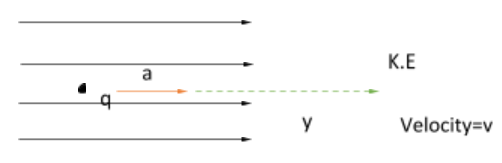
Now, we will find out the kinetic energy of the particle after moving a distance y.
The value of force will be-
Force = charge$ \times $electric field
Charge= q
Electric field= E
$ \Rightarrow F = qE$
Since we know that $F = ma$, we will put the value of F into the above equation, we get-
$
\Rightarrow F = qE \\
\\
\Rightarrow ma = qE \\
\\
\Rightarrow a = \dfrac{{qE}}{m} \\
$
As we know that the third equation of motion is ${v^2} = {u^2} + 2as$, where u is initial velocity, v is final velocity and s is distance.
Since initial velocity is 0 as per the question, the value of v will be-
$ \Rightarrow {v^2} = 2as$
Putting the value of a and distance y into the above equation, we get-
$
\Rightarrow {v^2} = 2as \\
\\
\Rightarrow {v^2} = 2\dfrac{{qE}}{m}y \\
$
The formula for kinetic energy is $\dfrac{1}{2}m{v^2}$. Substituting the value of ${v^2}$ into this, we have-
$
\Rightarrow K.E = \dfrac{1}{2}m{v^2} \\
\\
\Rightarrow K.E = \dfrac{1}{2}m.2\dfrac{{qE}}{m}y \\
\\
\Rightarrow K.E = qEy \\
$
Thus, option C is the correct option.
Note: Kinetic energy, the type of energy that an object or a particle has by reason of its movement. In the event that work, which transfers energy, is done on a particle by applying a net force, the object accelerates and thus gains kinetic energy. Kinetic energy is a property of a moving object or particle and depends on its movement as well as on its mass.
Formula used: $K.E = \dfrac{1}{2}m{v^2}$, $F = Eq = ma$ and ${v^2} = {u^2} + 2as$.
Complete Step-by-Step solution:
Now, we will find out the kinetic energy of the particle after moving a distance y.
The value of force will be-
Force = charge$ \times $electric field
Charge= q
Electric field= E
$ \Rightarrow F = qE$
Since we know that $F = ma$, we will put the value of F into the above equation, we get-
$
\Rightarrow F = qE \\
\\
\Rightarrow ma = qE \\
\\
\Rightarrow a = \dfrac{{qE}}{m} \\
$
As we know that the third equation of motion is ${v^2} = {u^2} + 2as$, where u is initial velocity, v is final velocity and s is distance.
Since initial velocity is 0 as per the question, the value of v will be-
$ \Rightarrow {v^2} = 2as$
Putting the value of a and distance y into the above equation, we get-
$
\Rightarrow {v^2} = 2as \\
\\
\Rightarrow {v^2} = 2\dfrac{{qE}}{m}y \\
$
The formula for kinetic energy is $\dfrac{1}{2}m{v^2}$. Substituting the value of ${v^2}$ into this, we have-
$
\Rightarrow K.E = \dfrac{1}{2}m{v^2} \\
\\
\Rightarrow K.E = \dfrac{1}{2}m.2\dfrac{{qE}}{m}y \\
\\
\Rightarrow K.E = qEy \\
$
Thus, option C is the correct option.
Note: Kinetic energy, the type of energy that an object or a particle has by reason of its movement. In the event that work, which transfers energy, is done on a particle by applying a net force, the object accelerates and thus gains kinetic energy. Kinetic energy is a property of a moving object or particle and depends on its movement as well as on its mass.
Recently Updated Pages
Master Class 10 Computer Science: Engaging Questions & Answers for Success

Master Class 10 General Knowledge: Engaging Questions & Answers for Success
Master Class 10 English: Engaging Questions & Answers for Success
Master Class 10 Social Science: Engaging Questions & Answers for Success
Master Class 10 Maths: Engaging Questions & Answers for Success
Master Class 10 Science: Engaging Questions & Answers for Success
Trending doubts
What is the median of the first 10 natural numbers class 10 maths CBSE
Which women's tennis player has 24 Grand Slam singles titles?
Who is the Brand Ambassador of Incredible India?
Why is there a time difference of about 5 hours between class 10 social science CBSE
Write a letter to the principal requesting him to grant class 10 english CBSE
A moving boat is observed from the top of a 150 m high class 10 maths CBSE